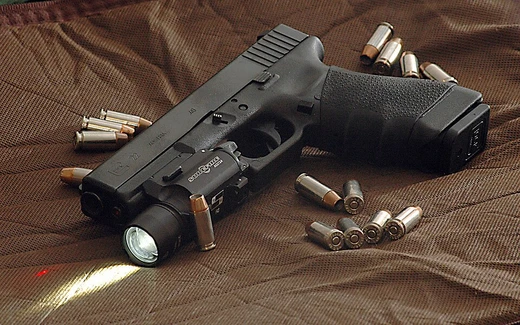
Beretta APX
Beretta's first striker-fired duty pistol, modular and competition-proven.

The Beretta APX is a line of polymer-framed, modular, striker-fired semi-automatic pistols made by Beretta. The series launched in 2016 with a full-size model, and later expanded to include compact, concealed carry, and competition versions. Most APX pistols have a decocker pin, which means you don’t need to dryfire the gun to take it apart. An updated APX A1 series came out in 2022.
The original APX (sometimes called the APX A0) was built mainly for the U.S. military’s XM17 Modular Handgun System competition. Beretta had offered to sell its M9A3 at a discount to continue the M9 program, but the Department of Defense said the M9A3’s changes were too big for an Engineering Change Proposal, so they wanted a new procurement instead. If the APX had won, it would have been made at Beretta’s factory in Gallatin, Tennessee. The Army Times reported on January 19, 2017, that the SIG-Sauer P320 won the competition, though the APX passed every test. Beretta claimed the pistol can handle a 45,000-round firing schedule with 5,000 rounds between stoppages. On February 28, 2017, Beretta USA said the APX would be available for U.S. civilians starting April 15, 2017.
In 2018, Beretta announced three new variants: the APX Centurion (slightly smaller frame, slide, and barrel), the APX Compact (subcompact size), and the APX Combat (threaded barrel and optics plate). Beretta began selling frames with or without finger grooves in black, olive green, flat dark earth (FDE), and grey. In 2019, Beretta cut the APX’s MSRP from $499 to $399 to compete in the crowded polymer striker-fired market. That April, they introduced the APX Carry, a single-stack magazine model for concealed carry (based on the Beretta Nano, with some features from the full-size APX). In July 2019, they added FDE versions of the Centurion and Compact, plus the Centurion Combat (threaded barrel and optics plate like the full-size Combat).
The APX Target arrived in 2020 as a competition variant with a longer slide and a 4.7-inch pre-tensioned barrel, fitted together at the factory for better accuracy.
- Introduced
- 2016
- Caliber
- 9×19mm Parabellum (implied by MHS competition context)
- Action
- Striker-fired, Browning tilting-barrel short recoil
- Frame
- Polymer with replaceable grip straps
- Barrel length (full-size)
- 4.7 inches (APX Target)
- Capacity
- 17 rounds (standard full-size), 21 rounds (APX A1 Tactical)
Lore & Background
The APX was designed largely for the U.S. Armed Forces' XM17 Modular Handgun System competition. Beretta had offered their M9A3 at a reduced price as a continuance of the M9 program, but the Department of Defense deemed the changes too significant for an Engineering Change Proposal and preferred a new procurement. The APX passed every test in the competition, but the SIG-Sauer P320 was selected as the winner in January 2017. Beretta USA announced civilian market availability starting April 15, 2017.
In 2018, three variants were introduced: the APX Centurion (slightly smaller), APX Compact (subcompact), and APX Combat (threaded barrel, optics-ready). Beretta offered frames with or without finger grooves in black, olive green, flat dark earth, and grey. In 2019, the MSRP was lowered from $499 to $399. The APX Carry, a single-stack variant based on the Beretta Nano, was introduced in April 2019. Later that year, flat dark earth Centurion and Compact models appeared, along with the Centurion Combat.
The APX Target, a competition variant with a longer slide and 4.7-inch pre-tensioned barrel, was introduced in 2020. It featured a fiber-optic front sight, blacked-out rear sight, extended magazine release and slide stop, a green striker guide, and a trigger half a pound lighter with a shorter reset. It came with four 17-round magazines and was a limited production model that effectively became the basis for the APX A1 line.
Reader's Guide
The Beretta APX represents Beretta's entry into the modern striker-fired duty pistol market, competing directly with established designs like the Glock and SIG Sauer P320. Its modular stainless steel chassis allows frame swaps without serialization issues, and the replaceable grip straps address the MHS requirement for fitting different hand sizes. The APX's striker deactivation button addresses a common safety concern with striker-fired pistols that require trigger pull during disassembly. The APX A1 series, introduced in 2022, incorporated improvements from the competition-oriented APX Target, including deeper slide serrations, an undercut trigger guard, enhanced beavertail, and the Aqua Tech Shield finish. As of January 2024, first-generation APX models continued to be manufactured for military and police contracts, while only A1 models were sold on the civilian market. The APX A1 Ported, released in August 2026, added a single angled port in the barrel and seven ports in the slide to reduce muzzle rise and felt recoil.
Did You Know?
- The APX Target was 20 to 30 percent more accurate than a standard full-size APX, according to Beretta's product manager.
- The APX A1 Ported, released in August 2026, has a front sight moved back on the slide to allow gas to escape from the top of the barrel.
- The APX Carry is based on the Beretta Nano design with some features from the full-sized APX.
The XM17 Bid and Military Ambitions
The APX platform was conceived primarily to contest the U.S. Armed Forces' XM17 Modular Handgun System competition. Beretta had first proposed supplying their M9A3 at a reduced price as a continuation of the existing M9 procurement, but the Department of Defense ruled that the M9A3's modifications were too substantial to qualify as an Engineering Change Proposal and insisted on a brand-new procurement. The APX entered the MHS evaluation and, according to Beretta, cleared every test without failure, demonstrating a durability rating of 45,000 rounds with 5,000 rounds between stoppages. Had the contract gone Beretta's way, manufacturing would have been anchored at their Gallatin, Tennessee plant. The Army Times reported on January 19, 2017, that SIG-Sauer's P320 ultimately won. Within weeks, on February 28, Beretta USA announced the APX would hit the civilian market on April 15, 2017, repurposing a military-grade design for commercial buyers.
Building the Family: 2018 to 2020
Following the 2016 launch of the full-size standard model, Beretta steadily broadened the APX family. In 2018, three new variants arrived: the Centurion, featuring a slightly smaller frame, slide, and barrel; the Compact, with subcompact dimensions; and the Combat, equipped with a threaded barrel and an optics mounting plate on the slide. Frames were offered in black, olive green, flat dark earth, and grey, with or without finger grooves. In 2019, Beretta cut the MSRP from $499 to $399, acknowledging the oversaturated polymer striker-fired market. That year also brought the APX Carry, a single-stack concealed-carry variant built on the Beretta Nano platform with select full-size APX features, plus FDE versions of the Centurion and Compact and a Centurion Combat. The 2020 APX Target crowned the first generation: a competition pistol with a 4.7-inch pre-tensioned barrel factory-matched to its slide, a trigger half a pound lighter than standard, no finger grooves, extended magazine release and slide stop, and four 17-round magazines. Beretta's product manager claimed 20 to 30 percent improved accuracy over the standard APX, calling it "the most accurate APX we've ever built."
The A1 Redesign and Tactical Expansion
In May 2022, designer Giovanni Prandini unveiled the APX A1, an ergonomically refined successor that reworked both slide and frame. The slide gained deeper, more conventional serrations, while the frame received a higher undercut trigger guard and an enhanced beavertail. Numerous features migrated directly from the competition-oriented APX Target: a blacked-out rear sight, a red-dot-ready slide, a smooth frame without finger grooves, and the competition striker and trigger assembly. Additional upgrades included Beretta's Aqua Tech Shield finish on both slide and barrel, a stainless steel chassis, and a heavier competition-grade flat recoil spring to reduce felt recoil. The A1 family now spans a full-size standard, a Tactical variant with a threaded barrel, suppressor-height sights, and three 21-round magazines in olive drab, a Compact matching the A0 Centurion's dimensions, a Compact Tactical, and a subcompact Carry. In 2024, a flat dark earth Tactical with a tan slide and frame joined the lineup. Parts interchangeability between A0 and A1 is maintained, though A0 frames must retain their original recoil spring for proper function.
Modular Design Philosophy and the Ported Variant
From the outset, the APX was engineered as a modular, polymer-framed, striker-fired family rather than a single fixed design. Most models incorporate a decocker pin that eliminates the need to dryfire the striker during disassembly, a practical safety and convenience feature. The modular philosophy is most visible in parts interchangeability: A0 and A1 slides and frames can be mixed, provided the A0 uses its original recoil spring, and A0 frames with finger grooves remain compatible with A1 platforms. This modularity extends to the 2026 APX A1 Ported, released in August of that year, which features a single angled barrel port and seven ports machined into the slide. The expanding gas is directed upward, reducing muzzle rise. To accommodate the gas escape, the front sight, painted in high-visibility orange, was repositioned rearward on the slide. The Ported variant illustrates how Beretta continues to extract new performance characteristics from the same core architecture without redesigning the entire platform.
More in Semi-Automatic Pistols, Part 3 1-24
Spotted an error? Know more?
Reader corrections go straight into our review queue. Suggest an edit · How this site is sourced