Test (biology)
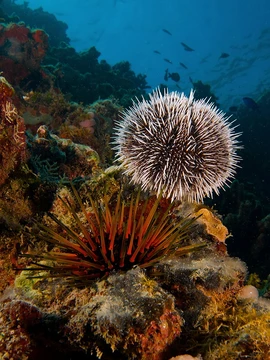
Hard shell of sea urchins and foraminiferans, made of calcium carbonate.

In biology, a test is the rigid outer casing of certain round aquatic animals and single-celled organisms, most famously sea urchins and tiny life forms like testate foraminiferans, radiolarians, and testate amoebae. The word also describes the covering of scale insects. The related Latin term *testa* refers to the tough outer coat of a plant seed.
The word "test" comes from the Latin *testa*, meaning an earthenware object such as pottery, a tile, or a potsherd, and later came to mean the shell of a mollusk or a skull.
A test is a skeleton built from hard substances like calcium carbonate, silica, chitin, or composite materials. It shields internal organs and gives soft tissues something to attach to. Its structure is notable for alternating wide and narrow patterns called ambulacra. The outer surface often has small serrations, bumps, ridges, or thorns. The magnesium calcites inside share three traits: uneven magnesium distribution, calcite crystals that keep their orientation, and the formation of thermodynamically unstable Mg-calcites.
In sea urchins, the test is made of calcium carbonate reinforced by a framework of calcite monocrystals in a "stereomic" structure. This mix gives sea urchins great strength and moderate weight, plus the ability to regenerate the mesh from the cuticle. The skeleton is about 92% calcite monocrystal "bricks" (for hardness) and 8% amorphous lime "mortar" (for flexibility and lightness). That lime is 99.9% calcium carbonate and 0.1% structural proteins, making sea urchins extremely mineralized—which explains why they fossilize so well. The inner skeleton forms from calcite spicules and extracellular matrix proteins arranged in concentric folded layers.
For foraminifera, single-celled organisms, the test is extremely diverse across evolution. Some lack a test entirely (like *Reticulomyxa*), while others have proteinaceous tests (allogromiids), agglutinated tests made from foreign particles (textulariids), silica tests (silicoloculinids), or aragonite or calcite tests (miliolids and rotaliids). Test types include proteinaceous, agglutinated, porcelain-like, or hyaline. Multi-chambered foraminifera are called multilocular and build new chambers as they grow. Chambers are arranged in species-specific geometries: rectilinear, curved, coiled, cyclic, uniserial, or multiserial. These patterns can mix or become more complex.
- Sea urchin test composition
- 92% calcite monocrystals, 8% amorphous lime
- Amorphous lime composition
- 99.9% calcium carbonate, 0.1% structural proteins
- Foraminifera test types
- proteinaceous, agglutinated, porcelain-like, hyalin
- Ascidian test component
- cellulose (tunicine)
- First ascidian cellulose discovery year
- 1845
- Last year ascidians believed only cellul
- 1958
Lore & Background
The anatomical term 'test' derives from the Latin word testa, which originally referred to an earthenware object such as pottery or a tile, and by extension came to mean the shell of a mollusc or a skull. The test is notable for its ambulacra, which alternate in wide and narrow patterns, and often features small serrations, bumps, ridges, or thorns along the outer cortex. Magnesium calcites in the structures share three common features: lack of uniformity in Mg distribution, calcite minerals that maintain crystallographic orientations, and formation of Mg-calcites that are thermodynamically unstable.
In sea urchins, the test is made of calcium carbonate strengthened by a framework of calcite monocrystals in a characteristic 'stereomic' structure. This provides great solidity and moderate weight, as well as the capacity to regenerate the mesh from the cuticle. The endoskeletal matrix is formed by spicules of calcite and extracellular matrix proteins that form concentric folded layers. In foraminifera, the test is extremely evolutionarily diverse, ranging from absent in Reticulomyxa to proteinaceous, agglutinated, silica, aragonite, or calcite forms. Foraminifera with multi-chambered tests are called multilocular and build new chambers in geometries specific to each species.
In ascidians, the sheath is sometimes called test and is composed largely of a particular type of cellulose historically termed 'tunicine'. From 1845 until 1958, ascidians were believed to be the only animals that synthesized cellulose. On a strictly scientific point of view, the term 'test' should be restricted to the hard shell protecting sea urchins and foraminiferans; similar structures in other organisms have distinct names such as lorica, theca, frustule, or capsule.
Reader's Guide
Tests are valuable tools in the fossil record used as proxies for reconstructing environmental conditions. Sea urchins appeared in the Phanerozoic and are globally distributed, and the skeletal nature of their tests allowed for consistent conservation in the fossil record. The rapid growth and incorporation of isotopes including oxygen, magnesium, calcium, and carbon allow scientists to evaluate the relative conditions of the oceans throughout Earth's history. The effects of ocean acidification and sea temperature change can be detrimental to test formation and function due to their incorporation of calcium and carbonate. Increase in pCO2 has decreased structural integrity resulting in skeletal failure. Alteration and decreased test robustness results in lower growth rates and smaller adult diameters of urchin tests. Other studies indicate that there are some species able to adapt to long-term exposure to higher acidity, due to evidence of enhanced growth after prolonged proximity to a hydrothermal vent or seasonal hypercapnia events. The test's composition—92% calcite monocrystals and 8% amorphous lime—makes sea urchins animals with an extremely mineralized skeleton, which also explains their excellent conservation as fossils.
Did You Know?
- The test of sea urchins consists of 92% calcite monocrystals and 8% amorphous lime.
- The amorphous lime in sea urchin tests is 99.9% calcium carbonate and 0.1% structural proteins.
- Foraminifera tests can be proteinaceous, agglutinated, porcelain-like, or hyalin.
Architecture and Material Composition
The test functions as a rigid skeletal framework, constructed from hard substances such as calcium carbonate, silica, chitin, or various composite materials. Its primary roles are shielding the animal's internal organs and providing a surface to which soft tissue can anchor. Externally, the structure is distinguished by ambulacral grooves that alternate between wide and narrow bands, while the outer cortex is often studded with small serrations, bumps, ridges, or thorns. In sea urchins, the test achieves its remarkable solidity through a stereomic architecture: a 2012 study revealed that roughly 92 percent of the skeleton consists of calcite monocrystal "bricks" that confer hardness, while the remaining 8 percent is an amorphous lime "mortar" that supplies flexibility and keeps overall weight moderate. That lime itself is 99.9 percent calcium carbonate with just 0.1 percent structural proteins, making the urchin skeleton extraordinarily mineralized. The endoskeletal matrix is further organized into concentric folded layers of calcite spicules interwoven with extracellular matrix proteins. Magnesium-bearing calcites within these structures consistently show non-uniform magnesium distribution, preserved crystallographic orientations, and thermodynamic instability.
Evolutionary Diversity of Construction Strategies
Among foraminiferans, single-celled protists, the test displays extraordinary evolutionary variety in both material and method. Some lineages, such as Reticulomyxa, lack a test altogether, while allogromiids build proteinaceous enclosures. Many groups, including textulariids, agglutinate foreign particles into their shells, silicoloculinids construct theirs from silica, and miliolids or rotaliids form tests of aragonite or calcite. Multilocular foraminifera grow by adding new chambers to their existing test, and the geometric arrangement of those chambers is species-specific: rectilinear, curved, rolled, cyclic, uniserial, or multiserial, sometimes mixed or even more complex. Miliolids possess a distinctive chamber layout called the milioline. The test surface may be smooth or textured and can be perforated with tiny holes. In a different branch of the animal kingdom, ascidians produce a sheath also termed a test, composed largely of a cellulose variant historically called tunicine. From Schmidt's discovery in 1845 until cellulose fibres were identified in mammalian connective tissue in 1958, ascidians were thought to be the sole animal group capable of synthesizing cellulose.
Windows into Ancient Oceans
Because sea urchins first appeared during the Phanerozoic eon and are distributed across the globe, their tests have left a remarkably consistent fossil record. The skeleton's extreme mineralization—nearly 99.9 percent calcium carbonate with a trace of structural proteins—explains why urchin tests are preserved so well in rock. Beyond their physical durability, these structures serve as powerful paleoenvironmental proxies. As the test grows rapidly, it incorporates isotopes of oxygen, magnesium, calcium, and carbon from surrounding seawater, effectively recording the chemical and thermal conditions of the ocean at the time of deposition. By analyzing the isotopic signatures locked into fossil tests, scientists can reconstruct relative ocean temperatures, salinity, and carbonate chemistry across vast stretches of Earth's history. This makes the test not merely a protective shell but a natural archive, encoding environmental data that no soft tissue could preserve over geological timescales.
Vulnerability Under a Warming, Acidifying Ocean
The very chemistry that makes the test so robust also renders it vulnerable to shifting ocean conditions. Because test formation depends on the incorporation of calcium and carbonate, rising atmospheric CO₂ and the resulting increase in ocean pCO₂ can compromise structural integrity, leading to skeletal failure in affected organisms. Studies have documented that altered and weakened test robustness translates into slower growth rates and smaller adult diameters in sea urchins. Warming sea temperatures compound these stresses. Yet the picture is not uniformly dire. Some species appear capable of acclimating to prolonged elevated acidity: evidence from individuals living near hydrothermal vents, where hypercapnia is chronic, and from populations experiencing seasonal hypercapnia events, suggests enhanced growth after long-term exposure to higher CO₂ levels. These findings hint at a degree of physiological plasticity that could buffer certain populations against the accelerating pace of ocean acidification.
Frequently Asked Questions
What is the Test (biology)?
The test is the rigid, bony outer shell that encases a sea urchin's body, serving as its primary structural skeleton. It gives the animal its characteristic round shape and acts as an anchor point for muscles and spines.
What is the Test made of?
The sea urchin test consists of roughly 92% calcite monocrystals set within a matrix of about 8% amorphous lime. That amorphous fraction is itself almost entirely calcium carbonate (99.9%) with only a trace of structural proteins (0.1%) binding the structure together.
Where does the name 'Test' come from?
The term traces back to the Latin word *testa*, which originally referred to earthenware items such as pottery, tiles, or broken potsherds. Over time the meaning broadened to include the hard shell of a mollusk or even a skull before settling on its current biological usage.
How does the sea urchin Test compare to other organisms' tests?
While sea urchins build their test from calcium carbonate crystals, other test-bearing organisms use very different materials. For example, testate foraminiferans produce tests that can be proteinaceous, agglutinated, porcelain-like, or hyalin, and ascidians construct their tunic from cellulose (tunicine), a fact first identified in 1845 but not widely accepted until 1958.
Why is the Test important to the sea urchin?
The test is the defining structural element of a sea urchin, shielding internal organs while providing attachment surfaces for muscles and spines. Its crystalline architecture also makes it a subject of intense study in biomaterials science, as researchers hope to replicate its remarkable strength-to-weight ratio in engineering applications.
More in Sea Urchins 1-24
Spotted an error? Know more?
Reader corrections go straight into our review queue. Suggest an edit · How this site is sourced