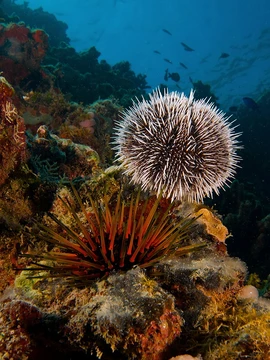
Sea urchin injury
Puncture wounds from brittle spines cause pain and inflammation.

Sea urchin injuries happen when someone makes contact with the animal, typically through accidental stepping or touching while swimming, diving, surfing, or fishing. The injury itself is a puncture wound caused by the urchin's thin, easily broken spines. Right away, the person may feel pain and notice bleeding, redness, swelling, and inflammation.
Most symptoms come from the local trauma and the body's inflammatory response to spine fragments. These spines are made of calcium carbonate, which makes them brittle and likely to snap off inside the skin. The wound might also show small purple or black dots or staining from the urchin's natural dye. These symptoms usually go away once all spine pieces are removed. Out of about 600 sea urchin species, roughly 80 contain toxins, but these generally don't cause serious harm to humans. However, a large dose—such as from more than 15 to 20 spines—or an allergic reaction can lead to systemic effects like nausea, vomiting, tingling, general weakness, and trouble breathing. The flower urchin, common in the tropical Indo-West Pacific, is the most notable venomous species. There are unconfirmed reports of accidental drowning linked to the paralysis, numbness, and confusion caused by its puncture. If spine fragments stay in the body, long-term problems can develop even after initial symptoms fade, including ongoing discomfort, tenosynovitis, and arthritis.
When a non-venomous sea urchin causes the injury, a spine may remain lodged in the flesh, causing pain. Spines that don't dissolve or get pushed out can eventually become surrounded by a granuloma—a normal inflammatory nodule that forms around foreign material. This granuloma and its symptoms might not appear until months later. If the granuloma forms near tendons, joints, or muscles, it can interfere with their function, leading to chronic discomfort, movement problems, or local inflammation. Surgery to remove the spine and granuloma often resolves these issues.
For treatment, tweezers can often remove embedded spines, but the spines' brittleness means fragments frequently stay behind. Soaking the wound in hot water is thought to neutralize toxins, ease pain, and help dissolve remaining spine pieces. Other home remedies like salicylic acid paste, hot candle wax, vinegar, or urine are sometimes used, but there's no clear evidence they help.
Quick Facts
- Treatment
- Removal of spines, hot water soaks
- Specialty
- Emergency medicine
Facts from the source article.
Lore & Background
Sea urchin injuries result from local trauma and inflammatory reactions to spine fragments, which are made of calcium carbonate, making them very brittle and easy to break off in the body. Symptoms of the initial injury may include pain, bleeding, redness, swelling, and inflammation, and the injury may show small purple or black dots or staining of the skin from the natural dye inside the sea urchin. These symptoms generally subside with complete removal of the spines. About 80 of the 600 unique species of sea urchins contain poisons, but they generally do not cause significant harm to humans. However, an allergic reaction or large enough dose of the toxins (such as puncture by > 15-20 spines) may lead to systemic effects such as nausea, vomiting, paraesthesia, generalized weakness, and respiratory distress. The most notable species is the flower urchin, which is common in the tropical Indo-West Pacific. There are reports of accidental drowning due to the muscular paralysis, numbness, and disorientation caused by puncture from a flower urchin, but they remain difficult to confirm.
Reader's Guide
Leaving spine fragments in the body may lead to chronic effects, even if the initial local and systemic symptoms reside. The most common long-term complications include discomfort, tenosynovitis, and arthritis. Following injury by a non-venomous sea urchin, the spine can stay for a while inside the flesh, causing pain and discomfort. Spines not dissolved or expelled from the body may eventually be surrounded by a granuloma, a normal inflammatory reaction that forms a nodule around foreign bodies. Granuloma formation and associated symptoms may not present until several months after the initial injury. Granulomas that happen to form near or within tendons, joints, or muscles may obstruct normal function of those structures, leading to chronic discomfort, movement deficits, or local inflammation. Surgical removal of the spine and granuloma often relieves the symptoms. Embedded spines can often be removed with tweezers with no long-term consequences, but their brittle nature often leaves fragments within the body. Hot water soaks are thought to destroy toxins, alleviate pain, and help dissolve any remnants of the spines. Other common remedies include salicylic acid paste, hot candle wax, vinegar, and urine, but evidence of their benefit remains unclear. Small fragments too deep to remove with tweezers are often left alone, as they are known to either extrude through the skin or dissolve over time.
Did You Know?
- The flower urchin is the most notable venomous species, common in the tropical Indo-West Pacific.
- Spine fragments left in the body may eventually be surrounded by a granuloma, which can obstruct normal function of tendons, joints, or muscles.
Who Gets Stung and What Happens First
Sea urchin injuries are a sneaky hazard of ocean recreation and work. Swimmers wading through shallow water, divers exploring reef structures, surfers paddling over rocky seabeds, and fishers handling catch near the ocean floor all risk accidentally brushing against or stepping on these spiny animals. The damage is fundamentally mechanical: the urchin's spines are composed of calcium carbonate, making them inherently brittle and fragile. Rather than piercing cleanly, they tend to snap at the point of contact, embedding sharp fragments deep in soft tissue. The immediate aftermath is unmistakable—sharp pain, visible bleeding, localized redness, swelling, and inflammation radiating from the puncture site. Some victims also notice small purple or black discolorations on the skin, a telltale stain left behind by the natural dye contained within the urchin's body. In most straightforward cases, these symptoms fade once all spine material is successfully extracted from the wound.
The Toxic Question: When Spines Carry More Than Pain
Of the roughly 600 distinct species of sea urchin known to science, approximately 80 harbor some form of poison within their tissues. For the vast majority of human encounters, however, these toxins pose little genuine threat. The situation changes dramatically when a person suffers a heavy puncture load—fifteen to twenty spines or more simultaneously—or when an individual happens to be allergic to the compounds involved. In such cases the injury escalates beyond the local wound into a systemic event: nausea and vomiting set in, tingling and numbness spread through the body, generalized weakness takes hold, and in severe instances respiratory distress can develop. The species most frequently cited in connection with serious envenomation is the flower urchin, widespread across tropical waters of the Indo-West Pacific. Unconfirmed reports of accidental drowning attributed to the muscular paralysis, profound numbness, and disorientation that a heavy flower urchin puncture can produce exist, though verifying these accounts remains difficult. For most casual encounters, the toxic payload is a secondary concern compared to the mechanical damage of the spines themselves.
The Slow Burn: Granulomas and Chronic Aftermath
Perhaps the most insidious aspect of a sea urchin injury is not the initial sting but what follows weeks or even months later. Because the spines are made of calcium carbonate, they are extraordinarily brittle. When they fracture inside the body, the tiny shards often resist both natural dissolution and simple extraction. The immune system, recognizing these fragments as foreign material, mounts a defensive response: it walls them off within a small nodule of inflammatory tissue called a granuloma. This process can remain silent for months before the person begins to feel its effects. If a granuloma forms near a tendon, within a joint capsule, or embedded in muscle tissue, it can obstruct normal mechanical function, producing persistent discomfort, restricted range of motion, or localized inflammation that mimics arthritis or tenosynovitis. These chronic complications can persist long after the original redness and swelling have vanished. In many documented cases, the only definitive relief comes from surgical excision of both the residual spine fragment and the surrounding granulomatous tissue, after which symptoms typically resolve.
Pulling Them Out: Treatment and the Limits of Home Remedies
The first-line approach to a sea urchin puncture is straightforward: use fine-tipped tweezers to grasp and extract whatever spine material is visible at the wound's surface. When performed carefully, this simple maneuver often prevents any long-term sequelae. The difficulty lies in the spines' brittle composition—each tug risks snapping the fragment further into the flesh, leaving behind shards too small or too deep for manual removal. Hot water soaks are a widely recommended adjunct, believed to neutralize residual toxins, ease acute pain, and gradually dissolve leftover calcium carbonate debris. A host of folk remedies—salicylic acid paste, heated candle wax, vinegar, even urine—have been passed down through generations of coastal communities, yet clinical evidence supporting their actual benefit remains inconclusive. Fragments lodged too deep for tweezers are frequently left in place, on the reasonable expectation that the body will either push them out through the skin or dissolve them over time. When pain persists, infection signs appear, or nerve and joint structures are implicated, professional medical evaluation becomes necessary, and imaging such as X-ray or MRI may be employed to locate deep spines and determine whether surgical intervention is warranted.
Frequently Asked Questions
What causes a sea urchin injury?
A sea urchin injury happens when a person accidentally steps on or brushes against the animal while swimming, diving, surfing, or fishing. The thin spines puncture the skin, producing an immediate stinging pain along with bleeding and local redness.
Why do sea urchin spines break off inside the skin?
The spines are built from calcium carbonate, a mineral that is hard yet extremely brittle, so they tend to snap rather than bend on impact. Those trapped fragments then provoke the body's inflammatory response, leading to swelling, redness, and sometimes small purple marks around the wound.
How many spine punctures turn a minor sting into a medical concern?
A handful of spines usually stays a localized, self-limiting issue, but once roughly 15 to 20 spines penetrate the skin the cumulative tissue damage can trigger systemic effects. At that threshold, seeking professional medical care is strongly advised.
Are all sea urchin injuries just mechanical punctures, or can they be venomous?
About 80 of the roughly 600 known sea urchin species carry some form of poison, with the flower urchin of the tropical Indo-West Pacific being the most well-known example. In most everyday beach encounters, though, the reaction is driven by the mechanical puncture and the calcium carbonate debris rather than by true envenomation.
What long-term complications can a sea urchin injury lead to?
If spine fragments are not fully extracted, they can cause persistent discomfort, tenosynovitis, or even arthritis in the affected joint over time. Prompt and thorough removal of all embedded pieces is the single best way to prevent those chronic problems.
More in Sea Urchins 1-24
Spotted an error? Know more?
Reader corrections go straight into our review queue. Suggest an edit · How this site is sourced