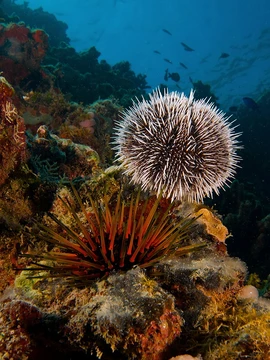
Coelopleurus
Brightly colored abyssal sea urchins with fossil records from the Eocene.

Coelopleurus is an extant genus of echinoids, or sea urchins, with fossil records dating back to the Eocene. It is notable for its surprisingly bright color pattern, usually red and white, which persists even in dried tests and sometimes in fossils.
Quick Facts
- Taxon
- Coelopleurus
Facts from the source article.
Lore & Background
Coelopleurus is an extant genus of echinoids whose fossil records date back to the Eocene, with remains found in Europe and North America. These abyssal sea urchins are characterized by their surprisingly bright color pattern, usually red and white. Even more surprisingly, their tests (skeletons) are brightly colored, too, even after drying, or sometimes fossilization. The genus includes numerous species, both extant and fossil, as listed by the World Register of Marine Species. Among the fossil species is †Coelopleurus elegans, from the Pleistocene of the Jizo-do formation of Japan. The genus was originally described by L. Agassiz in 1840a.
Reader's Guide
Coelopleurus is significant as an extant genus of echinoids with a fossil record extending back to the Eocene, indicating a long evolutionary history. Its remains have been found in Europe and North America, suggesting a broad historical distribution. The genus is particularly notable for its bright color pattern—usually red and white—which is unusual among abyssal sea urchins and persists even in dried tests and sometimes in fossils. This retention of color after death and fossilization is a distinctive characteristic that sets Coelopleurus apart from many other echinoids. The World Register of Marine Species lists 14 extant species and one fossil species, †Coelopleurus elegans from the Pleistocene of Japan, highlighting the genus's continued presence in modern oceans and its paleontological importance. The genus's legacy lies in its unique combination of deep-sea habitat, vivid coloration, and extensive fossil record, making it a subject of interest for both marine biologists and paleontologists.
Did You Know?
- Coelopleurus is an extant genus with fossil records dating back to the Eocene.
- Its tests (skeletons) remain brightly colored even after drying or sometimes fossilization.
- Fossil remains of Coelopleurus have been found in Europe and North America.
- The fossil species †Coelopleurus elegans is from the Pleistocene of the Jizo-do formation of Japan.
Frequently Asked Questions
What is Coelopleurus?
Coelopleurus is a living genus of sea urchins (echinoids) that inhabits deep-sea, abyssal environments. It is best recognized for its vivid red-and-white coloration, which stands out among typically muted deep-sea echinoderms.
How many species are in the genus Coelopleurus?
The genus currently encompasses 14 extant species, with an additional 3 species known only from fossil material.
Why is Coelopleurus's coloration so remarkable?
Its bright red-and-white pattern survives the drying process, remaining visible on preserved tests. In some cases, traces of that coloration are even detectable in Eocene-age fossils, which is unusual for deep-sea organisms.
How far back do Coelopleurus fossils go?
Fossil records place the genus in the Eocene epoch, indicating it has been a part of abyssal ecosystems for tens of millions of years.
What sets Coelopleurus apart from other sea urchins?
It combines a deep-sea (abyssal) lifestyle with a striking color scheme that persists in dried specimens and occasionally in fossils, a trait rare among echinoids that generally lack such vivid, long-lasting pigmentation.
More in Sea Urchins 1-24
Spotted an error? Know more?
Reader corrections go straight into our review queue. Suggest an edit · How this site is sourced