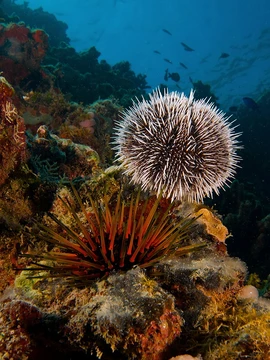
Sea urchin
Spiny, globular echinoderms found in all oceans and depths.

Sea urchins make up the class Echinoidea, part of the larger group known as echinoderms. There are about 950 species living on the ocean floor, spread across every ocean and depth, from the shoreline down to the deep sea. Their bodies are usually round and covered in a hard, spiny shell called a test, which typically measures between 3 and 10 centimeters across. These animals move slowly, using tiny tube feet to crawl and sometimes pushing themselves along with their spines. Their diet is mostly algae, but they also eat slow-moving or stationary creatures like crinoids and sponges. Predators include sharks, sea otters, starfish, wolf eels, triggerfish, and people. If predators are scarce, urchins can overgraze an area, creating what are known as urchin barrens—damaged habitats where large algae and the animals that depend on them disappear.
Like all echinoderms, adult sea urchins have five-part symmetry, while their larvae, called pluteus, have bilateral symmetry. That bilateral symmetry shows they belong to the Bilateria group, which also includes chordates, arthropods, annelids, and molluscs. Sea urchins live in every ocean and climate, from tropical to polar waters, and inhabit seafloor environments ranging from rocky shores to the deepest hadal zone. Their fossils date back to the Ordovician period, around 450 million years ago. Their closest echinoderm relatives are sea cucumbers, and both are deuterostomes—a group that includes chordates.
Since the 19th century, scientists have studied sea urchins as model organisms in developmental biology because their embryos are easy to observe. Research continues today, focusing on their genomes, unusual fivefold symmetry, and their evolutionary link to chordates. Some species, like the slate pencil urchin, are popular in home aquariums, where they help control algae. In the past, fossil urchins were used as protective amulets.
**Diversity**
Sea urchins belong to the phylum Echinodermata, which also includes starfish, sea cucumbers, sand dollars, brittle stars, and crinoids. Like other echinoderms, they have fivefold symmetry and move using hundreds of tiny, transparent, adhesive tube feet. This symmetry isn’t obvious in a living urchin but is easy to see in a dried test.
Quick Facts
- Taxon
- Echinoidea
Facts from the source article.
Lore & Background
Sea urchins are members of the phylum Echinodermata, which also includes starfish, sea cucumbers, sand dollars, brittle stars, and crinoids. Like other echinoderms, they have five-fold symmetry (called pentamerism) and move by means of hundreds of tiny, transparent, adhesive 'tube feet'. The symmetry is not obvious in the living animal, but is easily visible in the dried test. Specifically, the term 'sea urchin' refers to the 'regular echinoids', which are symmetrical and globular, and includes several different taxonomic groups, with two subclasses: Euechinoidea ('modern' sea urchins, including irregular ones) and Cidaroidea, or 'slate-pencil urchins', which have very thick, blunt spines, with algae and sponges growing on them. The 'irregular' sea urchins are an infra-class inside the Euechinoidea, called Irregularia, and include Atelostomata and Neognathostomata. Irregular echinoids include flattened sand dollars, sea biscuits, and heart urchins. Together with sea cucumbers (Holothuroidea), they make up the subphylum Echinozoa, which is characterized by a globoid shape without arms or projecting rays.
Reader's Guide
Sea urchins have been studied since the 19th century as model organisms in developmental biology, as their embryos were easy to observe. That has continued with studies of their genomes because of their unusual fivefold symmetry and relationship to chordates. Species such as the slate pencil urchin are popular in aquaria, where they are useful for controlling algae. Fossil urchins have been used as protective amulets. The animals have a rigid, usually spherical body bearing moveable spines, which give the class the name Echinoidea (from the Greek ἐχῖνος ekhinos 'spine'). The name urchin is an old word for hedgehog, which sea urchins resemble; they have archaically been called sea hedgehogs. The internal organs are enclosed in a hard shell or test composed of fused plates of calcium carbonate covered by a thin dermis and epidermis. The test is referred to as an endoskeleton rather than exoskeleton even though it encloses almost all of the urchin. Sea urchins convert aqueous carbon dioxide using a catalytic process involving nickel into the calcium carbonate portion of the test. The mouth of most sea urchins is made up of five calcium carbonate teeth or plates, with a fleshy, tongue-like structure within. The entire chewing organ is known as Aristotle's lantern from Aristotle's description in his History of Animals.
Did You Know?
- The name 'urchin' is an old word for hedgehog, and sea urchins have archaically been called sea hedgehogs.
- The closest echinoderm relatives of the sea urchin are the sea cucumbers (Holothuroidea), which like them are deuterostomes.
- The fossil record of the echinoids dates from the Ordovician period, some 450 million years ago.
Architecture of a Spiny Globe
Sea urchins are built around a rigid, spherical shell called a test, constructed from fused plates of calcium carbonate. Though it encloses nearly the entire animal, biologists classify it as an endoskeleton rather than an exoskeleton, because a thin layer of muscle and living skin covers the outside and the plates grow incrementally with the animal rather than being shed. The test is divided into five ambulacral grooves and five broader interambulacral bands, each band made of two plate sets, yielding twenty longitudinal columns in all. Tiny perforations in the ambulacral plates allow hundreds of transparent tube feet to extend outward for locomotion. Protruding from rounded tubercles on the plate surfaces are two series of spines—long primary and shorter secondary—typically hollow and cylindrical, with the longest clustered near the equator. Scattered among them are pedicellariae, small stalked structures bearing functional jaws. The animal converts dissolved carbon dioxide into the calcium carbonate of its shell through a catalytic reaction that depends on nickel. The class name Echinoidea comes from the Greek word for spine, while the common name urchin traces back to an Old French term ultimately meaning hedgehog.
Life on the Seabed
Roughly nine hundred and fifty species of sea urchin occupy every ocean on Earth, from sunlit intertidal rocks down to the crushing pressures of the hadal zone. They are benthic animals, crawling slowly across the seafloor on hundreds of tiny adhesive tube feet and occasionally prodding themselves forward with their spines. Their diet is overwhelmingly herbivorous, centered on algae, though they will also nibble on slow or sessile animals such as crinoids and sponges. At the top of their food web sit an impressive roster of predators: sharks, sea otters, starfish, wolf eels, triggerfish, and humans. When those predators are removed or insufficient, urchin populations can explode and strip the surrounding habitat of large algae, leaving behind what ecologists call urchin barrens—depleted stretches of seafloor where the complex communities that once depended on kelp and seaweed have collapsed. This makes urchins a keystone element in marine ecosystems: their grazing shapes the structure of entire coastal habitats, and their unchecked growth can transform a thriving reef into a spiny wasteland.
Deep Time and Deep Branches
The fossil record of echinoids stretches back to the Ordovician period, roughly four hundred and fifty million years ago, making sea urchins among the oldest continuously represented marine animal groups. In the living world they display a striking developmental transformation: their pluteus larvae are bilaterally symmetrical, a hallmark of the Bilateria superphylum that also encompasses chordates, arthropods, annelids, and molluscs. As the larvae metamorphose, they acquire the pentagonal, five-fold symmetry characteristic of all adult echinoderms. Phylogenetically, sea urchins sit closest to sea cucumbers, and together the two classes form the subphylum Echinozoa, defined by a globoid body plan lacking the arms or projecting rays seen in starfish and crinoids. Within Echinoidea, the regular globular forms are split into two subclasses: Euechinoidea, the so-called modern urchins, and Cidaroidea, the slate-pencil urchins with their thick, blunt spines. The irregular echinoids—sand dollars, sea biscuits, heart urchins—nest inside Euechinoidea and have secondarily evolved flattened, bilaterally oriented bodies suited to burrowing through soft sediment.
In the Laboratory and the Home
Since the nineteenth century, sea urchins have served as model organisms in developmental biology, largely because their embryos are easy to observe. That early utility has carried into the modern era, where researchers continue to study urchin genomes precisely because of the animals' unusual five-fold symmetry and their deep evolutionary relationship to chordates. Outside the laboratory, certain species have found a place in domestic aquaria; the slate-pencil urchin, for example, is popular among hobbyists who value its appetite for algae, making it a practical tool for managing unwanted growth in a tank. The cultural footprint of urchins extends further back in time: fossil urchin tests have been fashioned into protective amulets, their spiny geometry lending them an almost talismanic quality. Even the common name carries a folk-etymological story, tracing through Old French herichun to the Latin ericius, the word for hedgehog, a comparison that captures the animal's unmistakable spiny silhouette as it tumbles across a rocky shore.
Frequently Asked Questions
What is a sea urchin?
Sea urchins are spiny, round-bodied marine animals belonging to the class Echinoidea within the broader echinoderm family. They live on ocean floors in every ocean, from shallow shorelines all the way down to the deep sea, with roughly 950 recognized species.
How big do sea urchins get?
Most species measure between 3 and 10 centimeters across their hard, spiny outer shell (called a test). The largest known species can reach up to 36 centimeters, or about 14 inches, in diameter.
How do sea urchins move around?
They crawl along the seabed using clusters of tiny tube feet, and some species also nudge themselves forward with their spines. As a concrete example, the red sea urchin covers roughly 7.5 centimeters per day when food is plentiful, but can push up to 50 centimeters a day when it must forage farther.
What do sea urchins eat?
Their primary food source is algae, but they will also consume slow or stationary animals such as crinoids and sponges. This mixed diet helps them survive across the wide range of habitats they occupy.
How far back do sea urchins go in the fossil record?
Fossil evidence places the origin of sea urchins in the Ordovician period, roughly 450 million years ago. This makes them one of the older groups of echinoderms still alive today.
More in Sea Urchins 1-24
Spotted an error? Know more?
Reader corrections go straight into our review queue. Suggest an edit · How this site is sourced