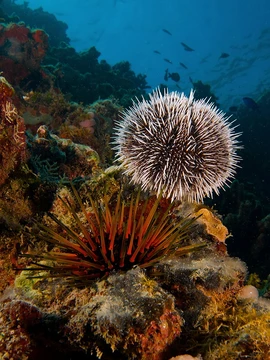
Cidaroidea (subclass)
Primitive sea urchins with widely separated primary spines.

Cidaroidea is a superfamily within the order Cidaroida, which comprises primitive sea urchins known as pencil urchins. Cidaroida is the only living order of the subclass Perischoechinoidea; all other orders of that subclass became extinct during the Mesozoic.
Quick Facts
- Taxon
- Cidaroida
Facts from the source article.
Lore & Background
Cidaroida, also called pencil urchins, are an order of primitive sea urchins and the only living representatives of the subclass Perischoechinoidea. All other orders of this subclass, which were even more primitive than the living forms, became extinct during the Mesozoic. Their primary spines are much more widely separated than in other sea urchins, and they have no buccal slits. Other primitive features include relatively simple plates in the test, and the ambulacral plates continuing as a series across the membrane that surrounds the mouth.
Reader's Guide
The superfamily Cidaroidea belongs to the order Cidaroida, which is notable as the sole surviving order of the subclass Perischoechinoidea. This makes Cidaroida a key group for understanding the evolutionary history of sea urchins, as all other orders of the subclass, which were even more primitive, died out during the Mesozoic. The order's primitive features—such as widely separated primary spines, absence of buccal slits, simple test plates, and ambulacral plates extending across the oral membrane—distinguish it from other sea urchins. The World Register of Marine Species lists several families within Cidaroidea, including Cidaridae, Ctenocidaridae, and extinct families like Diplocidaridae and Heterocidaridae. These families, along with the superfamily Histocidaroidea, comprise the order Cidaroida. The persistence of Cidaroida into the present day provides a living link to ancient echinoderm lineages.
Did You Know?
- All other orders of Perischoechinoidea became extinct during the Mesozoic.
- Cidaroida have no buccal slits and relatively simple test plates.
Evolutionary Solitude: The Last of Perischoechinoidea
Cidaroida, commonly called pencil urchins, occupies a uniquely isolated position in the tree of life. This order stands as the sole surviving lineage within the subclass Perischoechinoidea, a group of primitive sea urchins whose evolutionary story stretches back deep into the history of echinoderms. Every other order that once belonged to this subclass—forms that were even more archaic in their anatomy—perished during the Mesozoic Era, leaving no living descendants. This mass extinction of sister lineages means that modern pencil urchins are not merely a curious branch of the sea urchin family; they are the last representatives of an entire subclass. Their continued existence offers biologists a rare window into the body plans that characterized early echinoderm evolution, preserving structural features that have been lost in all other surviving urchin lineages. In a sense, each living pencil urchin is a walking fossil, carrying forward a morphological heritage that no other extant sea urchin retains.
Primitive Architecture: Anatomy of a Living Fossil
The physical structure of pencil urchins reveals a suite of features that set them apart from every other living sea urchin and mark them as retainers of ancient body-plan elements. Their primary spines are spaced far more widely than the densely packed spines typical of other urchin orders, giving the animal a more open, skeletal appearance. They entirely lack buccal slits, structures found in more derived echinoderms. The calcareous test—the internal shell—shows a comparatively simple arrangement of plates, lacking the complex interlocking geometry seen in modern echinoids. Perhaps most strikingly, the ambulacral plates, which in other urchins are confined to the tube-foot grooves, extend as a continuous series across the membrane that encircles the mouth. Together, these traits paint a picture of an organism that has preserved, over hundreds of millions of years, a body architecture that its extinct Mesozoic relatives shared, making pencil urchins invaluable for understanding the ancestral echinoderm condition.
A Fossil Roster: Families Past and Present
The taxonomic record for Cidaroida reads like a memorial to a once-diverse group. Under the World Register of Marine Species, the order is split into two superfamilies—Cidaroidea and Histocidaroidea—comprising fourteen families in total. Yet the majority of these families bear the dagger symbol of extinction. Anisocidaridae, Paurocidaridae, Diplocidaridae, Heterocidaridae, Miocidaridae, Polycidaridae, Rhabdocidaridae, Serpianotiaridae, and Triadocidaridae are all known only from the fossil record. Only a handful, including Cidaridae, Ctenocidaridae, Histocidaridae, and Psychocidaridae, still contain living representatives. The descriptions of these families span more than a century of taxonomic work, from Gray's 1825 naming of Cidaridae to Vadet's 1999 establishment of Anisocidaridae, reflecting both the deep fossil history of the group and the slow, layered process by which scientists have pieced together its full diversity.
A Century of Naming: The Taxonomic Trail
The classification of Cidaroida is a product of sustained scholarly effort stretching across nearly two hundred years. The order itself was formally established by Claus in 1880, yet the superfamily Cidaroidea had already been named by Gray in 1825, indicating that the broad group was recognized even before the order received its definitive rank. Individual families were described by a succession of taxonomists—Mortensen in 1928 and 1934, Gregory in 1900, Lambert in 1900, Ikeda in 1936, Durham and Melville in 1957, Vadet in 1988 and 1999, Hagdorn in 1995, and Smith in 1994—each adding a new family or redefining boundaries as fossil material and morphological understanding improved. Key reference works such as Barnes's 1982 Invertebrate Zoology and the National History Museum's online entries have helped consolidate this knowledge for broader audiences. The result is a classification that, while still rooted in nineteenth-century frameworks, has been refined repeatedly to reflect what the fossil record and living specimens collectively reveal about this ancient lineage.
Frequently Asked Questions
What is Cidaroidea?
Cidaroidea is a superfamily of sea urchins that falls under the order Cidaroida, commonly known as pencil urchins. They are considered one of the more primitive lineages within the echinoderm family tree.
Which subclass does Cidaroidea belong to, and what makes that subclass special?
Cidaroidea sits within the subclass Perischoechinoidea, a group that once contained multiple orders of sea urchins. Today, the order Cidaroida (and thus Cidaroidea) is the sole surviving order of that entire subclass, making it a living remnant of a once-larger clade.
What do Cidaroidea look like compared to other sea urchins?
Members of Cidaroidea are easily recognized by their widely spaced primary spines, which give them a sparse, pencillike silhouette rather than the dense, uniform spine coverage seen in more derived urchin groups. This open-spine arrangement is a hallmark of their primitive body plan.
Why is Cidaroidea important to sea-urchin fans and biologists?
Because every other order of the subclass Perischoechinoidea vanished during the Mesozoic, Cidaroidea stands as the last living representative of that ancient lineage. Studying it offers a rare window into what early echinoderms looked like before the mass diversification of modern urchin forms.
How did Cidaroidea survive when its sister orders did not?
The exact ecological reasons are still debated, but the fact is that all other Perischoechinoidea orders went extinct during the Mesozoic while the Cidaroida line persisted into the present. This makes Cidaroidea a surviving 'living fossil' group that outlasted its close relatives by roughly 100 million years.
More in Sea Urchins 1-24
Spotted an error? Know more?
Reader corrections go straight into our review queue. Suggest an edit · How this site is sourced