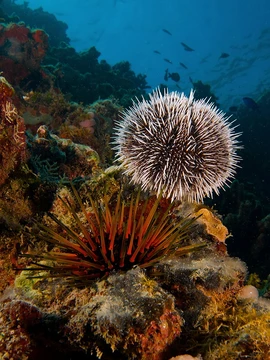
Aspidodiadema
A genus of sea urchins with slender whorled spines.

Aspidodiadema is a genus of echinoderms within the family Aspidodiadematidae. Its species inhabit the Indo-Pacific and Caribbean regions. The test is small, nearly spherical, and composed of delicate yet tightly interlocking plates. The apical disc is arranged in a single circle, and the membrane of the plates is embedded without contacting the coronal plates. Ambulacral plating is pseudocompound, with a single large primary tubercle on every third plate—these tubercles are significantly larger than the others and form an alternating series down the perradius, a feature that separates the genus from *Plesiodiadema* and *Gymnotiara*. The primary tubercles are perforated and notched, while secondary tubercles are limited to the plate edges. The peristome has shallow, rounded buccal notches. Spines are slender and arranged in whorls, and their lumens contain a mesh of horizontal dividers and vertical pillars. Recognized species include *Aspidodiadema africanum*, *A. annulatum*, *A. arcitum*, *A. hawaiiense*, *A. intermedium*, *A. jacobyi*, *A. meijerei*, *A. montanum*, *A. multituberculatum*, *A. nicobaricum*, *A. sinuosum*, and *A. tonsum*.
Quick Facts
- Taxon
- Aspidodiadema
- Type Species
- Aspidodiadema tonsum
- Type Species Authority
- Agassiz, 1878
Facts from the source article.
Lore & Background
The genus Aspidodiadema is distinguished by its small, subglobular test with fragile but firmly tessellated plating. The apical disc is monocyclic, and the plate membrane is embedded, not touching the coronal plates. The ambulacral plating is pseudocompound, featuring a single large primary tubercle on every third plate, which is much enlarged compared to the others; these primary tubercles form an alternate series down the perradius. This arrangement distinguishes Aspidodiadema from the related genera Plesiodiadema and Gymnotiara. The primary tubercles are perforated and notched, while secondary tuberculation is confined to the plate margins. The peristome has shallow, rounded buccal notches. The spines are slender and arranged in whorls, with lumens filled by a mesh of horizontal dividers and vertical pillars.
Reader's Guide
Aspidodiadema is notable for its distinctive morphological traits that separate it from other genera within the family Aspidodiadematidae. The pseudocompound ambulacral plating with enlarged primary tubercles on every third plate, forming an alternate series, is a key diagnostic feature. The slender, whorled spines with internal mesh of horizontal dividers and vertical pillars are also characteristic. The genus has a broad geographic range, with species found in both the Indo-Pacific and Caribbean regions. The 12 recognized species listed in the source article include Aspidodiadema africanum, Aspidodiadema annulatum, Aspidodiadema arcitum, Aspidodiadema hawaiiense, Aspidodiadema intermedium, Aspidodiadema jacobyi, Aspidodiadema meijerei, Aspidodiadema montanum, Aspidodiadema multituberculatum, Aspidodiadema nicobaricum, Aspidodiadema sinuosum, and Aspidodiadema tonsum. These species were described by various authors, including Mortensen, Koehler, Shigei, Agassiz, Döderlein, and Mironov. The genus's significance lies in its unique skeletal and spine architecture, which contributes to the understanding of echinoderm diversity and evolution.
Did You Know?
- The test of Aspidodiadema is small and subglobular with fragile plating that is firmly tessellated.
- The primary tubercles are perforated and notched, and secondary tuberculation is confined to plate margins.
- The genus includes 12 recognized species, such as Aspidodiadema hawaiiense and Aspidodiadema tonsum.
Taxonomic Placement and Nomenclature
Aspidodiadema africanum occupies a specific position within the broader tree of marine invertebrate taxonomy. It is classified as a species of sea urchin, anchoring it firmly within the echinoderm lineage. At the family level, it belongs to Aspidodiadematidae, a grouping that distinguishes it from other sea urchin families. Within that family, it is assigned to the genus Aspidodiadema, a name that reflects shared structural traits with close relatives. The specific epithet africanum signals an association with African waters, though the available facts confirm only that this organism inhabits the sea. Together, the binomial name encapsulates both its generic identity and its species-level distinction. This layered classification—from sea urchin, to family, to genus, to species—provides researchers with a precise taxonomic address, situating the organism among a small but recognizable cluster of spiny marine creatures.
Armour and Spine-Covered Defence
The most immediately striking feature of Aspidodiadema africanum, as noted in its brief scientific profile, is its armour. Like other members of the sea urchin group, this species presents a hardened exterior, but what sets it apart within its family is that this armour is specifically described as being covered with spines. These spines form a protective layer over the body, serving as a physical barrier against predators and environmental abrasion in its marine surroundings. The spine-covered armour is a defining characteristic that helps distinguish Aspidodiadema africanum from smoother-bodied echinoderms and reinforces its placement within the Aspidodiadematidae family, where such spiny defences appear to be a shared trait. The fact that the description emphasizes the spines as covering the armour suggests they are a prominent, visible feature rather than a subtle textural detail. This spiny exterior is, in essence, the species' most recognizable physical signature in the open sea.
The 1939 Description and a Danish Scientist's Contribution
The formal scientific recognition of Aspidodiadema africanum traces back to 1939, the year the organism received its first documented description in the scientific literature. The individual responsible for this act of taxonomic identification was Ole Theodor Jensen Mortensen, a Danish scientist whose work brought this particular sea urchin to the attention of the broader biological community. The fact that a researcher from Denmark undertook the description of a species whose name references Africa highlights the international and often far-reaching nature of mid-twentieth-century marine biology. Mortensen's contribution was foundational: without his 1939 description, this species would lack the formal nomenclature that anchors it in the genus Aspidodiadema and the family Aspidodiadematidae. His work represents a single, pivotal moment in the species' scientific history—the point at which it transitioned from an unnamed organism in the sea to a recognized, catalogued member of the biological record.
Marine Habitat and Neighbouring Species
Aspidodiadema africanum is, at its most fundamental level, a creature of the sea. Its life is conducted in marine environments, and it is within these saltwater habitats that its spine-covered armour serves its protective purpose. The species does not exist in isolation; it is part of a small constellation of related organisms that share taxonomic proximity. Among its recognised neighbours in the broader taxonomic landscape are Aspidodiadema annulatum, a fellow member of the same genus, as well as Argopatagus planus and Argopatagus vitreus, species that sit in a closely related genus. These four organisms together form a compact group of spiny sea urchins linked by shared family-level traits within Aspidodiadematidae. Their co-mention in reference materials underscores that Aspidodiadema africanum is one thread in a small but distinct weave of marine invertebrate diversity, each species contributing its own particular form of spined armour to the seascape.
Frequently Asked Questions
What is Aspidodiadema?
Aspidodiadema is a genus of small, subglobular sea urchins in the family Aspidodiadematidae. Its test is built from delicate, tightly interlocking plates, and the spines are slender and organized into whorls around the body.
Where do Aspidodiadema species occur?
Members of this genus are found in marine waters of the Indo-Pacific region as well as the Caribbean, giving the group a notably broad and disjunct distribution.
What is special about Aspidodiadema's apical disc?
The apical disc is monocyclic, with its plates set in a single circular ring. The membrane of those plates is embedded in a way that avoids any contact with the coronal plates, a structural detail fans often point to as a key identifying trait.
How are Aspidodiadema's tubercles and spines arranged?
A single large primary tubercle—perforated and notched—sits on every third ambulacral plate, producing an alternating series that runs down the perradius. The spines themselves are slender and laid out in whorls rather than in dense radial rows.
What sets Aspidodiadema apart from other Aspidodiadematidae?
The combination of pseudocompound ambulacral plating, the distinctive notched-and-perforated primary tubercles at regular intervals, and the monocyclic apical disc together separate the genus from its close relatives. Fans typically use that tubercle spacing pattern as the quickest visual test in the field.
More in Sea Urchins 1-24
Spotted an error? Know more?
Reader corrections go straight into our review queue. Suggest an edit · How this site is sourced