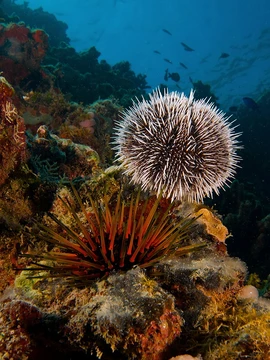
Fossil echinoids
Fossilised sea urchins with a rich cultural and geological history.

Fossil echinoids are the preserved remains of sea urchins, spiny creatures that once lived on the ocean floor. Their most recognizable feature is a five-petalled pattern on the shell, created by five radiating grooves called ambulacra. The oldest known examples come from the late Ordovician, roughly 450 million years ago, and the group has left behind a wealth of fossils ever since. Their hard shells are made of calcite plates, and their spines are also commonly found in rocks of all subsequent ages. Early echinoids from the Paleozoic had thin shells, so their fossils are often fragmentary, appearing as clusters of plates or loose spines. Later species developed sturdier shells that preserved well, though the spines usually separated from the body. Fossils are especially common in Jurassic and Cretaceous rocks, particularly in late Cretaceous chalk. In the White Cliffs of Dover, these echinoids help date the different chalk layers because they are plentiful, well-preserved, and vary by type across different time periods.
People have collected fossil echinoids for thousands of years, and they turn up frequently at archaeological sites. They played roles in Celtic and Norse mythology, where they were revered, linked to burials, woven into stories, and used to make tools and ornaments. Common names for them include thunderstones, fairy loaves, and shepherds' crowns. One early English example is a Middle Pleistocene Acheulean hand axe from Kent, where the maker chose a flint that clearly shows the sea urchin’s jaw structure, known as Aristotle’s lantern. Similar finds have been made in France, across Western and Central Europe, and in Northern Africa, spanning the Paleolithic, Neolithic, Bronze Age, and Iron Age.
- Earliest fossil date
- late Ordovician period, some 450 Mya
- Common rock ages
- Jurassic and Cretaceous
- Notable location
- White Cliffs of Dover, southern England
- Earliest known archaeological example in
- Acheulean hand axe from the Middle Pleistocene found in Kent
Lore & Background
The main feature of echinoid fossils is the set of five ambulacra on the test radiating out from a central point, forming a distinctive five-petalled pattern. The earliest echinoid fossils date from the late Ordovician period, some 450 Mya. The group has a rich fossil record, their hard tests made of calcite plates and their spines being found in rocks from every period since then. Echinoids from the Paleozoic era had thin tests and their fossils are often incomplete, consisting of groups of plates or isolated spines. Later echinoids had more robust tests and fossilised well, usually with the spines detached from the test.
Fossils of echinoids are common in rocks from the Jurassic and Cretaceous age, especially from late Cretaceous chalk. In the White Cliffs of Dover in southern England, the echinoid fossils that are present can be used for dating the various chalk strata in which they occur. This is because they are relatively abundant and well-preserved compared to other fossilised animals and can be differentiated by type between different ages.
Humans have long had a propensity for collecting fossil echinoids, and these fossils are often found at archaeological sites. The fossils played a part in both Celtic and Norse mythology, were venerated, associated with burials, woven into myths and legends and used when making tools and decorative objects. These fossils are commonly known as thunderstones, fairy loaves or shepherds' crowns.
Reader's Guide
Fossil echinoids hold significance both as geological markers and as cultural artifacts. Geologically, their abundance and preservation in rocks from the Jurassic and Cretaceous periods, particularly in late Cretaceous chalk, allow them to be used for dating strata, as seen in the White Cliffs of Dover. Their hard calcite tests and spines provide a continuous fossil record from the late Ordovician onward, though Paleozoic specimens are often fragmentary.
Culturally, humans have collected these fossils for millennia, associating them with luck, magic, and deities. They appear in Celtic and Norse mythology, were venerated, linked to burials, and used in tools and decorative objects. Known as thunderstones, fairy loaves, or shepherds' crowns, they are found at archaeological sites across Europe and Northern Africa. The earliest known example in England is an Acheulean hand axe from the Middle Pleistocene found in Kent, where the craftsman chose flint containing an exposed Aristotle's lantern. Similar examples span the Paleolithic, Neolithic, Bronze Age, and Iron Age in France, Western and Central Europe, and Northern Africa.
The Five-Petalled Signature and a 450-Million-Year Record
The most immediately recognisable trait of any echinoid fossil is the arrangement of five ambulacral grooves that radiate outward from a central point on the test, producing a pattern that looks strikingly like a five-petalled flower. This geometry, combined with the hard calcite plates that make up the test and the long spines that once extended from it, has given the group one of the most continuous fossil records of any marine invertebrate. The earliest known echinoid fossils come from the late Ordovician, roughly 450 million years ago, and specimens have been recovered from rocks of every geological period since. In the Paleozoic, however, the tests were comparatively thin, so what survives is often fragmentary—clusters of individual plates or scattered spines rather than complete shells. Beginning in the Mesozoic, echinoids developed sturdier tests that preserved far better, though the spines typically broke away and are found separate from the body. By the Jurassic and especially the late Cretaceous, echinoid fossils became so abundant in chalk deposits that they form a cornerstone of the fossil assemblage in those strata.
Thunderstones, Fairy Loaves, and Sacred Objects
Long before modern science gave them a taxonomic name, people across Europe and beyond had already woven echinoid fossils into the fabric of their spiritual lives. For millennia these five-lobed shells were regarded as objects of luck, attributed with magical powers, and linked directly to the gods and goddesses of local pantheons. In Celtic tradition they appeared in myths and legends, were venerated as sacred objects, and were placed alongside the dead in burial contexts. Norse culture similarly incorporated them into its mythological landscape. Their practical uses extended beyond the purely symbolic: communities crafted tools and decorative ornaments from the hard calcite tests. The common names that persist in folklore—thunderstones, fairy loaves, shepherds' crowns—capture the sense of mystery and otherworldliness that people ascribed to them. A thunderstone, for instance, evokes the idea of a divine weapon hurled from the sky, while a fairy loaf suggests a tiny baked good left by supernatural beings. These names reveal how deeply the distinctive five-petalled shape resonated with human imagination, transforming a simple seabed invertebrate into a vessel for centuries of cultural meaning.
Acheulean Knappers and Iron Age Craftsmen: An Archaeological Thread
The intersection of echinoid fossils and human material culture stretches back to the deep Paleolithic. The earliest documented example in England is an Acheulean hand axe from the Middle Pleistocene, recovered in Kent. The flint knapper who shaped that tool appears to have deliberately selected a piece of flint that incorporated the exposed region around the sea urchin's jaws—the structure later named Aristotle's lantern—leaving it clearly visible on the finished blade. This is not an isolated curiosity. Comparable finds, in which echinoid material is embedded in or associated with worked stone, have been reported from France, from across Western and Central Europe, and from Northern Africa. Together these examples span a vast chronological range, from the Paleolithic through the Neolithic, the Bronze Age, and into the Iron Age. Their recurrence at archaeological sites across so many cultures and millennia suggests that echinoid fossils were not merely incidental inclusions in sediment but were actively collected, valued, and incorporated into the toolkits and decorative traditions of prehistoric and early historic communities.
Reading the White Cliffs: Echinoids as Time Markers
In the chalk formations of the White Cliffs of Dover in southern England, echinoid fossils serve a purpose that goes well beyond their aesthetic appeal. Because they are relatively abundant and better preserved than most other fossilised animals in those deposits, and because their morphology can be differentiated by type across successive ages, they function as practical stratigraphic markers. Geologists and palaeontologists can examine the specific echinoid species present in a given layer of chalk and use that information to assign a relative age to the stratum. This utility is a direct consequence of the group's evolutionary trajectory: the robust, well-preserved tests of Mesozoic and later echinoids, combined with their sheer numbers in late Cretaceous chalk, create a dense and easily identifiable fossil signal. The same principle applies more broadly across Jurassic and Cretaceous rocks worldwide, where echinoid assemblages provide one of the most reliable tools for correlating and dating sedimentary sequences. In this way, the humble sea urchin, frozen in stone for tens of millions of years, continues to help us read the deep-time architecture of the Earth.
Frequently Asked Questions
What are fossil echinoids?
Fossil echinoids are the mineralized remains of ancient sea urchins that once crawled across seafloors. Their bodies were built from calcite plates, and their spines often survive alongside the shell in sedimentary rock.
How old is the oldest known fossil echinoid?
The earliest identified examples date back to the late Ordovician period, approximately 450 million years ago. Because Paleozoic species had relatively thin shells, their fossils tend to be broken or incomplete compared to later specimens.
What creates the distinctive five-petalled pattern on fossil echinoids?
That radial design comes from five grooves called ambulacra that radiate outward across the shell's surface. It is one of the most instantly recognizable features when you spot a well-preserved specimen in a rock face.
Where are fossil echinoids most commonly found in rocks?
They show up especially frequently in Jurassic and Cretaceous-age strata. The White Cliffs of Dover in southern England are a well-known location where these fossils are exposed along the coastline.
What is the earliest known human connection to fossil echinoids?
The oldest documented archaeological example is an Acheulean hand axe from the Middle Pleistocene, discovered in Kent, England. This suggests that early humans were incorporating sea urchin shell material into their tool-making as far back as that period.
More in Sea Urchins 1-24
Spotted an error? Know more?
Reader corrections go straight into our review queue. Suggest an edit · How this site is sourced