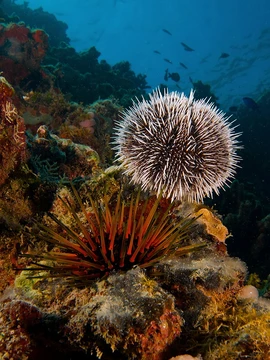
Sea urchins of the Gulf of California
Sea urchins of the Gulf of California, a biodiverse region.

The sea urchins of the Gulf of California are marine animals of the class Echinoidea, phylum Echinodermata, found in the Gulf of California between the Baja California Peninsula and the state of Sonora, Mexico. The Gulf is known for its high diversity and endemism of biota, and approximately 23 species of sea urchins, 3 species of heart urchins, and 9 species of sand dollars inhabit this region.
- Total echinoid species in northern gulf
- 35
- Species found throughout gulf
- 32
- Species endemic to gulf
- 1
- Endemic species name
- Mellita granti
- Biogeographic regions
- Northern Gulf, Central Gulf, Southern Gulf, Southwest Baja California Sur Region, Colorado River Delta Biosphere Reserve
Lore & Background
The Gulf of California is divided into three biogeographic regions for classifying sea urchins: the Northern Gulf, Central Gulf, and Southern Gulf. Two additional regions—the Southwest Baja California Sur Region and the Upper Gulf of California and Colorado River Delta Biosphere Reserve—are also used. The Northern Gulf extends from the Colorado River Delta south to Baja California and Sonora, including the Midriff Islands. The Central Gulf runs from the Midriff Islands to Sonora and Baja California Sur, while the Southern Gulf extends to Cabo Corrientes and Cabo San Lucas.
Reader's Guide
The sea urchins of the Gulf of California are notable for their distribution patterns and endemism. According to the source article, 35 species of echinoids occur in the Northern Gulf of California. Of these, 32 species (91.43%) are found throughout the entire Gulf, while 3 species (8.57%) are present in the Northern and Central Gulf and outside the Gulf but absent from the Southern Gulf. Fifteen species (42.86%) also reside in the Southwest Baja California Sur Region. One species, Mellita granti, is endemic to the Gulf of California. The article also provides world distribution acronyms used by marine biologists, such as PET (Tropical Eastern Pacific) and ENGC (Endemic to the Gulf of California), to designate major habitat locations. A 2005 study added species including Lytechinus anamesus, Toxopneustes roseus, and Cassidulus pacificus to the Northern Gulf list.
Did You Know?
- Mellita granti is the only sea urchin species endemic to the Gulf of California.
- The Northern Gulf of California contains 35 species of echinoids.
- 32 of the 35 Northern Gulf echinoid species are found throughout the entire Gulf.
Physical Habitat & Geographic Setting
The Gulf of California stretches roughly 1,126 kilometers in length and spans between 48 and 241 kilometers in width, covering approximately 177,000 square kilometers of Pacific waters. Its mean depth sits near 818 meters, yet complex geology driven by plate tectonics pushes maximum depths beyond 3,000 meters, creating a dramatic vertical range within a single body of water. Along its roughly 4,000-kilometer coastline—shared by Baja California, Baja California Sur, Sonora, and Sinaloa—three broad shore types dominate: rocky outcrops, sandy beaches, and tidal flats. For organisms that cling to or burrow in hard substrates, the mineral composition of coastal rock matters enormously. Softer, more porous lithologies such as coquina limestone, rhyolite, granite, and diorite tend to harbor noticeably greater species richness than harder, smoother formations like basalt or diabase, because their natural cracks and crevices offer sheltered microhabitats. Even rock color plays a role: darker stones absorb more heat and can exclude species with low thermal tolerance. In the northern reaches, tidal swings of up to five meters impose a powerful daily rhythm on intertidal life, while mixed semidiurnal tides govern most of the gulf.
Ecological Richness & Faunal Zonation
Widely regarded as one of the most ecologically diverse seas on the planet, the Gulf of California supports more than 5,000 species of micro-invertebrates and exhibits a level of endemism that makes it a global hotspot for marine biology and commercial fishing alike. The gulf's marine life is organized into three broad faunal regions—Northern, Central, and Southern—each defined by the particular assemblages of animals found there. Between these regions lie transition zones, the most formally recognized being the Southwestern Baja California peninsula, though the exact boundaries of these zones shift from one species to another, meaning no single organism experiences a sharp ecological border. The gulf also contains 37 major islands and over 900 smaller islets, many of which owe their existence to volcanic eruptions in the early geological history of the Baja California peninsula. Formations such as the Islas Marías, Isla San Francisco, and Isla Partida are believed to be products of those ancient eruptions, while others, including Isla Coronados, still host active volcanic features. The Colorado River Delta contributes its own cluster of islands, such as Isla Montague, adding yet another distinct habitat mosaic to the gulf's already extraordinary biodiversity.
Conservation Framework & Protected Status
The gulf's islands and waters benefit from a layered web of protection that spans local, national, and international governance. On August 2, 1978, all gulf islands collectively totaling around 420 hectares were enacted as an Area Reserve and Migratory Bird Refuge and Wildlife, and in June 2000 they received an additional designation as a flora and fauna protection area. Beyond Mexican federal law, every island in the gulf is incorporated into the United Nations Man and Biosphere program and holds status within the UNESCO World Reserve Network as a Special Biosphere Reserve; parts of the gulf also carry UNESCO World Heritage Site recognition. Because the protected area is so vast, day-to-day conservation and management are distributed across four regional directorates, one for each bordering state. A single overarching management program, published in 2000, coordinates these efforts and is supplemented by local, site-specific plans. In Baja California alone, the Directorate of Protection Area Wildlife California Gulf Islands oversees 56 islands grouped into four archipelagos: San Luis Gonzaga (also called the Enchanted group), Guardian Angel, Bahía de los Ángeles, and San Lorenzo. This multi-tiered structure aims to balance the gulf's extraordinary biological value with the practical realities of managing thousands of kilometers of coastline.
Hydrological Change & Environmental Pressures
Several inlets along the gulf's shoreline function as negative estuaries, where evaporation of seawater outpaces any freshwater inflow, producing salinities and temperatures higher than the open ocean. Evidence suggests these same inlets may once have been positive estuaries—brackish systems diluted by river water—before human settlement and large-scale water diversion for municipal and agricultural use in a region of comparatively low rainfall curtailed free-flowing rivers. The upper Colorado River Delta, once a major estuary and wetland ecosystem, now survives as a small, ephemeral remnant following the construction of upriver dams and diversion aqueducts in the twentieth century. Of the six rivers historically feeding the gulf—the Colorado, Fuerte, Mayo, Sinaloa, Sonora, and Yaqui—few still discharge freely into its waters. Despite this, the remaining inlets remain critical nursery and feeding grounds for commercially harvested fishes, crustaceans, and shellfish. On the physical front, although gulf shores are generally sheltered from the relentless wave energy typical of most North American coasts, brief but violent storms known as chubascos can still inflict significant damage on shorelines, reminding residents and researchers alike that the gulf's environment remains dynamic and occasionally destructive.
Frequently Asked Questions
What are the Sea urchins of the Gulf of California?
They are marine animals in the class Echinoidea (phylum Echinodermata) that live in the waters between the Baja California Peninsula and Sonora, Mexico. The Gulf collectively hosts about 23 sea urchin species, 3 heart urchin species, and 9 sand dollar species.
How many echinoid species are found in the northern Gulf of California?
A total of 35 echinoid species have been recorded in the northern Gulf, with 32 of them occurring throughout the entire Gulf and only one being exclusive to that region.
Is there a sea urchin species found only in the Gulf of California?
Yes. Mellita granti is the single echinoid species endemic to the Gulf, meaning it occurs nowhere else in the world.
Which biogeographic regions do these sea urchins occupy?
Their distribution spans five zones: the Northern Gulf, Central Gulf, Southern Gulf, the Southwest Baja California Sur Region, and the Colorado River Delta Biosphere Reserve.
Why is the Gulf of California considered a hotspot for sea urchin diversity?
The Gulf is renowned for its unusually high levels of species richness and endemism among marine biota, concentrating a remarkable number of echinoid species within a relatively small, semi-enclosed body of water.
More in Sea Urchins 1-24
Spotted an error? Know more?
Reader corrections go straight into our review queue. Suggest an edit · How this site is sourced