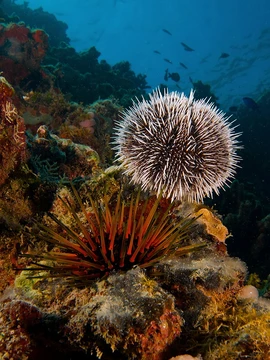
Echinoidea
Spiny, globular echinoderms found in all oceans and depths.

Sea urchins make up the class Echinoidea, a group within the echinoderms. About 950 species live on the ocean floor, found in every ocean and at every depth, from the shoreline to the deep sea. Their bodies are typically round and covered with a hard, spiny shell called a test, usually 3 to 10 cm (1 to 4 inches) wide. They move slowly, crawling with tiny tube feet and sometimes pushing themselves along with their spines. Their diet is mostly algae, but they also eat slow-moving or stationary animals like crinoids and sponges. Predators include sharks, sea otters, starfish, wolf eels, triggerfish, and humans. When predators are scarce, urchins can overgraze an area, creating "urchin barrens"—damaged environments stripped of large algae and the creatures that depend on them.
Like all echinoderms, adult sea urchins have five-part (pentagonal) symmetry, but their larvae, called pluteus, have bilateral (mirror) symmetry. This larval symmetry places them in the group Bilateria, alongside chordates, arthropods, annelids, and molluscs. Sea urchins live in every climate, from tropical to polar, and inhabit marine benthic (seabed) habitats, from rocky shores down to hadal zone depths. Their fossil record goes back to the Ordovician period, about 450 million years ago. Their closest echinoderm relatives are sea cucumbers (Holothuroidea), and like them, sea urchins are deuterostomes—a group that also includes chordates.
Since the 19th century, sea urchins have been studied as model organisms in developmental biology because their embryos are easy to observe. Research continues today with their genomes, thanks to their unusual fivefold symmetry and their evolutionary link to chordates. Some species, like the slate pencil urchin, are popular in aquariums for controlling algae. Fossil urchins have also been used as protective amulets.
**Diversity**
Sea urchins belong to the phylum Echinodermata, which also includes starfish, sea cucumbers, sand dollars, brittle stars, and crinoids. Like other echinoderms, they have fivefold symmetry (pentamerism) and move using hundreds of tiny, transparent, adhesive tube feet. This symmetry isn’t obvious on a living animal but is easy to see on a dried test. The term "sea urchin" specifically refers to "regular echinoids"—symmetrical and globular—and includes several taxonomic groups.
Quick Facts
- Taxon
- Echinoidea
Facts from the source article.
Lore & Background
Sea urchins are members of the phylum Echinodermata, which also includes starfish, sea cucumbers, sand dollars, brittle stars, and crinoids. Like other echinoderms, they have five-fold symmetry (pentamerism) and move by means of hundreds of tiny, transparent, adhesive tube feet. The symmetry is not obvious in the living animal but is easily visible in the dried test. The term 'sea urchin' refers to the 'regular echinoids', which are symmetrical and globular, and includes several taxonomic groups, with two subclasses: Euechinoidea and Cidaroidea. The 'irregular' sea urchins are an infra-class inside the Euechinoidea called Irregularia, and include flattened sand dollars, sea biscuits, and heart urchins.
Urchins typically range in size from 3 to 10 cm, but the largest species can reach up to 36 cm. They have a rigid, usually spherical body bearing moveable spines, which give the class the name Echinoidea (from the Greek ἐχῖνος ekhinos 'spine'). The name urchin is an old word for hedgehog, which sea urchins resemble. Like other echinoderms, sea urchin early larvae have bilateral symmetry, but they develop five-fold symmetry as they mature. The mouth is at the base of the animal and the anus at the top; the lower surface is described as 'oral' and the upper surface as 'aboral'. Several sea urchins, including sand dollars, are oval in shape with distinct front and rear ends, giving them a degree of bilateral symmetry.
Reader's Guide
Sea urchins have been studied since the 19th century as model organisms in developmental biology, as their embryos were easy to observe. That has continued with studies of their genomes because of their unusual fivefold symmetry and relationship to chordates. Species such as the slate pencil urchin are popular in aquaria, where they are useful for controlling algae. Fossil urchins have been used as protective amulets. Their predators include sharks, sea otters, starfish, wolf eels, triggerfish, and humans. When unchecked by predators, urchins can create urchin barrens, damaged environments devoid of large algae and the animals associated with them. The closest echinoderm relatives of the sea urchin are the sea cucumbers (Holothuroidea), which like them are deuterostomes, a clade that includes the chordates. The fossil record of the echinoids dates from the Ordovician period, some 450 million years ago. Sea urchins convert aqueous carbon dioxide using a catalytic process involving nickel into the calcium carbonate portion of the test.
Did You Know?
- Sea urchins have a rigid test composed of fused plates of calcium carbonate covered by a thin dermis and epidermis.
- The mouth of most sea urchins is made up of five calcium carbonate teeth or plates, known as Aristotle's lantern.
- Sea urchins move by walking using their many flexible tube feet, assisted by spines that can be used for pushing the body along.
- The red sea urchin manages about 7.5 cm a day when there is ample food, and up to 50 cm a day where there is not.
Taxonomic Landscape & Diversity
Sea urchins occupy a distinct position within the phylum Echinodermata, sharing that broader group with starfish, sand dollars, brittle stars, crinoids, and sea cucumbers. The term "sea urchin" specifically designates the regular echinoids—those with a symmetrical, roughly spherical body plan. Taxonomically, the class splits into two subclasses: Euechinoidea, which encompasses the "modern" urchins along with the irregular forms, and Cidaroidea, the slate-pencil urchins distinguished by their notably thick, blunt spines that often serve as substrates for algae and sponges. Within Euechinoidea, the irregular echinoids form their own infra-class called Irregularia, further divided into Atelostomata and Neognathostomata, and include recognizable shapes such as flattened sand dollars, sea biscuits, and heart urchins. Together with sea cucumbers, sea urchins constitute the subphylum Echinozoa, united by a globoid body without projecting arms or rays. Notably, the branched oral tentacles of many sea cucumbers evolved from modified tube feet and are not structurally equivalent to the arms seen in crinoids, sea stars, or brittle stars.
Architecture of the Test & Spine Mechanics
The defining feature of a sea urchin is its rigid, typically spherical shell—called the test—built from fused plates of calcium carbonate. Despite enclosing nearly the entire body, this structure is classified as an endoskeleton rather than an exoskeleton, because a thin layer of muscle and skin covers the outside, and the plates grow incrementally with the animal rather than being shed. The test is divided into five ambulacral grooves alternating with five wider interambulacral zones, creating twenty longitudinal plate columns in total. Tiny pores in the ambulacral plates allow tube feet to extend outward. Rounded tubercles dot the surface, anchoring the spines. Most species carry two sets: long primary spines and shorter secondary ones, with the longest concentrated near the equator. The spines are generally hollow and cylindrical. A muscular sheath surrounding the test can tilt spines in a chosen direction, while an inner collagen layer can stiffen or relax to lock a spine in place. Scattered among the spines are pedicellariae—small stalked, jawed structures. The urchin converts dissolved carbon dioxide into calcium carbonate through a nickel-catalyzed process.
Ecological Niche & Predation Dynamics
Roughly nine hundred and fifty species of sea urchin inhabit the seafloor across every ocean on Earth, ranging from sunlit intertidal rocks to the crushing pressures of the hadal zone. They occupy every climate band, from tropical reefs to polar waters, and are strictly benthic—living on or in the substrate. Their diet centers on algae, though they will also consume slow-moving or fixed animals such as crinoids and sponges. Movement is deliberate: urchins crawl using hundreds of tiny, adhesive tube feet and occasionally lever themselves along with their spines. A suite of predators keeps urchin populations in check, including sharks, sea otters, starfish, wolf eels, triggerfish, and humans. When those natural checks fail, urchins can overrun their habitat, stripping away large algae and the animals that depend on them, producing what ecologists call urchin barrens—degraded seascapes largely devoid of structural vegetation. In aquaria, species like the slate-pencil urchin are valued for their ability to graze algae, making them practical tools for maintaining tank health.
Deep Time & the Laboratory
The fossil record of echinoids stretches back to the Ordovician period, approximately four hundred and fifty million years ago, making them one of the oldest continuously represented echinoderm lineages. Their closest living relatives are the sea cucumbers, and together they form the deuterostome clade that also includes chordates—a relationship that places sea urchins in the broader Bilateria group alongside arthropods, annelids, and molluscs. This deep evolutionary connection, combined with the striking developmental shift from bilaterally symmetrical pluteus larvae to the pentagonal adult form, has made urchins invaluable to science. Since the nineteenth century, their transparent, easily observed embryos have served as model organisms in developmental biology. Modern research continues to probe their genomes, particularly to understand how fivefold symmetry is genetically orchestrated in an animal so closely related to the chordates that gave rise to vertebrates. Beyond the lab, fossil urchin tests have been fashioned into protective amulets, and living species remain popular in home aquaria.
Frequently Asked Questions
Who is Echinoidea?
Echinoidea is the class name for the roughly 950 species of spiny, globe-shaped echinoderms that carpet the seafloor in every ocean on Earth. They range from the shallow shoreline all the way down to the deepest trenches, making them one of the most widespread animal groups in the marine world.
What are Echinoidea's signature abilities?
Echinoidea crawls on hundreds of tiny tube feet and can also nudge itself forward using its spines, covering about 7.5 cm per day when food is plentiful but stretching to 50 cm a day when it is scarce. Its hard, spiny outer shell (called a test) serves as both armor and a means of locomotion.
What does Echinoidea feed on?
The primary diet is algae scraped from rocks and sediment, though Echinoidea will also snack on slow or stationary animals such as crinoids and sponges. This makes it a key grazer in benthic ecosystems.
How far back does Echinoidea's history go?
Fossil evidence places the origins of Echinoidea in the Ordovician period, roughly 450 million years ago, making it one of the oldest continuously surviving animal lineages on the planet.
Who preys on Echinoidea?
Its natural enemies include sea otters, starfish, sharks, wolf eels, and triggerfish, all of which have figured out ways to crack or bypass the spiny test. Despite this pressure, Echinoidea has persisted for hundreds of millions of years across every ocean depth.
More in Sea Urchins 1-24
Spotted an error? Know more?
Reader corrections go straight into our review queue. Suggest an edit · How this site is sourced