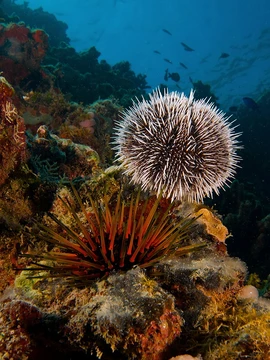
Sterechinus
A genus of Antarctic sea urchins with a fossil European origin.

Sterechinus belongs to the sea urchin family Echinidae. While all currently living species in this genus inhabit Antarctic waters, the very first member ever described was a fossil unearthed in Europe.
The genus’s type species, *Stirechinus scillae*, was named in 1856 from a fossil by Pierre Desor. It existed from the Late Miocene through the Plio-Pleistocene, and additional fossils have since turned up in France, Sicily, and Malta. None of these fossilized specimens have preserved any apical plates.
In terms of anatomy, *Sterechinus* urchins possess compound ambulacral plates made of three fused elements. On the middle element sits a primary tubercle that connects to a spine, while a smaller secondary tubercle lies in the interambulacral groove to one side. Three pairs of pores appear on the opposite side; in living animals, these pores link to tube feet, and the pore pairs are arranged in a vertical arc. The sutures between plates are deeply indented, and the narrow plates around the mouth are small, with shallowly grooved buccal notches.
The World Register of Marine Species lists these extant species: *Sterechinus agassizii*, *S. antarcticus*, *S. bernasconiae*, *S. dentifer*, *S. diadema*, and *S. neumayeri*.
Quick Facts
- Taxon
- Sterechinus
Facts from the source article.
Lore & Background
The genus Sterechinus was first known from a fossil species, Stirechinus scillae, described by Pierre Desor in 1856. This fossil lived from the Late Miocene to the Plio-Pleistocene and has since been found in France, Sicily and Malta. None of the fossilized urchins so far discovered had any apical plates. All living members of the genus are found in the waters around Antarctica. Members of the genus have compound ambulacral plates that are trigeminate, composed of three elements. These plates have a primary tubercle articulating with a spine on the middle element, a small secondary tubercle in the interambulacral groove on one side of it and 3 pairs of pores on the other. The tube feet are connected to these pores in the living animal and the pore pairs are arranged in a vertical arc. The sutures between the plates are deeply indented. The area of narrow plates around the mouth is small and the buccal notches are shallowly grooved.
Reader's Guide
The significance of Sterechinus lies in its dual fossil and extant distribution. The first described species was a fossil from Europe, yet all living members are restricted to Antarctic waters, suggesting a historical range shift. The type species, Stirechinus scillae, provides a paleontological record from the Late Miocene to the Plio-Pleistocene, with fossils found in France, Sicily and Malta. The absence of apical plates in all discovered fossils is a notable morphological detail. The extant species, listed in the World Register of Marine Species, include Sterechinus agassizii, Sterechinus antarcticus, Sterechinus bernasconiae, Sterechinus dentifer, Sterechinus diadema, and Sterechinus neumayeri. The genus is characterized by trigeminate compound ambulacral plates with a specific arrangement of tubercles and pore pairs, deeply indented sutures, and small mouth plates with shallow buccal notches. These anatomical features distinguish Sterechinus within the family Echinidae.
Did You Know?
- All living members of Sterechinus are found only in the waters around Antarctica.
- The first species described in the genus, Stirechinus scillae, was a fossil found in Europe.
- None of the fossilized Sterechinus urchins discovered had any apical plates.
- The type species Stirechinus scillae was first described by Pierre Desor in 1856.
More in Sea Urchins 1-24
Spotted an error? Know more?
Reader corrections go straight into our review queue. Suggest an edit · How this site is sourced