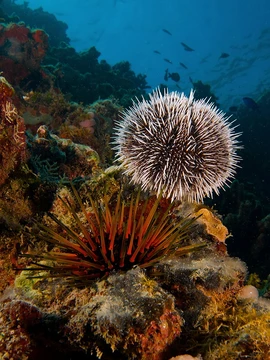
Salmacis (echinoderm)
A genus of Indo-Pacific sea urchins with hemispherical tests and sharp spines.

Salmacis is a genus of sea urchins belonging to the family Temnopleuridae. These animals are mostly found in warm, tropical and subtropical marine environments throughout the Indo-Pacific region. Their range includes coastal waters near Indonesia, Malaysia, the Philippines, Singapore, Thailand, Vietnam, Sri Lanka, India, Australia, and parts of East Africa. Typical habitats are shallow seagrass meadows, sandy seafloors, and coral reefs, where they live from the intertidal zone down to depths of about 90 meters.
The genus was first described by Louis Agassiz in 1841, with *Salmacis bicolor* as the type species. Their shells, or tests, are hemispherical and either globular or somewhat conical. The body is covered in short, thick, sharp spines called radioles, along with pedicellariae that help fend off predators. Like other echinoderms, they show pentaradial symmetry—a five-part organization radiating from a central axis. This axis runs from the mouth (peristome) on the lower, oral side to the anus (periproct) at the top, aboral apex. Their ambulacral pores are arranged in pairs, and the tubercles on their plates are crenulated, forming several vertical rows that appear as horizontal series on each interambulacral plate. Small pits or angular pores sit at the junctions of the coronal plates. The chewing apparatus resembles that of other genera, such as *Diadema* and *Echinothuriids*, except that the compass depressor ends in a spatula-shaped tip.
As omnivorous scavengers and detritus feeders, *Salmacis* urchins eat algae and soft-bodied creatures like sea pens, bryozoans, and jellyfish. They are dioecious, meaning individuals are either male or female, and they reproduce through external fertilization. Eggs may be held on the mouth, near the anus, or tucked into depressions within the petaloid regions. Their gonads serve dual roles: reproduction and storing nutrients.
Coloration helps tell different species apart. For instance, *Salmacis bicolor* is known for its two-toned pattern. In contrast, *Salmacis sphaeroides* is mostly white or olive-green, with spines that can be green and marked with reddish-brown, purple, white, or green bands.
Quick Facts
- Taxon
- Salmacis
- Type Species
- Salmacis bicolor
- Type Species Authority
- Louis Agassiz, 1841
Facts from the source article.
Lore & Background
The original description of Salmacis was recorded by Louis Agassiz in 1841, with the type species Salmacis bicolor. Salmacis urchins have hemispherical shells (tests) that are globular or subconical in shape. Their bodies are covered with short, thick, but sharp spines (radiole), and pedicellariae to deter predators. Their bodies exhibit pentaradial symmetry, with fivefold organization radiating from a central axis that connects the mouth (peristome) on the lower, oral surface to the anus (periproct) positioned at the upper aboral apex. Ambulacral pores are arranged in pairs, with crenulated tubercles forming several vertical rows which appear as horizontal series on each interambulacral plate. Small pits or angular pores are located at the junctions of the coronal plates. The masticatory apparatus is similar to other genera like Diadema and Echinothuriids, except for the compass depressor, which ends in a spatula-shaped tip.
Members of the genus can be differentiated based on their coloration. For example, Salmacis bicolor is distinctive by its two-toned coloration. On the other hand, species like Salmacis sphaeroides are predominantly white or olive-green, while its spines are green with reddish-brown, purple, white, or green brands. Salmacis urchins are omnivorous scavengers and detritus feeders, consuming algae and soft-bodied organisms like sea pens, bryozoans, and jellyfish. They are dioecious with separate male and female sexes, reproducing through external fertilization. Their eggs are retained either on the mouth (peristome), near the anus (periproct), or nestled deep within the depressions of the petaloid regions. Their gonads serve both reproduction and nutrient storage functions.
Reader's Guide
Salmacis is notable as a genus of sea urchins within the family Temnopleuridae, originally described by Louis Agassiz in 1841. Its members are distributed across the Indo-Pacific region, inhabiting shallow marine environments such as seagrass meadows, sandy substrates, and coral reefs. The genus is characterized by hemispherical, globular or subconical tests covered with short, thick, sharp spines and pedicellariae for defense. Their pentaradial symmetry and unique masticatory apparatus, with a spatula-shaped compass depressor, distinguish them from related genera. Coloration varies among species, aiding identification: Salmacis bicolor is two-toned, while Salmacis sphaeroides is white or olive-green with multicolored spines. As omnivorous scavengers and detritus feeders, they consume algae and soft-bodied organisms. Their reproductive strategy involves external fertilization, with eggs retained on the peristome, periproct, or in petaloid depressions. The gonads serve dual roles in reproduction and nutrient storage. The genus includes several species, such as Salmacis belli, Salmacis bicolor, Salmacis nuda, Salmacis roseoviridis, Salmacis rubricincta, Salmacis sphaeroides, and Salmacis virgulata, each with specific distributions across the Indo-Pacific. This genus contributes to the ecological dynamics of its habitats as a detritus feeder and prey for predators.
More in Sea Urchins 1-24
Spotted an error? Know more?
Reader corrections go straight into our review queue. Suggest an edit · How this site is sourced