Psychocidaridae
A sea urchin family with one living genus and a Jurassic fossil record.

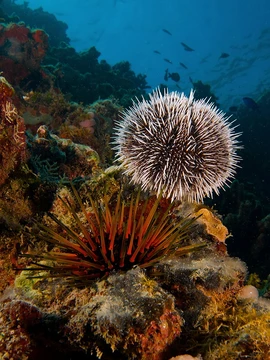
Psychocidaridae is a family of sea urchins in the order Cidaroida. It is notable because only one genus, Psychocidaris, is extant; all other genera are known only from fossils. The family has existed since the Lower Jurassic (Toarcian).
Quick Facts
- Taxon
- Psychocidaridae
Facts from the source article.
Lore & Background
Psychocidaridae belongs to the order Cidaroida. All Cidaroids are regular sea urchins with a test composed of twenty columns of plates: two ambulacral columns alternating with two interambulacral columns. Their pedicellariae are exclusively globiferous or tridentate. Psychocidarids are characterized by having no plates between the ambulacra; instead they have a single primary tubercle with a large mamelon. In most genera this mamelon is imperforate and non-crenulate. The pores are in pairs that are not connected by grooves. The spines are broad and either spindle-, gland-, or club-shaped.
Reader's Guide
The family Psychocidaridae is significant for its deep evolutionary history, having persisted since the Lower Jurassic (Toarcian). Its fossil record spans Europe, Ukraine, North America, North Africa, and the West Pacific, indicating a once widespread distribution. The only extant genus, Psychocidaris, is represented by a single living species, Psychocidaris ohshimai, found in the Philippines and the Bonin Islands, Japan. This species is distinguished by gland-shaped spines on the apical surface with a mat of hairs forming an overgrowth, and oral spines with longitudinal flanges. The family's combination of ancient fossil lineages and a single surviving species highlights its role as a relict group within the Cidaroida, offering insight into the morphological stability and specialization of sea urchins over millions of years.
More in Sea Urchins 1-24
Spotted an error? Know more?
Reader corrections go straight into our review queue. Suggest an edit · How this site is sourced