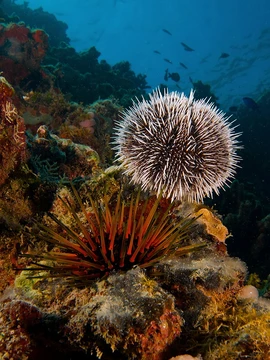
Phormosoma placenta
A deepwater Atlantic sea urchin with a flexible, collapsing test.

Phormosoma placenta is a species of deepwater sea urchin in the order Echinothurioida, found on both sides of the Atlantic Ocean on the continental slope. It is notable for its flexible, dome-shaped test that collapses into a disc when removed from water, and for its association with juvenile cusk-eels.
Quick Facts
- Genus
- Phormosoma
- Species
- placenta
Facts from the source article.
Lore & Background
Phormosoma placenta was first described in 1872 by Charles Wyville Thomson from a specimen dredged at 500 fathoms off the Butt of Lews and from fragments taken in the Rockall Channel. Its test is composed of overlapping plates bound by a membranous connection, giving it a flexible structure that collapses into a disc shape when brought to the surface. The upper surface bears few primary tubercles and spines, while the lower surface is densely covered with perforated tubercles bearing slender, club-shaped spines used for support and locomotion. Observations of live individuals show that the aboral spines are enclosed in large membranous sacs, which are usually destroyed during collection.
The species is gregarious, sometimes aggregating in large groups on sand and coral rubble substrates. It is believed to be an omnivore, feeding on algal fragments and detritus, with stomach contents including 3 mm pellets of mud bound by mucus. Juvenile cusk-eels associate with P. placenta, hiding underneath it or between its long spines, likely for protection and access to feeding areas with few natural refugia.
Reproduction is gonochoristic, with buoyant, large-yolked eggs that rise at 25 cm per minute, taking two days to ascend from bathyal depths to the surface before sinking. Development is direct, without a planktonic larval stage, and spawning occurs year-round. Aggregation increases fertilization success, and egg buoyancy aids dispersal.
Reader's Guide
Phormosoma placenta is a significant species in deepwater Atlantic ecosystems, occurring on the continental slope at depths normally between 500 and 3,700 meters. Its flexible test, which collapses upon removal from water, is a distinctive adaptation to high-pressure environments. The species is notable for its gregarious behavior, forming large aggregations on sand and coral rubble substrates, which likely enhances reproductive success through year-round spawning and buoyant eggs that ascend to the surface before sinking. Its omnivorous diet, consisting of algal fragments and detritus, positions it as a consumer of organic matter sinking from surface waters. The association with juvenile cusk-eels, which find refuge among its spines, highlights its role as a microhabitat provider in deep-sea environments with limited shelter. The three recognized subspecies—P. p. placenta in the north, P. p. sigsbei in the Caribbean, and P. p. africana off Africa—reflect its broad geographic range across the Atlantic. The species was first described in 1872 by Charles Wyville Thomson, based on specimens from the Butt of Lews and the Rockall Channel, marking an early contribution to deep-sea biology.
Did You Know?
- Phormosoma placenta specimens usually collapse into disc shapes when removed from water.
- Juvenile cusk-eels hide underneath or between the long spines of P. placenta for protection.
- The species has three recognized subspecies: P. p. placenta, P. p. sigsbei, and P. p. africana.
More in Sea Urchins 1-24
Spotted an error? Know more?
Reader corrections go straight into our review queue. Suggest an edit · How this site is sourced