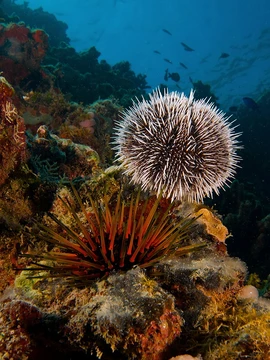
Loxechinus
Monotypic genus of sea urchin native to southern South America.

Loxechinus is a genus of sea urchin in the family Parechinidae, containing only the species Loxechinus albus. It is native to coastal southern South America, ranging from Ecuador along the coasts of Peru and Chile to Argentina and the Falkland Islands. Known as the Chilean sea urchin or red sea urchin, it is notable as the most common and widespread large sea urchin in Chile.
Quick Facts
- Genus
- Loxechinus
- Species
- albus
Facts from the source article.
Lore & Background
Loxechinus albus is a fast-growing, relatively large sea urchin with a dorsoventrally flattened test densely covered in small spines. Living individuals typically appear dull reddish with some pale green spines, but color is variable; some large deep-water specimens are white. It has 6 to 11 ambulacral plates, each bearing a single short primary spine and many longer secondaries, and its globiferous pedicellariae have a neck, large valves, and several lateral teeth.
The species is mostly found on rocky coasts associated with the kelp Macrocystis pyrifera, and is more numerous in exposed locations. It is a herbivore that feeds on whatever algae grow nearby; juveniles eat crustose coralline algae, diatoms, and algal detritus. Unlike some Northern Hemisphere urchins, L. albus appears to be in balance with its food supply and does not create barren grounds, partly because it also feeds on drifting algal fragments.
Spawning period varies along the Chilean coast, occurring later in the year as latitude increases. The echinopluteus larvae form part of the zooplankton for about thirty days, feeding on phytoplankton, then settle in the rocky intertidal zone and undergo metamorphosis before migrating to the neritic zone.
Reader's Guide
Loxechinus albus is significant as the only species in its genus and as the most common and widespread large sea urchin in Chile. It is harvested commercially by fishermen and used in Chilean cuisine, where it is known locally as 'Erizo rojo'. However, over-exploitation, its conspicuousness, and lack of official harvest control have made it relatively rare in some parts of its range. The species takes eight years to reach harvestable size, which contributes to its vulnerability. Its biology is notable for being in balance with its food supply, unlike some other urchin species that create barren grounds. The species also shows latitudinal variation in spawning timing, with populations at different latitudes spawning in different months. Its depth range extends to 340 meters, and far southern populations grow slower and reach smaller sizes. The species is found from Ecuador to Argentina and the Falkland Islands, inhabiting rocky reefs and shores in intertidal and subtidal zones.
Did You Know?
- Loxechinus albus is the only species in the genus Loxechinus.
- It takes 8 years to reach harvestable size.
- Spawning occurs in June at 23°S and in November–December at 45°S.
- The species is found at depths up to 340 m (1,120 ft).
More in Sea Urchins 1-24
Spotted an error? Know more?
Reader corrections go straight into our review queue. Suggest an edit · How this site is sourced