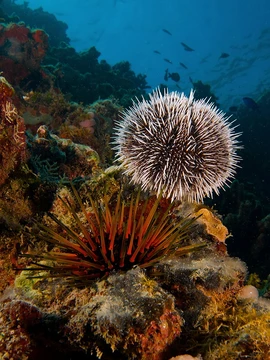
Lovenia
A genus of sea urchin with fossil and Recent species worldwide.

Lovenia is a genus of sea urchin closely related to the genera Breynia and Echinocardium. The genus includes both living and fossil species, spanning from the Oligocene epoch to the present. In 2020, the species Lovenia kerneri was described from fossils found in Florida’s Pliocene Tamiami Formation. This specimen is the first Lovenia recorded from the eastern United States, and it is also the largest and most recent member of the genus known from the eastern America and Caribbean region.
Quick Facts
- Taxon
- Lovenia
Facts from the source article.
Lore & Background
The genus Lovenia was established by Desor, Agassiz & Desor in 1847, with a stratigraphic range from the Oligocene to Recent. It is the sister taxon to Breynia and Echinocardium. The species list includes both fossil forms, such as †L. aegyptiaca from the Upper Miocene of Egypt and †L. bagheerae from the Miocene (Tortonian) of southern Australia, and Recent species like L. camarota from North Australia and L. cordiformis from the west coast of America.
Notably, Lovenia kerneri was described in 2020 from the Pliocene Tamiami Formation in Florida. It is the first documented Lovenia from the Eastern United States and is the largest as well as the latest member of this genus known from the Eastern America/Caribbean region. Other fossil species include †L. elongata (Miocene to Recent, Indo-West Pacific), †L. forbesii (Lower to Middle Miocene, Australia), and †L. mortenseni (Middle Miocene, Czech Republic).
Reader's Guide
Lovenia is significant as a genus that bridges fossil and Recent sea urchin faunas, with a distribution spanning the Oligocene to the present. Its status as the sister taxon to Breynia and Echinocardium places it within a well-defined phylogenetic context. The discovery of Lovenia kerneri in the Pliocene Tamiami Formation of Florida is notable because it represents the first documented occurrence of the genus in the Eastern United States, and it is both the largest and the latest member of Lovenia known from the Eastern America/Caribbean region. This finding extends the known geographic and temporal range of the genus in that area. The species list includes numerous fossil forms from Egypt, Australia, France, and the Czech Republic, as well as Recent species from the Indo-West Pacific, Hawaii, and the west coast of America, indicating a broad historical and modern distribution. The genus thus provides a record of sea urchin evolution and biogeography over tens of millions of years.
Did You Know?
- Lovenia kerneri is the largest and latest member of the genus known from the Eastern America/Caribbean region.
- The genus Lovenia ranges from the Oligocene to Recent.
More in Sea Urchins 1-24
Spotted an error? Know more?
Reader corrections go straight into our review queue. Suggest an edit · How this site is sourced