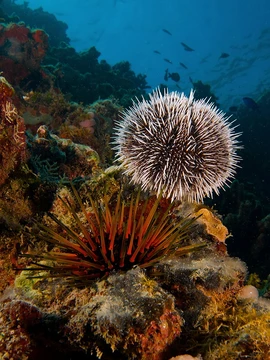
Heterocentrotus
Brightly colored sea urchins with thick, slate-pencil-like spines.

Heterocentrotus is a genus of sea urchins in the family Echinometridae, primarily found in the Indo-Pacific basin, notably around Reunion and Hawaii. They are notable for their bright coloration and very thick spines, which have earned them the nickname 'slate pencil urchins.'
Quick Facts
- Taxon
- Heterocentrotus
Facts from the source article.
Lore & Background
Heterocentrotus appeared in the Miocene and spread throughout the warm Indo-Pacific. The genus consists of sea urchins with a rounded but slightly elliptical test, with the peristome centered on the oral surface and the periproct at the apex of the aboral face. The apical disc is dicyclic with a reduced periproct, and the peristome is also reduced and elliptical with limited mouth notches. The ambulacra are polygeminate, with 9 to 14 pairs of pores per plate arranged in arcs, and each ambulacral plate bears a single large primary tubercle. Interambulacral plates have a single massive nipple flanked by secondary tubercles on the aboral surface. The radioles are very thick and dense, usually three-faceted, and are never modified into scales or plates.
Reader's Guide
The genus Heterocentrotus contains two visually similar species, H. trigonarius and H. mamillatus, which often share the same distribution area and are difficult to distinguish in the field. The main identification criteria involve the radioles: H. trigonarius generally has longer, more clearly triangular radioles, especially on the aboral side, and never has bifacial radioles on its underside. It is also usually darker in color, though color variability makes this criterion delicate. H. mamillatus often has white secondary radioles or a white ring at the base of the primary radioles, features not seen in H. trigonarius, which is almost always entirely monochromatic. Skeletal differences include H. mamillatus having fewer petalloid aboral ambulacral zones and fewer pore pairs per ambulacral plate (9–12 versus 15–16). These distinctions are important for researchers studying the genus, as the two species are otherwise very close visually.
More in Sea Urchins 1-24
Spotted an error? Know more?
Reader corrections go straight into our review queue. Suggest an edit · How this site is sourced