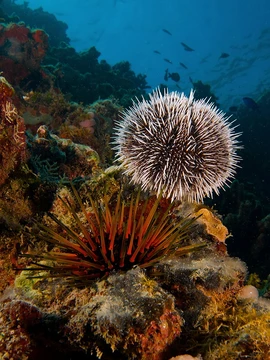
Hemicentrotus
Monotypic sea urchin genus with a long harvest history.

Hemicentrotus is a monotypic genus of sea urchin, containing only the species Hemicentrotus pulcherrimus. It is notable for being the sole member of its genus and for its long history of commercial harvest in Japan since the 1600s.
Quick Facts
- Genus
- Hemicentrotus
- Species
- pulcherrimus
Facts from the source article.
Lore & Background
Hemicentrotus pulcherrimus was first described in 1864 by the American engineer and marine zoologist Alexander Agassiz, who originally placed it in the genus Psammechinus. It is the only species in the genus Hemicentrotus. The sea urchin has a thick test and numerous tiny, fine, sharp spines. Its tubercles are small and closely packed, arranged in slightly zig-zag horizontal rows, with four to eight tubercles on each inter-ambulacral plate and three on each ambulacral plate. The pores are arranged in diagonal lines of four, separated by small tubercles. Its color is pale greenish-olive above and brownish-green below.
The species is herbivorous, grazing on marine algae. It primarily feeds on the red leafy alga Acrosorium polyneurum between December and March, migrating to areas of crustose coralline algae at other times when the red alga is scarce. Like other sea urchins, it releases eggs and sperm into the water column, and the echinopluteus larvae drift in the plankton for several months. Settlement is stimulated by diatoms and by particles of the alga Hizikia fusiformis.
In Japan, Hemicentrotus pulcherrimus has been harvested commercially as a seafood since the 1600s. It is eaten after being preserved with alcohol or brine, as it has a bitter taste when raw.
Reader's Guide
Hemicentrotus pulcherrimus holds significance as the sole species in its genus, Hemicentrotus, and for its long-standing role in Japanese seafood culture. First described by Alexander Agassiz in 1864, it is harvested commercially from Kyūshū to Fukui in the Sea of Japan, a practice dating back to the 1600s. The species is notable for its specific feeding ecology, shifting between the red alga Acrosorium polyneurum in winter and crustose coralline algae at other times. Its larvae require specific cues, such as diatoms and particles of Hizikia fusiformis, to settle. The sea urchin's range extends along the coasts of Korea, Taiwan, China, and Japan, and it is found primarily on boulders in shallow waters less than 2 meters deep, though it can occur down to about 45 meters. Its bitter taste when raw necessitates preservation with alcohol or brine before consumption. The species is also characterized by its thick test, fine sharp spines, and distinctive color pattern of pale greenish-olive above and brownish-green below.
Did You Know?
- Hemicentrotus pulcherrimus is the only species in the monotypic genus Hemicentrotus.
- It was first described in 1864 by Alexander Agassiz as Psammechinus pulcherrimus.
- It has been commercially harvested in Japan since the 1600s.
- The species has a bitter taste when raw and is eaten after preservation with alcohol or brine.
More in Sea Urchins 1-24
Spotted an error? Know more?
Reader corrections go straight into our review queue. Suggest an edit · How this site is sourced