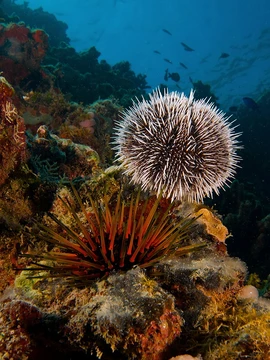
Echinus (echinoderm)
A genus of sea urchins first described by Linnaeus in 1758.

Echinus is a genus of sea urchins, a group of echinoderms that are usually round or flattened and covered in movable spines. These animals are key players in their environments, grazing on other organisms and helping to keep populations in balance. They also have economic value, as both the urchins and their roe are harvested and sold for food—this applies to Echinus species as well.
The genus was first named in 1758 by Linnaeus in his work *Systema Naturae*. He described it as having a rough-surfaced, submerged body with movable spines covering the surface.
Echinus sea urchins can significantly shape their habitats. For example, *Echinus esculentus* grazes on organisms that grow on submerged surfaces. This grazing may have been crucial for kelp communities, as it helps regulate the lower boundary of brown algae beds, potentially boosting species diversity.
**Feeding** Echinus sea urchins suspension feed using a ciliary band that runs across the body of the pluteus larva, removing particles from surfaces. These particles are then trapped by the pedicellaria and carried to the mouth, which is called Aristotle's lantern. Many Echinus species are omnivores, though some are herbivores. Like the purple sea urchin (*Strongylocentrotus purpuratus*), certain Echinus urchins are herbivorous. They can also be opportunistic feeders, meaning that while they mainly graze on algae, they may switch to an available food source, such as a dead fish.
**Nervous system** Echinus sea urchins have a nervous system typical of echinoderms: nerve rings around the pharynx connect to radial nerves that branch into the spines, pedicellaria, and other body parts. They are highly sensitive to touch, light, and chemicals, which they detect in the pharynx, spines, and pedicellaria. Studies on echinoderm neurobiology have found two types of neurons in their central nervous system, containing acetylcholine and dopamine/noradrenaline, which act as transmitters in motor and sensory neurons.
**Species** Species in this genus include:
**Age** It was once thought that Echinus sea urchins lived between 11 and 28 years (for *Echinus acutus* and *Echinus affinis*, respectively), but this is no longer accepted. Age estimates were based on growth lines in their skeletal ossicles, similar to tree rings.
Quick Facts
- Taxon
- Echinus (echinoderm)
Facts from the source article.
Lore & Background
The genus Echinus was first described in 1758 by Linnaeus in the book 'Systema Naturae Per Regna Tria Naturae, Secundum Classes, Ordines, Genera, Species, cum Characteribus, Differentiis, Synonymis, Locis'. In this book, the genus is described as having a submerged body with a rough surface, and the surface is characterized by moveable spines covering the animals. Species such as Echinus esculentus play the role of a grazer of organisms growing on the surface of substrate in marine environments that are consistently submerged, and this species could have been paramount for kelp communities by regulating the lower limit of beds of brown algae, potentially bolstering species diversity.
Echinus sea urchins suspension feed by using a ciliary band that extends across the body of the pluteus, removing particles from any surface. Those particles become confined by the pedicellaria and carried to the mouth, also known as Aristotle's lantern. Many Echinus sea urchins are omnivores, though there are many herbivorous urchins as well. Sea urchins could also be seen as opportunistic feeders, meaning that creatures that mainly graze on algae could change their normal feeding course to an opportunity nearby, like a dead fish.
Echinus sea urchins have a nervous system consisting of nerve rings that surround the pharynx and connect to radial nerves, which branch into the spines, pedicellaria, and other parts of the body. They are very sensitive to touch, light, and the presence of chemicals, which they can detect around their pharynx, spines, and pedicellaria. Two types of neurons have been found in the central nervous system of these species, containing acetylcholine and dopamine/noradrenaline, which are transmitters in motor and sensory neurons.
Reader's Guide
Echinus sea urchins are notable for their ecological and economic significance. As grazers, species like Echinus esculentus regulate the lower limit of kelp beds, potentially bolstering species diversity in marine environments. The genus also contributes to global economies, as both the urchins and their roe are sold for consumption. The genus was first described by Linnaeus in 1758, marking an early formal recognition of these echinoderms. Their feeding behavior includes suspension feeding and opportunistic omnivory, allowing them to adapt to available resources. The nervous system of Echinus sea urchins is sensitive to touch, light, and chemicals, with specific neurotransmitters identified. Age determination using sclerochronology has been found unreliable due to stress effects and inconsistency among size-classes and ossicle types. Development in deep-sea species like Echinus affinis is depth-dependent, with embryos unable to develop in shallow waters at pressures lower than 100 atm, and ideal development at 2,000 meters. Several fossil species are known, indicating a long evolutionary history.
Did You Know?
- Echinus was first described by Linnaeus in 1758 in his book 'Systema Naturae'.
- Echinus esculentus may regulate the lower limit of kelp beds, potentially increasing species diversity.
- Age determination using growth lines in ossicles (sclerochronology) is now considered unreliable for Echinus sea urchins.
More in Sea Urchins 1-24
Spotted an error? Know more?
Reader corrections go straight into our review queue. Suggest an edit · How this site is sourced