Echinothurioida
Deepsea sea urchins with flexible tests and hollow spines.

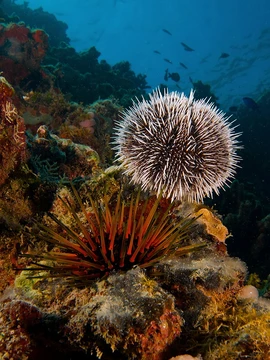
The Echinothurioida are an order of sea urchins in the class Echinoidea. They are notable for having a flexible test and hollow spines, which distinguishes them from other sea urchins. Nearly all species are deepsea dwellers, and their mouthparts are simpler than those of their close relatives, the Diadematoida.
Quick Facts
- Taxon
- Echinothurioida
Facts from the source article.
Lore & Background
Echinothurioids have regular tests with 10 columns of plates fused in groups of three, overlapping like roof tiles, which gives the test flexibility. They usually collapse to a disc shape when brought to the surface. The primary spines are hollow and used for support and locomotion; secondary spines in many species are tipped with poison glands. The mouthparts, or Aristotle's lantern, have simple plates and grooved teeth, and gills are small or absent.
For many years, echinothurioids were believed extinct, known only from fossils. Their fossils are rare because the test disintegrates after death. The earliest known echinothurioid, Pelanechinus, dates to the Middle to Late Jurassic and had a more fused test, bridging the gap to diadematoids. The earliest crown group example, Echinothuria, came from the Upper Cretaceous of southern England. Living members were found after the Challenger expedition began exploring the deep sea.
Nearly all echinothurioids are found on the seabed at abyssal depths, except Asthenosoma ijimai, which is found in shallow water. Little is known of their feeding habits, but stomach contents suggest they eat detritus, mostly algal fragments. Reproduction is also understudied; some species, like Phormosoma placenta, produce large-yolked eggs that rise then sink. The bilaterally symmetrical larva, an echinopluteus, is planktonic and may not feed, relying on yolk before metamorphosis.
Reader's Guide
The Echinothurioida hold significance as a deepsea order of sea urchins that were long thought extinct until deep-sea exploration revealed living members. Their flexible test and hollow spines are key distinguishing features, and their simple mouthparts contrast with those of the Diadematoida. The order's fossil record is sparse due to the fragile test, but Pelanechinus from the Middle to Late Jurassic provides an evolutionary link to diadematoids, while Echinothuria from the Upper Cretaceous represents the earliest crown group. The Challenger expedition of 1872–1876 was pivotal in discovering extant species. Their biology remains poorly understood because of the difficulty of studying them at abyssal depths; known feeding is on detritus, and reproduction involves large-yolked eggs and a non-feeding planktonic larva. The presence of poison-tipped secondary spines in many species necessitates careful handling. The taxonomy includes several families and genera, with extinct taxa marked accordingly.
Did You Know?
- Echinothurioids have a flexible test because their plates overlap like roof tiles.
- Living echinothurioids were discovered after the Challenger expedition of 1872–1876.
- Some species, like Asthenosoma ijimai, are exceptions to the deepsea habitat and are found in shallow water.
More in Sea Urchins 1-24
Spotted an error? Know more?
Reader corrections go straight into our review queue. Suggest an edit · How this site is sourced