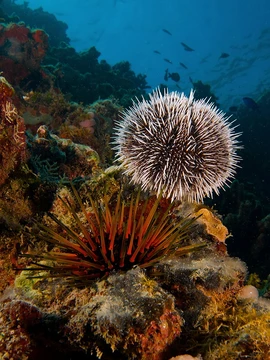
Diadema (echinoderm)
A widespread, ecologically important genus of tropical sea urchins.

Diadema is a genus of sea urchins belonging to the family Diadematidae. These are among the most common, widely distributed, and ecologically significant shallow-water tropical sea urchins. They occur across all tropical oceans, with a particularly strong presence in the Indo-Pacific region.
The genus inhabits depths down to 70 meters, though individual species tend to occupy largely separate oceanic areas. Identifying distinct species within Diadema can be challenging, partly because hybridization occurs—at least between *Diadema savignyi* and *Diadema setosum*. Different species also prefer different seafloor types; for example, *D. savignyi* is found on sandy beds and damaged back reefs, while *D. setosum* is often seen among seagrass.
The fossil record for Diadema is very sparse, consisting only of spines that may belong to the genus. These spines date back to the Miocene epoch, roughly 5 to 25 million years ago.
According to the World Register of Marine Species, the genus includes two fossil taxa: *Diadema principeana* (from the Eocene of Cuba) and *Diadema vetus* (which first appeared in the Miocene of North Africa).
Quick Facts
- Taxon
- Diadema (echinoderm)
Facts from the source article.
Lore & Background
The genus Diadema is notable for its abundance and ecological importance in shallow tropical waters. It occurs in all tropical oceans, with particular prevalence in the Indo-Pacific, where it inhabits depths down to 70 m. Each species occupies roughly separate ocean areas. Speciation within the genus can be difficult to confirm, partly due to hybridization, which is at least known to occur between Diadema savignyi and Diadema setosum. The species vary in the types of sea bed they inhabit: Diadema savignyi is found on sandy beds and back reef where damaged, while Diadema setosum can also commonly be found among seagrass. The fossil record of Diadema is extremely poor, consisting only of spines that possibly belong to the genus, some of which go back to the Miocene, 5 to 25 million years ago. Two fossil taxa are recognized: Diadema principeana from the Eocene of Cuba, and Diadema vetus, which first appeared in the Miocene in North Africa.
Reader's Guide
Diadema is one of the most abundant, widespread, and ecologically important shallow water genera of tropical sea urchins. Its presence across all tropical oceans, especially in the Indo-Pacific, underscores its role in reef ecosystems. The genus is known for difficulties in confirming speciation, partly due to hybridization between Diadema savignyi and Diadema setosum. The species show habitat differentiation, with Diadema savignyi favoring sandy beds and damaged back reef areas, while Diadema setosum also occurs among seagrass. The fossil record is extremely poor, limited to spines possibly belonging to the genus from the Miocene onward. Two fossil species are listed: Diadema principeana from the Eocene of Cuba, and Diadema vetus from the Miocene of North Africa. The genus continues to be studied for its population structure and speciation patterns, as documented in works such as those by Muthiga and McClanahan, and Lessios, Kessing, and Pearse.
Frequently Asked Questions
What is Diadema?
Diadema is a genus of tropical sea urchins classified under the family Diadematidae. It represents one of the most widespread and ecologically important groups of shallow-water urchins found in tropical oceans worldwide.
Can Diadema species hybridize with each other?
Yes—hybridization has been documented at least between Diadema savignyi and Diadema setosum. This genetic mixing between species makes it harder to cleanly distinguish one Diadema species from another in the field.
How old is the Diadema genus in the fossil record?
Diadema fossils date back to the Miocene, roughly 5 to 25 million years ago. Even older relatives such as Diadema principeana from Eocene Cuba and Diadema vetus from Miocene North Africa push the lineage further into the geological past.
Why is Diadema considered important in marine ecology?
As one of the most common and broadly distributed tropical sea urchin genera, Diadema plays a significant role in shallow-water reef and coastal ecosystems. Their wide range and ecological influence make them a key component of tropical marine communities.
More in Sea Urchins 1-24
Spotted an error? Know more?
Reader corrections go straight into our review queue. Suggest an edit · How this site is sourced