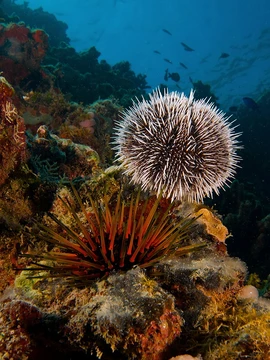
Dendraster excentricus
A burrowing sand dollar with an off-center flower pattern.

The eccentric sand dollar, also known as the Pacific or western sand dollar, sea-cake, or biscuit-urchin, is a flattened, burrowing sea urchin from the family Dendrasteridae. Its range spans the northeastern Pacific Ocean from Alaska down to Baja California, which is larger than the ranges of its two living relatives, *D. vizcainoensis* and *D. terminalis*. Its common and scientific names come from the flower-like pattern on its upper side, which is off-center.
These animals are colored gray, brown, black, or shades of purple. They average about 76 mm wide, with the largest recorded specimen reaching 120 mm. Their dome-shaped body, or test, is circular and up to 10 mm tall. Like all echinoderms, they have five-fold radial symmetry. The underside (oral surface) holds the mouth, anus, and food grooves, while the upper (aboral) surface features a petal-shaped structure called a petalidium with tube feet. Dead individuals wash up as gray or white skeletons. A water-vascular system connects the internal cavity to tube feet, which are arranged in five paired rows along the ambulacra on the underside. These tube feet are used for moving, feeding, and breathing. Adults have club-shaped spines, while juveniles have less club-like ones. Five ambulacral rows alternate with five interambulacral areas, where calcareous plates form the test. On the aboral side, a perforated madreporite sits at the center, and four tiny genital pores lie on the interambulacra. The five flower petals radiate from these pores, marking the ambulacral radii. The mouth is centered on the bottom, with the anus near the edge.
They live subtidally in bays or open coastal areas, as well as in the low intertidal zone on sandy shores of the Northeast Pacific. Their depth range is 40 to 90 meters, though they are usually found in shallower water. Sand dollars often crowd together, half-buried in the sand, with up to 625 individuals per square yard (0.85 square meters).
As suspension feeders, they eat crustacean larvae, small copepods, diatoms, plankton, and detritus. Adults move mainly by waving their spines; juveniles use their tube feet. The tube feet on the petalidium are larger and used for breathing, while those elsewhere are smaller and used for feeding and movement. They often shift position if lying flat.
Quick Facts
- Genus
- Dendraster
- Species
- excentricus
Facts from the source article.
Lore & Background
Dendraster excentricus is an irregular echinoid that burrows into sand, unlike regular sea urchins. Its test (skeleton) is flattened and circular, colored gray, brown, black, or shades of purple. The flower pattern on its aboral surface is off-center, giving it the species name excentricus. It has five-fold radial symmetry, with tube feet arranged in five paired rows on the ambulacra, used for locomotion, feeding, and respiration. The mouth, anus, and food grooves are on the lower surface, while the aboral surface has a petalidium with tube feet. Dead individuals leave a gray/white test often found on beaches.
This species is found subtidally in bays or open coastal areas, or in the low intertidal zone on sandy bottoms of the Northeast Pacific coast. They usually live crowded together, half buried in sand, at depths of 40 to 90 meters but typically in shallower areas. As many as 625 sand dollars can inhabit one square yard. They are suspension feeders, consuming crustacean larvae, small copepods, diatoms, plankton, and detritus. Adults move by waving their spines; juveniles use tube feet. When feeding, they often lie at an angle with the anterior end buried, catching prey with pedicellariae, tube feet, and spines.
A notable behavior is their hydrofoil design: when exposed to steady water flow, they gather in aligned rows, digging their front edge in and raising the back edge so water passes from right to left. This draws food particles closer to their mouths, a benefit enhanced by communal feeding groups. Reproduction is sexual, with external fertilization; females discharge eggs through gonopores, and males protrude a genital papilla. Larvae develop through prism and echinopluteus stages, eventually receiving a chemical cue from adults to settle and metamorphose into benthic adults.
Reader's Guide
Dendraster excentricus is significant as a common and ecologically important burrowing echinoderm along the Pacific coast from Alaska to Baja California. Its off-center flower pattern distinguishes it from other sand dollars, and its hydrofoil-shaped body enables a unique communal feeding behavior where individuals align in rows to optimize food capture. This species plays a role in sandy seafloor ecosystems as a suspension feeder, consuming plankton and detritus, and serves as prey for predators such as the seastar Pisaster brevispinus, the starry flounder Platichthys stellatus, crabs, and sea gulls. Its habitat is sometimes damaged by bottom trawling, and populations are harmed by ocean acidification and sea surface warming. The species can live up to 13 years, with age determined by counting growth rings on test plates or pores in the petalidium. Mass mortality can occur from storms, high temperatures, or desiccation during low tide. Its larvae are pelagic and disperse with currents before settling in response to chemical cues from adults, contributing to the formation of dense beds. The species reaches sexual maturity between 1 and 4 years and spawns in late spring and early summer, with external fertilization facilitated by living in large groups that release gametes simultaneously.
Did You Know?
- The flower pattern on its test is off-center, giving it the species name excentricus.
- As many as 625 sand dollars can live in one square yard (0.85 sq m).
- When feeding, they align in rows and raise their back edge to create a hydrofoil effect that draws food closer.
- They can be aged by counting growth rings on the plates of the test or by counting pores in a petal of the petalidium.
More in Sea Urchins 1-24
Spotted an error? Know more?
Reader corrections go straight into our review queue. Suggest an edit · How this site is sourced