Cassiduloida
A once-diverse order of sea urchins, now reduced to seven species.

Cassiduloida is an order of sea urchins. During the Mesozoic, this group was highly diverse, containing many families and species, but only seven species are still alive today. A 2019 study by Souto and colleagues, which used phylogenetic systematics, proposed a new classification for the cassiduloids and suggested that the order likely first appeared in the Early Cretaceous.
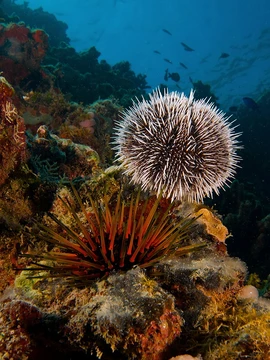
Cassiduloids have a rounded or slightly oval shape, resembling heart urchins in appearance, though they are more closely related to sand dollars. They can be told apart from other sea urchins by the presence of smaller areas between the main ambulacral areas on the oral surface. Adults lack a lantern, and their petaloids are either poorly developed or missing.
The order includes the following families and genera:
Family Cassidulidae L.
- Extant species
- 7
- Origin hypothesis
- Early Cretaceous
- Classification revision year
- 2019
- Classification revision authors
- Souto et al.
- Families listed
- Cassidulidae, Eurhodiidae, Faujasiidae, Neolampadidae, Pliolampadidae, Galeropygidae
Lore & Background
Cassiduloids have a rounded or slightly oval appearance, and look somewhat similar to heart urchins, although they are actually more closely related to the sand dollars. They are distinguished from other sea urchins by the presence of smaller intervening areas between the main ambulacral areas on the oral surface. They have no lantern as adults, and the petaloids are poorly developed or absent.
The order was extremely diverse during the Mesozoic, with many families and species. Today, only seven extant species remain. A 2019 phylogenetic systematics study by Souto et al. presented a revised classification of the cassiduloids, and hypothesised that the order probably originated in the Early Cretaceous.
The families listed in the source include Cassidulidae, Eurhodiidae, Faujasiidae, Neolampadidae, Pliolampadidae (extinct), and Galeropygidae (extinct). Genera within Cassidulidae include Cassidulus, Paralampas, and Rhyncholampas. Eurhodiidae includes Australanthus, Eurhodia, Glossaster, and Kassandrina. The extinct family Galeropygidae includes Galeropygus and Eogaleropygus.
Reader's Guide
The significance of Cassiduloida lies in its dramatic decline from a highly diverse Mesozoic group to a relict of only seven extant species. This pattern makes it a notable example of evolutionary contraction and extinction. The 2019 phylogenetic revision by Souto et al. provides a modern framework for understanding the relationships among its families and genera, and places its origin in the Early Cretaceous. The order's morphology—rounded or oval shape, lack of a lantern in adults, poorly developed or absent petaloids, and distinctive intervening areas on the oral surface—distinguishes it from other sea urchins and links it more closely to sand dollars than to heart urchins. The listing of both extant and extinct families (Pliolampadidae and Galeropygidae) underscores the group's past richness and current rarity. The presence of genera such as Cassidulus, Eurhodia, and the recently described Kassandrina (2018) highlights ongoing taxonomic work. The order's legacy is one of a once-flourishing lineage now reduced to a handful of living species, preserved in the fossil record and studied through modern systematics.
Did You Know?
- Only seven extant species of Cassiduloida remain today.
- The order probably originated in the Early Cretaceous, according to a 2019 study.
- Cassiduloids have no lantern as adults, and their petaloids are poorly developed or absent.
- The family Galeropygidae and Pliolampadidae are known only from fossils.
More in Sea Urchins 1-24
Spotted an error? Know more?
Reader corrections go straight into our review queue. Suggest an edit · How this site is sourced