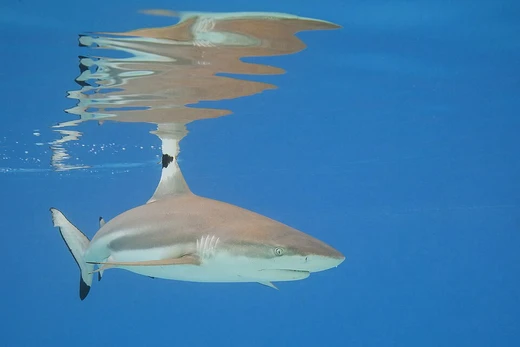
Spot-tail shark
A near-threatened requiem shark with black-tipped fins.

The spot-tail shark, also known as the sorrah shark (Carcharhinus sorrah), is a species of requiem shark in the family Carcharhinidae. It is found in the tropical Indo-West Pacific Ocean between latitudes 31°N and 31°S, from the surface to a depth around 72 m (236 ft). This shark is notable for its distinctive black fin tips and is fished commercially over much of its range, leading the IUCN to consider it near threatened.
Quick Facts
- Genus
- Carcharhinus
- Species
- sorrah
Facts from the source article.
Lore & Background
The species name sorrah originates from சுறா ('sura'), the Tamil word for 'shark'. The spot-tail shark is a spindle-shaped fish with a fairly long, pointed snout and moderately large eyes. Its first dorsal fin is large and curved, while the second dorsal fin is small and low. The back and sides are grey, the belly white, and a long white streak is on the flank. It can be distinguished from other requiem sharks by the distinctive black tips to the second dorsal fin, the pectoral fins, and the lower lobe of the caudal fin. A ridge over the spine extends from the first to the second dorsal fin, and a pit is present just in front of the upper lobe of the caudal fin. The upper teeth are serrated, oblique, and triangular. The Australian blacktip shark (C. tilstoni), which occupies a similar range, has similar black fin tips but additionally has a black tip to its first dorsal fin, lacks the ridge between the two dorsal fins, and has different upper teeth that are slender, upright, and pointed.
Reader's Guide
The spot-tail shark is found in the tropical Indo-Pacific on continental and insular shelves, commonly to a depth around 73 m (240 ft) but possibly as deep as 140 m (460 ft). Its range extends from the East African coast, Madagascar, and the Red Sea to India, Malaysia, China, the Philippines, and northern Australia. It spends the day near the seabed and the night at the surface, most frequently around reefs. It is a predator feeding on bony fish such as bonito and sea bass, cephalopods, and crustaceans. The species is viviparous with a yolk-sac placenta, giving birth once a year to a litter of one to eight live young after a gestation period of 10 months. The pups measure about 50 cm (20 in) at birth and develop in shallow inshore waters. They grow rapidly at first, increasing in length by about 20 cm (8 in) during their first year, but growth slows thereafter. Females reach sexual maturity at two to three years and live for a maximum of seven years, while males live up to five years. The shark is caught by line and gillnet in many parts of its range by small-scale commercial fisheries. Its flesh is used for food, the liver for vitamins, the fins for shark fin soup, and the offal for fish meal. The IUCN has listed this shark as near threatened due to overfishing throughout much of its range, with many populations in decline, though fisheries in northern Australia are relatively well managed.
Did You Know?
- The species name sorrah comes from the Tamil word 'sura', meaning 'shark'.
- The spot-tail shark can be distinguished by black tips on the second dorsal fin, pectoral fins, and lower lobe of the caudal fin.
- Pups grow about 20 cm (8 in) in their first year.
Discovery & Taxonomic Journey
In 1817, French naturalists Jean René Constant Quoy and Joseph Paul Gaimard set sail aboard the corvette Uranie on an exploratory voyage that would last until 1820. During that journey, they encountered a juvenile male shark measuring 59 centimeters, caught off the island of Waigeo just west of New Guinea. This specimen would become the type for a newly described species, which they named Carcharias melanopterus, drawing on the Greek words for "black" and "fin" to capture the animal's striking dark-tipped appendages. Their account was not published until 1824, embedded within Louis de Freycinet's sweeping thirteen-volume report on the expedition. Over the following decades, taxonomists reassigned the species to the genus Carcharhinus, and in 1965 the International Commission on Zoological Nomenclature elevated it to the status of type species for that entire genus. The shark has accumulated a colorful array of common names over the years, including blackfin reef shark, guliman, and reef blacktip shark, while older literature occasionally confused it with the spottail shark under the mistaken name C. spallanzani.
A Vast Indo-Pacific Domain
The blacktip reef shark commands one of the broadest nearshore ranges of any requiem shark, stretching across tropical and subtropical waters of both the Indian and Pacific Oceans. In the Indian Ocean, its footprint extends from South Africa to the Red Sea, encompassing Madagascar, Mauritius, the Seychelles, the Indian subcontinent, Sri Lanka, the Andaman Islands, and the Maldives. Across the Pacific, it ranges from southern China and the Philippines through Indonesia, northern Australia, and New Caledonia, and it has established itself on scattered island chains including the Marshall, Gilbert, Society, and Hawaiian archipelagos. Perhaps most remarkably, this species has also colonized the eastern Mediterranean as a Lessepsian migrant, slipping through the Suez Canal. Although recorded at 75 meters, the shark overwhelmingly favors water just a few meters deep, where its dorsal fin regularly breaks the surface. Young sharks gravitate toward sandy flats, while adults patrol reef ledges and drop-offs. The species has even been documented in brackish estuaries and freshwater lakes in Madagascar and Malaysia, though it lacks the salt-tolerance of the bull shark.
Life in the Shallows
The blacktip reef shark is a creature of remarkable locality. Rather than roaming vast oceanic distances, individuals maintain extremely small home ranges and demonstrate strong site fidelity, often remaining within the same patch of reef for several consecutive years. This sedentary lifestyle suits an active predator that hunts small bony fish, cephalopods, crustaceans, and occasionally sea snakes or seabirds in the shallow waters it calls home. Reproduction follows a viviparous pattern, with females producing litters of two to five pups on cycles that may be biennial, annual, or even biannual depending on the population. Gestation estimates vary widely across the literature, ranging from seven to sixteen months, a discrepancy that likely reflects genuine geographic differences within the species. Mating behavior is subtle: the male shadows the female at close range, presumably tracking her chemical cues. Newborns appear in shallower, more inshore waters than their parents, frequently gathering in large groups over areas that flood only at high tide. At Aldabra, for instance, these sharks congregate in inter-reef channels at low tide and migrate to mangrove fringes as the water rises.
A Vulnerable Resident
Despite its widespread distribution and relative commonality across the Indo-Pacific, the blacktip reef shark faces mounting pressure from human activity. The IUCN has classified the species as Vulnerable, a designation driven primarily by overfishing of what is, by shark standards, a slow reproducer. Its meat, fins, and liver oil are all harvested, though the species is not considered commercially significant on a global scale. The combination of small litters, lengthy gestation, and infrequent breeding cycles means that local populations can be depleted before they recover, and declines have been documented at numerous sites. In terms of human encounters, the blacktip reef shark is generally timid and skittish, making it difficult to approach and rarely a threat unless provoked by the presence of food. The principal risk to people occurs in very shallow water, where a wading individual's legs can be mistaken for prey and bitten. Phylogenetically, the species remains one of the most puzzling members of its genus; multiple analyses from the 1980s and 1990s have failed to resolve its exact relationships, placing it in an irreducible polytomy with up to ten other Carcharhinus species.
Frequently Asked Questions
Who is Spot-tail shark?
The spot-tail shark (Carcharhinus sorrah) is a small requiem shark in the family Carcharhinidae, instantly recognizable by the black tips on its fins. It lives in tropical waters throughout the Indo-West Pacific Ocean.
What are Spot-tail shark's powers/role?
As a mid-level coastal predator, it helps keep smaller fish and invertebrate populations in check around reefs and nearshore habitats. It typically reaches about 1.6 m (5 ft 3 in) and ranges from the surface to roughly 72 m, with some records hinting at depths near 140 m.
Why is Spot-tail shark important?
It serves as a keystone mid-trophic predator that helps structure reef and coastal food webs in the Indo-Pacific. Its striking black fin tips also make it a handy visual marker for gauging the overall health of those marine communities.
Where can I find Spot-tail shark?
Look for it in tropical Indo-West Pacific waters stretching from about 31°N to 31°S latitude. It favors shallower coastal and reef zones but is regularly encountered at deeper offshore sites as well.
More in Reef Sharks and Rays, Part 2 1-24
Spotted an error? Know more?
Reader corrections go straight into our review queue. Suggest an edit · How this site is sourced