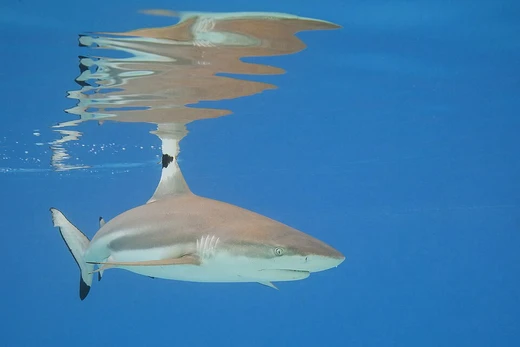
Smoothtooth blacktip shark
A rare requiem shark with smooth-edged teeth and black-tipped fins.

The smoothtooth blacktip shark (Carcharhinus leiodon) is a requiem shark found only in a few locations: the Gulf of Aden near eastern Yemen and the Persian Gulf off Kuwait. It grows to about 1.3 meters (4.3 feet) long, with a stocky, greenish body, a short snout, and black tips on its fins. Its most distinctive feature is its teeth—narrow, upright, and smooth-edged—which set it apart from similar sharks. Very little is known about its life. It probably lives in shallow water and eats small bony fish. Like other requiem sharks, it is thought to give birth to live young. The International Union for Conservation of Nature has classified it as endangered.
Quick Facts
- Genus
- Carcharhinus
- Species
- leiodon
Facts from the source article.
Lore & Background
The first known specimen of the smoothtooth blacktip shark was a 75-cm-long, immature male caught by Wilhelm Hein in 1902 and deposited at the Naturhistorisches Museum in Vienna. The location was recorded as the Gulf of Aden near 'Gischin', which likely refers to the town of Qishn in eastern Yemen. In 1985, the shark was examined and described as a new species by New Zealand ichthyologist Jack Garrick in a National Oceanic and Atmospheric Administration technical report. He gave it the specific epithet leiodon, from the Greek leios meaning 'smooth', and odon meaning 'tooth'. This species was known only by the single specimen until 2008, when fishery surveys in Kuwait uncovered several more specimens. Based on morphology, Leonard Compagno in 1988 tentatively grouped the smoothtooth blacktip shark with the spinner shark, the blacktip shark, the graceful shark, and the finetooth shark. Using molecular phylogenetic techniques on mitochondrial DNA sequences, Alec Moore and colleagues reported in 2011 that this species is closely related to the graceful shark, the blacktip shark, and the Australian blacktip shark.
Reader's Guide
The smoothtooth blacktip shark is notable for its rarity and the wide gap between its two known locations—eastern Yemen and Kuwait, some 3,000 km apart. These two locations differ markedly: the Gulf of Aden near Yemen is over 2.5 km deep with a narrow continental shelf and no permanent riverine inputs, while the Persian Gulf near Kuwait is entirely shallower than 40 m and receives abundant fresh water from the Tigris-Euphrates-Karun river system. The Kuwait specimens were obtained from fish markets; given the practices of Kuwaiti speedboat fishers, this shark can be supposed to inhabit shallow, coastal waters. Still, these waters encompass a range of habitats from estuaries to coral reefs, thus the habitat requirements of the smoothtooth blacktip shark remain largely unknown. Prior to the finding of additional specimens in Kuwait, the International Union for Conservation of Nature assessed the smoothtooth blacktip shark as Endangered based on its presumed small range and population. Despite the discovery of a second subpopulation off Kuwait, this species likely still warrants an Endangered assessment because the waters around the Arabian Peninsula are subject to heavy fishing pressure and habitat degradation. Gillnet and other fisheries off Kuwait are known to take the smoothtooth blacktip shark as bycatch, while intensive Yemeni and Somalian shark fisheries operate in the Gulf of Aden. The status of the Yemen subpopulation is uncertain because no further specimens have been recorded since the original over a century ago.
Did You Know?
- The smoothtooth blacktip shark was known from only a single specimen for over a century, from 1902 until 2008.
- Its teeth are narrow, erect, and smooth-edged, which distinguishes it from similar species.
- The largest recorded specimen is 1.2 m (3.9 ft) long.
- The species is named from Greek leios meaning 'smooth' and odon meaning 'tooth'.
A Name Born from a Naval Voyage
The blacktip reef shark first entered scientific record through the work of French naturalists Jean René Constant Quoy and Joseph Paul Gaimard, who observed the species during the 1817–1820 expedition aboard the corvette Uranie. Their formal description appeared in 1824 within Louis de Freycinet's thirteen-volume account of that circumnavigation. The original type specimen was a juvenile male measuring just 59 centimeters, collected off the island of Waigeo, situated west of New Guinea. Quoy and Gaimard derived the species epithet from two Greek roots—melas, meaning black, and pteron, meaning fin or wing—directly referencing the striking dark markings on this shark's fins. Over time, taxonomists reclassified the animal into the genus Carcharhinus, and in 1965 the International Commission on Zoological Nomenclature elevated it to the status of type species for that entire genus. Earlier literature occasionally confused it with C. spallanzani, a name now understood to belong to the spottail shark. Beyond its formal binomial, the species is known by a colorful array of common names, including blackfin reef shark, black-finned shark, reef blacktip shark, and the local term guliman.
A Wide but Shallow World
The blacktip reef shark ranges across nearshore waters of the tropical and subtropical Indo-Pacific, a distribution stretching from South Africa and the Red Sea through Madagascar, Mauritius, the Seychelles, and the Indian subcontinent to Sri Lanka, the Andaman Islands, and the Maldives. In the Pacific, its range encompasses southern China, the Philippines, Indonesia, northern Australia, New Caledonia, and scattered island groups including the Marshall, Gilbert, Society, and Hawaiian archipelagos. A handful of sightings have been recorded from Ishigaki Island in southern Japan, though some researchers suspect those specimens may actually come from Taiwan. Most remarkably, this species has become a Lessepsian migrant, colonizing the eastern Mediterranean Sea through the Suez Canal. Despite its broad geographic spread, the shark overwhelmingly favors water only a few meters deep, where its dorsal fin is a familiar silhouette above the surface. Younger individuals gravitate toward sandy flats, while older sharks patrol reef ledges and drop-offs. In brackish estuaries of Madagascar and freshwater habitats in Malaysia, the species has been recorded, though it cannot endure low salinity as readily as the bull shark. At Aldabra, sharks gather in channels between reef flats at low tide and then move into mangroves as the tide rises.
Reproduction and Early Life
The blacktip reef shark reproduces viviparously, meaning females carry developing young internally until live birth. Litter sizes are modest, typically two to five pups, and the reproductive cycle may be biennial, annual, or even biannual depending on the population. Gestation periods reported in the literature are notably inconsistent, ranging from seven to nine months, through ten to eleven, up to a possible sixteen months—discrepancies that likely reflect genuine geographic variation within the species. Mating behavior is characterized by the male trailing closely behind the female, presumably guided by her chemical cues. Newborn sharks occupy a distinctly different niche from adults: they are found further inshore and in shallower water, often roaming in large groups over areas that are only flooded at high tide. Adults, by contrast, maintain extremely small home ranges and display strong site fidelity, remaining within the same local area for up to several years. Females consistently exceed males in size, and the species typically reaches a maximum length of about 1.6 meters. As an active predator, the blacktip reef shark preys on small bony fish, cephalopods, and crustaceans, with occasional reports of it taking sea snakes and seabirds.
Conservation Pressures and Human Encounters
Despite being one of the most abundant shark species inhabiting tropical coral reefs across the Indian and Pacific Oceans, the blacktip reef shark has been assessed by the International Union for Conservation of Nature as Vulnerable. The species as a whole remains widespread and relatively common, yet overfishing of this slow-reproducing shark has driven measurable declines at numerous local populations. The shark is harvested for its meat, fins, and liver oil, though it is not regarded as a commercially significant species. In terms of human interaction, the blacktip reef shark is notably timid and skittish, making it difficult to approach and rarely posing a genuine threat to people unless provoked by the presence of food. The most common risk to humans occurs when individuals wade through shallow water and the shark mistakenly bites their legs. The species' small home ranges and strong site fidelity mean that local overexploitation can quickly deplete a particular reef population, compounding the impact of its already slow reproductive rate. Geographic variation in life-history traits, including the variable gestation and reproductive cycle lengths documented across its range, further complicates conservation planning, as management strategies effective in one region may not translate to another.
Frequently Asked Questions
What is the smoothtooth blacktip shark?
It is a small requiem shark (Carcharhinus leiodon) first formally described in 1985 by Jack Garrick, recognizable by its stocky greenish body, short snout, black-tipped fins, and notably smooth-edged teeth.
Where can you find the smoothtooth blacktip shark?
Its range is extremely limited, restricted to just two areas: the Gulf of Aden off eastern Yemen and the Persian Gulf near Kuwait.
What makes the smoothtooth blacktip shark's teeth different from other requiem sharks?
While most requiem sharks have serrated tooth edges, this species carries narrow, upright teeth with completely smooth margins, a trait that distinguishes it from closely related blacktip species.
How big does a smoothtooth blacktip shark grow?
It tops out at roughly 1.3 meters (4.3 feet), though the largest individual actually documented measured 1.2 meters (3.9 feet).
What does the smoothtooth blacktip shark eat and how does it reproduce?
It most likely forages on small bony fish in shallow coastal waters, and, consistent with other requiem sharks, it is thought to bear live young rather than depositing eggs.
More in Reef Sharks and Rays, Part 2 1-24
Spotted an error? Know more?
Reader corrections go straight into our review queue. Suggest an edit · How this site is sourced