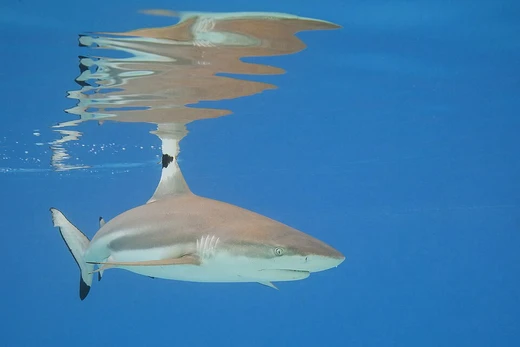
Glyphis (shark)
River sharks of the genus Glyphis, poorly known and often sympatric with bull sharks.

Glyphis is a genus of sharks in the family Carcharhinidae, better known as river sharks. These sharks inhabit rivers and coastal areas across Southeast Asia and parts of Australia. Although the bull shark is sometimes called a "river shark" or "Ganges shark," it is a different species from the true river sharks of the genus Glyphis, even though both types often share the same river systems.
Taxonomy The exact number of species in Glyphis may be higher than currently recognized, but research is difficult because these sharks are secretive. The genus was once thought to contain five species, but molecular studies showed that Glyphis gangeticus has an uneven distribution across the Indo-West Pacific, and that the Bornean and Irrawaddy River sharks fall within the variation of G. gangeticus. Some experts still treat them as separate species. The closest relatives of Glyphis are sharks in the genus Lamiopsis. The accepted living species are: Glyphis gangeticus (Ganges shark), Glyphis garricki (northern river shark), and Glyphis glyphis (speartooth shark). The only known prehistoric species is †Glyphis pagoda from the middle and late Miocene of Myanmar. Another fossil, †Glyphis hastalis, was originally described from the Early Eocene of England and is technically the type species of the genus, but its placement in Glyphis is now considered incorrect. Additionally, fossil teeth from an indeterminate Glyphis, possibly from G. glyphis or G. garricki, have been found in the Late Miocene of Brunei.
Distribution and habitat The exact geographic range of these sharks is uncertain, but known species occur in parts of South Asia, Southeast Asia, New Guinea, and Australia. Among the accepted species, the Ganges shark lives only in freshwater, while the northern river shark and speartooth shark also inhabit coastal marine waters. They have been found in nine different tidal areas with muddy, low-salinity water. Their connection to coastal marine waters suggests they are usually born around October.
Conservation River sharks remain very poorly understood by researchers. They were thought to be extinct until the end of the 20th century, when small populations were discovered in Borneo and northern Australia.
Quick Facts
- Taxon
- Glyphis
- Type Species
- Carcharias (Prionodon) glyphis
- Type Species Authority
- Müller & Henle, 1839
Facts from the source article.
Lore & Background
The number of Glyphis species may be higher than is currently accepted, though research is hampered by the secretive habits of these sharks. This genus was thought to contain five different species, but molecular studies revealed that Glyphis gangeticus has an irregular distribution in the Indo-West Pacific region, and that the Bornean and Irrawaddy River sharks fall within the variation of Glyphis gangeticus. Some authorities continue to separate these species. The genus Glyphis is closest to the Lamiopsis.
Their precise geographic range is uncertain, but the known species are documented in parts of South Asia, Southeast Asia, New Guinea, and Australia. Of the accepted species, the Ganges shark is restricted to freshwater, while the northern river shark and the speartooth shark are also found in coastal marine waters. They have been found in nine different tidal areas, which consist of muddy waters with a low salinity. Their placement in connection to coastal marine waters indicates that they are usually born around October.
River sharks remain very poorly known to researchers; they were thought to be extinct until the end of the 20th century, when small populations were discovered in Borneo and Northern Australia. Glyphis gangeticus uses the Ganges River as nursery grounds and the birthplace of many Ganges shark offspring, however the population has been severely diminished owing to a long history of fishing and other pollution-related issues in the Northern Arabian Sea.
Reader's Guide
The significance of Glyphis lies in its extreme rarity and the mystery surrounding its true diversity. The genus was once thought to contain five species, but molecular studies have collapsed some into Glyphis gangeticus, though authorities still disagree. These sharks were believed extinct until the late 20th century, when small populations were rediscovered in Borneo and Northern Australia. Their secretive habits continue to hamper research. The Ganges shark, restricted to freshwater, uses the Ganges River as nursery grounds, but its population has been severely diminished by fishing and pollution. India is reported to be one of the top three greatest shark and ray capturers in the world, accounting for up to nine percent of reported global landings. The only known prehistoric species is Glyphis pagoda from the Miocene of Myanmar, while fossil teeth of an indeterminate Glyphis, potentially modern G. glyphis or G. garricki, are known from the Late Miocene of Brunei. The type species Glyphis hastalis from the Early Eocene London Clay is now thought to be erroneously classified within Glyphis.
Did You Know?
- The bull shark is also called 'river shark' and 'Ganges shark' but is not a Glyphis species.
- River sharks were thought to be extinct until small populations were discovered in Borneo and Northern Australia at the end of the 20th century.
Freshwater Intrusion & Euryhaline Mastery
The bull shark's most remarkable trait is its ability to thrive in both salt and fresh water, a physiological capability that sets it apart from many of its closest relatives. While the sandbar shark in the same genus lacks osmoregulation entirely, Carcharhinus leucas navigates estuaries, brackish channels, and deep freshwater rivers with ease. It has been documented traveling roughly 1,100 kilometers up the Mississippi to Alton, Illinois, and an astonishing 4,000 kilometers up the Amazon to Iquitos in Peru. Populations persist in Lake Nicaragua, the Ganges and Brahmaputra rivers of eastern India, and the Tigris as far as Baghdad. In Australia, more than 500 individuals are thought to inhabit the Brisbane River, and during the 2010–11 Queensland floods, sharks were even spotted swimming through flooded streets in Goodna. Despite these freshwater records, the bull shark is not a true freshwater species in the way the river sharks of genus Glyphis are; taxonomic analysis places the two in distinct branches of Carcharhinidae, suggesting their similar freshwater physiologies evolved independently through convergent evolution.
Built for Force – Anatomy & Bite
Few requiem sharks pack as much raw mass into a comparable length as the bull shark. Females average 2.4 meters and 130 kilograms, while males sit slightly smaller at 2.25 meters and 95 kilograms. A single verified female measured exactly 4.0 meters, and a pregnant specimen of 3.25 meters tipped the scales at 450 kilograms, with the largest pregnant individuals potentially exceeding 600 kilograms. The body is notably wider and heavier than other requiem sharks of similar length, with a broad, flat snout, a grey dorsal surface fading to white below, and a second dorsal fin smaller than the first. The caudal fin is proportionally longer and lower than in larger sharks, and the species lacks an interdorsal ridge. But the figure that truly stands out is bite force: up to 5,914 newtons, which, adjusted for body weight, is the highest recorded among all cartilaginous fishes investigated. This combination of stocky frame and extraordinary jaw pressure underpins the shark's reputation for aggression and unpredictability that has shaped both its common name and human perceptions of it.
A Worldwide Warm-Water Wanderer
The bull shark's range is nearly as impressive as its freshwater tolerance. In the Atlantic, it stretches from Massachusetts down to southern Brazil and from Morocco to Angola. In the Pacific, it spans Baja California to Ecuador. It has been recorded at depths up to 150 meters, though it rarely ventures below 30 meters, and it shows a clear preference for warm ocean currents. Populations cluster in estuaries and coastal shallows, but the species also appears in surprisingly specific inland locations: the canals of the Gold Coast in Queensland, Sydney Harbour during warmer months, the Scarborough canals near Moreton Bay, and the St. Lucia Estuary in South Africa, where salt content is high. After Hurricane Katrina, numerous bull sharks were sighted in Lake Pontchartrain, and by July 2023, local fishermen on the Atchafalaya River were reporting increasing numbers. The species even appears on the image of Costa Rica's 2000 colones banknote, a small but telling nod to how deeply it is woven into the coastal cultures of the warm-water world it inhabits.
Aggression, Culling, and a Fragile Future
The bull shark's aggressive and unpredictable temperament has made it a persistent target of human conflict. Its stocky build, broad snout, and reputation for sudden attacks have driven ongoing culling programs near beaches in multiple countries, aimed at protecting swimmers and surfers. Larger individuals are responsible for a significant share of nearshore shark attacks, and because many incidents involve unidentified species, the bull shark may be behind even more unattributed attacks than the official records suggest. These culling efforts are cited as one of the causes of the species' continued population decline. The IUCN Red List currently classifies Carcharhinus leucas as vulnerable, a designation that reflects both direct human pressure and the loss of estuarine and riverine habitats. In India, the species is sometimes confused with the Sundarbans or Ganges shark, and across Africa it goes by the informal name zambi, while in Nicaragua it is simply the Lake Nicaragua shark. These many local names underscore just how widespread and widely misunderstood the bull shark truly is.
Frequently Asked Questions
Who is Glyphis (shark)?
Glyphis is a genus of sharks in the family Carcharhinidae, widely known as river sharks. They live in freshwater rivers and coastal waters across Southeast Asia and parts of Australia, and currently include three recognized species: Glyphis gangeticus, Glyphis garricki, and Glyphis glyphis.
What are Glyphis (shark)'s powers/role?
River sharks of the genus Glyphis are secretive, elongated predators that patrol river channels and estuaries, ambushing fish and other aquatic prey. Their low visibility and elusive behavior have made them notoriously difficult to study, so much of their ecology remains poorly documented.
Why is Glyphis (shark) important?
As apex predators in river and estuarine ecosystems, Glyphis sharks help regulate fish populations across South and Southeast Asia. They also carry deep evolutionary significance: a prehistoric relative, Glyphis pagoda, is known from middle and late Miocene deposits in Myanmar, and the genus's type species (Glyphis hastalis from the Early Eocene London Clay) is now considered a misclassification, highlighting how much is still unresolved about their lineage.
What's the difference between Glyphis (shark) and bull sharks?
Although both are colloquially called "river sharks," bull sharks (Carcharhinus leucas) and true river sharks (genus Glyphis) are entirely separate lineages that can co-occur in the same river systems. Glyphis's closest living genus is Lamiopsis, not Carcharhinus, and its body shape and riverine specialization set it apart from the more robust, saltwater-tolerant bull shark.
More in Reef Sharks and Rays, Part 2 1-24
Spotted an error? Know more?
Reader corrections go straight into our review queue. Suggest an edit · How this site is sourced