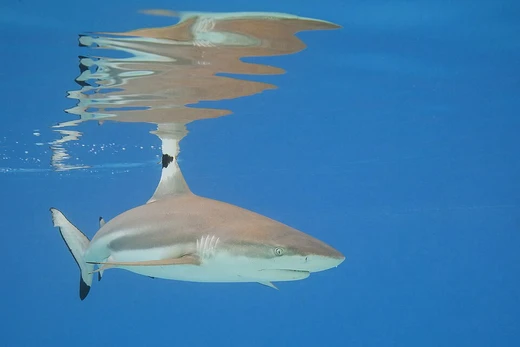
Northern river shark
A rare requiem shark of turbid tidal rivers and coastal waters.

The northern river shark, also known as the New Guinea river shark (Glyphis garricki), belongs to the requiem shark family Carcharhinidae. It lives in scattered tidal rivers and nearby coastal waters across northern Australia and Papua New Guinea. This shark prefers areas with murky water, soft muddy or silty bottoms, and strong tides. Young sharks can be found in fresh, brackish, or salt water, while adults have only been seen in marine environments. It has a stocky grey body, a high back, tiny eyes, and broad fins, reaching up to 2.5 meters (8.2 feet) long.
The species likely eats fish. Females give birth to live young, with litters of about nine pups, possibly every other year, just before the wet season. The northern river shark is very rare and faces threats from commercial and recreational fishing, as well as possible habitat damage. The International Union for Conservation of Nature lists it as Vulnerable.
The first known specimens—two newborn males from Papua New Guinea—were found by New Zealand fish expert Jack Garrick, after whom the shark was later named. It was called "Glyphis sp. C" until 2008, when Leonard Compagno, William White, and Peter R. Last formally described it in a paper for the Commonwealth Scientific and Industrial Research Organisation. The type specimen is a 67-centimeter (26-inch) female from the East Alligator River in Kakadu National Park, Northern Territory.
This shark has been reported from King Sound, the Ord River, and Doctors Creek near Derby in Western Australia; the Adelaide and Alligator Rivers in Australia's Northern Territory; and the Daru area, and possibly the Fly River, in Papua New Guinea. It lives in large rivers, estuaries, and coastal bays that are highly turbid with silty or muddy bottoms and large tides. Young sharks tolerate salinity from 2 to 36 parts per thousand, but adults are only found in saltwater.
Like other river sharks, it has a stocky body with a high back. Its head is wide and flat, with a rounded snout and very small eyes that have nictitating membranes. Each nostril is split into a large inlet and a small outlet by a triangular skin flap. The mouth is large and arched, with short grooves at the corners. The upper jaw has 31 to 34 tooth rows, and the lower jaw has 30 to 35. Upper teeth are upright, triangular, and serrated; lower teeth are narrower and straight or slightly curved.
Quick Facts
- Genus
- Glyphis
- Species
- garricki
Facts from the source article.
Lore & Background
The first known specimens of the northern river shark, two newborn males from Papua New Guinea, were discovered by New Zealand ichthyologist Jack Garrick, after whom the species was eventually named. This shark was referred to as 'Glyphis sp. C' until 2008, when it was formally described by Leonard Compagno, William White, and Peter R. Last in a Commonwealth Scientific and Industrial Research Organisation paper. The type specimen is a female 67 cm long, collected from the East Alligator River, Kakadu National Park, Northern Territory.
Like other members of its genus, the northern river shark has a stocky body with a high back. The head is wide and flattened, with a broadly rounded snout and minute eyes equipped with nictitating membranes. The pectoral fins are large and broad, and the first dorsal fin is long-based and triangular. This shark is steel-gray above and white below, with a sharp, jagged color transition. It differs from the speartooth shark in having fewer vertebrae (137–151 versus 213–222) and a lower, jagged gray-white colour boundary.
With its slender teeth, small eyes, and high density of ampullae of Lorenzini, the northern river shark seems to be adapted for hunting fish in conditions of poor visibility. In Doctors Creek, sharks may move to and from favored feeding areas with the tide. Like other requiem sharks, this species is viviparous, with females giving birth around October before the wet season, possibly on a biennial cycle.
Reader's Guide
The northern river shark appears to be extremely rare, though more subpopulations may remain to be discovered in Australia and Papua New Guinea. Based on present information, no more than 250 mature individuals are estimated to exist in the wild, with no more than 50 in any particular subpopulation. This species is caught legally and illegally by commercial fisheries using longlines and gillnets, as well as by recreational fishers; habitat degradation may pose a further threat to its survival. Because of its low natural abundance, limited distribution, stringent habitat requirements, and susceptibility to various human-caused threats, the IUCN has assessed the northern river shark as Vulnerable. It has also been listed as endangered on the 1999 Commonwealth Environment Protection and Biodiversity Conservation Act, and on the 2000 Territory Parks and Wildlife Conservation Act. Kakadu National Park may be an important protected area for this species. No regulations restrict the capture of this species in Papua New Guinea. The species' significance lies in its extreme rarity and the conservation challenges it faces across its limited range in northern Australia and Papua New Guinea.
Frequently Asked Questions
Who is the Northern river shark?
The Northern river shark (Glyphis garricki), also called the New Guinea river shark, is a rare requiem shark in the family Carcharhinidae. It inhabits scattered tidal rivers and adjacent coastal waters across northern Australia and Papua New Guinea.
What are the Northern river shark's powers or role?
This stocky grey shark is built for murky, silty habitats with strong tides, relying on tiny eyes and broad fins to hunt where sight is limited. It likely preys on fish, serving as a specialized predator in turbid riverine and estuarine zones that few other sharks occupy.
Why is the Northern river shark important?
It is one of the few requiem sharks genuinely adapted to inland tidal rivers, linking freshwater and marine ecosystems in a single species. Its presence signals the health of turbid, silty-bottom river habitats in the region, and its rarity makes it a conservation priority.
What does the Northern river shark look like and how big does it get?
It has a high-backed, stocky grey body, very small eyes, and broad fins, reaching a maximum length of about 2.5 meters. Its upper jaw bears 31–34 rows of teeth, the lower jaw 30–35 rows, and its spine contains between 137 and 151 vertebrae.
More in Reef Sharks and Rays, Part 2 1-24
Spotted an error? Know more?
Reader corrections go straight into our review queue. Suggest an edit · How this site is sourced