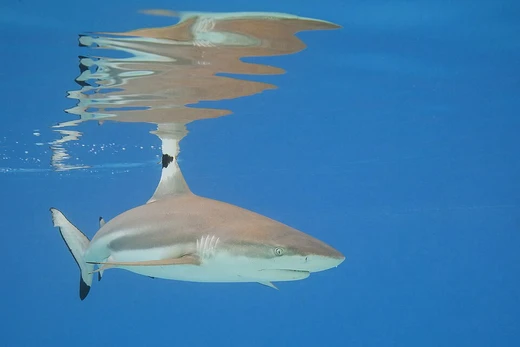
Silvertip shark
A large requiem shark with distinctive white fin margins.

The silvertip shark is a large requiem shark found in scattered locations across the tropical Indian and Pacific Oceans. It typically lives around offshore islands and coral reefs, and can dive as deep as 800 meters. While it looks like a bigger, heavier version of the grey reef shark, its fins have distinct white edges that make it easy to recognize. This species can reach up to 3 meters in length.
Its diet includes a wide range of bony fish, along with eagle rays, smaller sharks, and cephalopods. When food is scarce, it dominates other requiem sharks of the same size, and larger individuals often carry many scars from fights with their own kind. Like other requiem sharks, it gives birth to live young, with females producing one to 11 pups in the summer. Silvertip sharks are considered potentially dangerous to humans because they often swim very close to divers. Because they reproduce slowly, commercial fishing for their meat, fins, skin, cartilage, and jaws has caused local populations to drop or disappear entirely.
Quick Facts
- Genus
- Carcharhinus
- Species
- albimarginatus
Facts from the source article.
Lore & Background
The silvertip shark was originally described as Carcharias albimarginatus by German naturalist Eduard Rüppell in 1837. The specific epithet is derived from the Latin albi meaning 'white' and marginatus meaning 'to enclose with a border', in reference to the distinct white fin margins. Based on similarities in morphology, tooth shape, and vertebral characters, Garrick (1982) proposed the grey reef shark as its closest relative, a view corroborated by Lavery (1992) using allozyme data. The earliest fossil record consists of teeth from the Middle Miocene of Chile, with additional fossils from the Late Miocene and Early Pliocene of Chile and Ecuador.
The silvertip shark is a robust, streamlined species with a moderately long, broad snout and large, round eyes. It has 12–14 tooth rows on each side of both jaws, with upper teeth bearing broad, oblique triangular cusps and coarse serrations, while lower teeth have erect cusps with fine serrations. A ridge occurs between the first and second dorsal fins. Its coloration is blue-gray above with a bronze sheen, white below, and a subtle white band along the sides, with distinctive white tips and borders on all fins. Females are larger than males.
Silvertip sharks exhibit fidelity to certain areas and are usually encountered alone or in pairs. They behave very aggressively towards one another, and many individuals are heavily scarred. They dominate other requiem sharks of equal size when competing for food. Like the grey reef shark, they sometimes perform a stereotypical threat display if pursued by divers, which includes accelerating away, charging, braking, dropping pectoral fins, gaping jaws, lowering the posterior body, and 'shivering'—a unique element that may emphasize their white fin markings.
Reader's Guide
The silvertip shark is notable for its bold and inquisitive behavior toward humans, often approaching divers closely and sometimes circling or pursuing them. In one experiment involving bait, a large silvertip shark tore the leg off a dummy dressed in SCUBA gear, demonstrating its capacity to inflict lethal injuries. As of 2008, the International Shark Attack File listed four provoked attacks attributable to this species, none fatal. The species is caught by commercial and artisan fisheries across its range using longlines, gillnets, and trawls, both intentionally and as bycatch. Its fins are highly valued for shark fin soup, and its skin, cartilage, meat, and jaws and teeth are also marketed. This slow-reproducing species has apparently experienced local population declines or extirpations due to fishing pressure. Its diet consists primarily of bony fishes such as grouper, mackerel, tuna, and bonito, as well as eagle rays, smaller sharks, and cephalopods. The differently shaped dentition in its upper and lower jaws allows it to tackle large prey by gripping and sawing off chunks of flesh. Silvertip sharks often approach ships, attracted to certain artificial, low-frequency sounds.
Did You Know?
- The silvertip shark can dive to a depth of 800 m (2,600 ft).
- Its threat display includes a unique 'shivering' motion that may emphasize its white fin markings.
- Females give birth to one to 11 pups in the summer after a gestation period of about one year.
- The earliest fossil record of the silvertip shark are teeth from the Middle Miocene of Chile.
Taxonomic History & Evolutionary Ties
The scientific identity of this species has shifted considerably since its formal description. In 1856, Dutch ichthyologist Pieter Bleeker introduced it under the name Carcharias (Prionodon) amblyrhynchos, based on a 1.5-metre female specimen recovered from the Java Sea. Subsequent taxonomists reassigned it to the genus Carcharhinus, where it remains today. Over the decades, the shark accumulated a long list of regional common names—including black-vee whaler, bronze whaler, graceful shark, and shortnose blacktail shark—many of which are also applied to unrelated species, creating persistent confusion in both trade and literature. Older publications frequently cited the name C. menisorrah, while the blacktail reef shark (C. wheeleri) of the western Indian Ocean is now generally folded into the same species. Phylogenetically, Garrick's 1982 morphological and vertebral analysis placed this shark as the closest relative of the silvertip shark (C. albimarginatus), a conclusion later reinforced by Lavery's 1992 allozyme study. The species' deep evolutionary history is underscored by fossil teeth recovered from Late Miocene deposits in Brunei, representing the oldest known record.
Physical Form & Distinguishing Marks
Visually, this shark presents a streamlined yet moderately robust silhouette, capped by a long, blunt snout and notably large, round eyes that give it an alert expression. Each jaw carries thirteen or fourteen teeth; the upper row features broad, triangular teeth with slanted cusps and prominent serrations, while the lower row is narrower with more erect cusps. The first dorsal fin is medium in size, and no ridge separates it from the second dorsal—a key diagnostic trait. Pectoral fins are narrow and sickle-shaped. Coloration runs grey dorsally, occasionally carrying a bronze sheen, fading to white ventrally. The most striking mark is a broad, black band along the entire rear margin of the tail fin, complemented by dusky-to-black tips on the pectoral, pelvic, second dorsal, and anal fins. Populations in the western Indian Ocean often show a narrow white margin at the tip of the first dorsal fin, a trait typically absent in Pacific individuals. Sharks spending extended time in shallow water gradually darken, a tanning effect. Most adults measure under 1.9 metres, though the largest recorded individual reached 2.6 metres and 33.7 kilograms.
Social Life & Predatory Behavior
Despite its moderate size, this shark commands respect on the reef through sheer aggression and speed, routinely outcompeting larger congenerics for prey. Its diet centers on free-swimming bony fishes and cephalopods, pursued with agile, fast bursts. Rather than defending a fixed territory, individuals maintain a preferred home range on a particular stretch of reef to which they repeatedly return. Socially, the species is gregarious: during daylight hours, groups of five to twenty sharks gather near coral reef drop-offs, then disperse in the evening as hunting commences. Adult females also congregate in very shallow water, where warmer temperatures may accelerate their own growth or that of developing embryos. Reproduction is viviparous, with the mother sustaining embryos through a placental connection; litters of one to six pups are produced roughly every other year. Perhaps most remarkably, this species was the first shark documented to execute a deliberate threat display—a hunched posture with dropped pectoral fins and exaggerated side-to-side swimming—typically triggered when a diver follows or corners the animal, signaling that an attack is imminent.
Range, Conservation & Human Encounters
Geographically, this shark spans the Indian and Pacific Oceans, ranging from South African and Indian waters through Madagascar, the Red Sea, and the Maldives, and across the Pacific from southern China to northern Australia and New Zealand, with records from dozens of island chains including Easter Island, the Hawaiian Islands, and the Solomon Islands. It is predominantly a coastal, shallow-water species, typically encountered below 60 metres, though it has been documented at depths of 1,000 metres. It favors the leeward sides of coral reefs with clear water and rugged topography, especially near drop-offs and current-swept reef channels, and occasionally ventures several kilometres into open ocean. The species has been implicated in a number of attacks on humans, warranting caution—particularly when the characteristic threat display begins. Ecologically, its slow reproductive rate and limited dispersal make local populations vulnerable to overfishing. Caught in numerous fisheries across its range, the species has been assessed as endangered by the International Union for Conservation of Nature.
Frequently Asked Questions
What is a silvertip shark?
The silvertip shark is a large requiem shark species native to tropical waters of the Indian and Pacific Oceans. It is often mistaken for a bigger grey reef shark, but its fins carry unmistakable white edges that set it apart from look-alikes.
How big can a silvertip shark grow?
Adults can reach up to 3 meters (about 10 feet) in length and weigh as much as 162 kilograms (roughly 358 pounds). That makes it one of the larger reef-associated requiem sharks.
Where do silvertip sharks live and how deep do they dive?
They hang around offshore islands and coral reefs in scattered tropical locations across the Indian and Pacific Oceans. Despite their reef association, they are capable of diving to depths of around 800 meters.
What does a silvertip shark eat?
Their diet is broad, covering bony fish, cephalopods, eagle rays, and even smaller shark species. When prey is scarce, they assert dominance over other requiem sharks of comparable size to secure food.
How do silvertip sharks reproduce?
They are viviparous, giving birth to litters of 1 to 11 pups after a gestation period of roughly one year. The type specimen for the species was a 103-centimeter immature male caught off Ras Muhammad in the Red Sea.
More in Reef Sharks and Rays, Part 2 1-24
Spotted an error? Know more?
Reader corrections go straight into our review queue. Suggest an edit · How this site is sourced