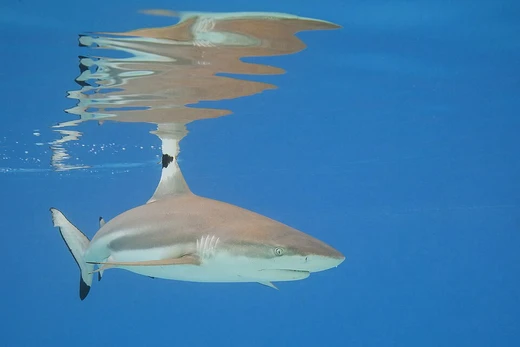
Sandbar shark
A large coastal shark with a high dorsal fin and interdorsal ridge.

The sandbar shark (Carcharhinus plumbeus), also called the brown shark or thickskin shark, belongs to the requiem shark family Carcharhinidae. It lives in the Atlantic Ocean and the Indo-Pacific. Its most distinctive features are a very tall first dorsal fin and a ridge running between its two dorsal fins. It should not be confused with the sand tiger shark (Carcharias taurus), despite the similar name.
The oldest known fossil teeth of this species come from the Early Miocene of Italy. By the Middle Miocene, fossils appear on the eastern coast of the United States and in Venezuela. After that, the fossil record shows the species spread more widely.
The sandbar shark is one of the largest coastal sharks worldwide. It is closely related to the dusky shark, bignose shark, and bull shark. It has a triangular, very high dorsal fin and long pectoral fins. Its body is heavy-set, with a rounded snout that is shorter than average for a shark. The upper teeth have broad, uneven cusps with sharp edges. The second dorsal fin and anal fin are nearly the same height. Females reach 2 to 2.5 meters (6.6–8.2 feet) in length, while males grow up to 1.8 meters (5.9 feet). The heaviest recorded individual weighed 240 kilograms (530 pounds). On average, females have a fork-length (nose to tail fork) of 154.9 centimeters, and males 151.6 centimeters. Their color ranges from bluish brown to gray or bronze, with a white or pale belly. They swim alone or gather in sex-separated schools of varying sizes.
True to its nickname, the sandbar shark is often found over muddy or sandy bottoms in shallow coastal waters like bays, estuaries, harbors, and river mouths. It also inhabits deeper waters (200 meters or more) and intertidal zones. It lives in tropical to temperate waters worldwide. In the western Atlantic, its range stretches from Massachusetts to Brazil. Juveniles are common in the lower Chesapeake Bay, and nursery areas exist from Delaware Bay to South Carolina. Other nurseries include Bonjuk Bay in Marmaris, Turkey, and the Florida Keys.
Natural predators include the tiger shark and, rarely, the great white shark. The sandbar shark feeds on fish, rays, crabs, and molluscs. In areas like the Mediterranean or the Gulf of Gabés, its diet mainly consists of bony fish, octopuses, European squid, and cuttlefish. It is considered a top predator in its ecosystem.
Quick Facts
- Genus
- Carcharhinus
- Species
- plumbeus
Facts from the source article.
Lore & Background
The earliest fossil teeth of the sandbar shark are known from the Early Miocene of Italy, appearing on the eastern coast of the US and in Venezuela around the Middle Miocene, with fossils becoming more geographically widespread afterwards. It is closely related to the dusky shark, the bignose shark, and the bull shark. Its dorsal fin is triangular and very high, and it has very long pectoral fins, a heavy-set body, and a rounded snout that is shorter than average. Its upper teeth have broadly uneven cusps with sharp edges, and its second dorsal fin and anal fin are close to the same height. Body color varies from blue-ish brown, grey, or bronze, with a white or pale underside. Sandbar sharks swim alone or gather in sex-segregated schools that vary in size.
Reader's Guide
The sandbar shark is commonly found over muddy or sandy bottoms in shallow coastal waters such as bays, estuaries, harbors, or river mouths, but also swims in deeper waters (200 m or more) and intertidal zones. It ranges from Massachusetts to Brazil in the western Atlantic, with juveniles common in the lower Chesapeake Bay and nursery grounds from Delaware Bay to South Carolina, as well as Bonjuk Bay in Turkey and the Florida Keys. Natural predators include the tiger shark and, rarely, great white sharks. It preys on fish, rays, crabs, and molluscs, and in the Mediterranean or Gulf of Gabés primarily consumes bony fish, octopuses, European squid, and cuttlefish. It is described as a top predator in its ecosystem. Females reach sexual maturity around 13 years, males around 12. They are viviparous with placental yolk sac support, exhibiting biennial or triennial reproduction, ovulating in early summer, and giving birth to an average of eight pups after a one-year gestation. The sandbar shark has been disproportionately targeted by U.S. commercial fisheries due to its high fin-to-body weight ratio, leading to a 2008 ban on commercial landings by the National Marine Fisheries Service based on a 2006 stock assessment. It is listed as vulnerable due to overfishing. A small number of specially permitted vessels fish for sandbar sharks for scientific research, requiring an independent researcher on board. Despite its large size, it is not considered dangerous to people, with very few attacks attributed to it; however, a 12-year-old girl was bitten on the leg in Ocean City, Maryland on August 2, 2021, requiring 42 stitches. Immune system studies focus on MHC genes, which are similar to tetrapods rather than fish. The New Zealand Department of Conservation classifies it as 'Data Deficient'.
Did You Know?
- Females can grow to 2–2.5 m, while males reach up to 1.8 m.
- Sandbar sharks are viviparous, with embryos supported in a placental yolk sac inside the mother.
- A 12-year-old girl was bitten by a sandbar shark in Ocean City, Maryland on August 2, 2021, requiring 42 stitches.
Anatomy and Taxonomic Identity
The sandbar shark, scientifically designated Carcharhinus plumbeus, belongs to the requiem shark group within the family Carcharhinidae. It carries alternative common names—brown shark and thickskin shark—that reflect its coloration and robust build, though it should never be mistaken for the sand tiger shark (Carcharias taurus), a completely separate species. Native to both the Atlantic and Indo-Pacific regions, this shark ranks among the largest coastal species in the world and shares close evolutionary ties with the dusky, bignose, and bull sharks. Its silhouette is immediately recognizable: a very tall, triangular first dorsal fin paired with a distinctive interdorsal ridge, complemented by exceptionally long pectoral fins. The body is heavy-set with a rounded snout noticeably shorter than that of most other sharks, and the upper jaw bears broadly uneven cusps edged with sharp cutting surfaces. The second dorsal and anal fins sit at nearly identical heights. Females typically reach two to two and a half meters, while males top out around 1.8 meters, with a maximum recorded weight of 240 kilograms. Coloration ranges across blue-brown, grey, or bronze tones above a pale or white belly, and individuals may travel solo or form sex-segregated groups.
Evolutionary Journey and Global Habitat
Fossil evidence traces the sandbar shark's lineage back to the Early Miocene, with the oldest known teeth recovered from Italian deposits. By the Middle Miocene, the species had expanded to the eastern seaboard of what is now the United States and to waters around Venezuela, and from that point its geographic footprint continued to broaden. Today, the sandbar shark inhabits tropical and temperate coastal waters across the globe. In the western Atlantic its range stretches from Massachusetts down to Brazil. True to its common name, the species favors muddy and sandy substrates in shallow settings—bays, estuaries, harbors, and river mouths—yet it also ventures into depths exceeding 200 meters and into intertidal zones. Juveniles are particularly abundant in the lower Chesapeake Bay, and recognized nursery grounds extend from Delaware Bay through South Carolina. Additional nurseries have been identified in the Florida Keys and in Bonjuk Bay near Marmaris, in the Muğla province of Turkey. This combination of shallow-water preference and deep-water capability gives the species a remarkably flexible habitat profile across its wide distribution.
Reproductive Biology and Ecological Role
Sandbar sharks are slow to mature, with most research indicating females reach sexual maturity around thirteen years of age and males around twelve, though exact timing remains debated among scientists. They are viviparous, meaning embryos develop inside the mother sustained by a placental yolk sac. Female reproductive cycles show two patterns: a biennial rhythm of giving birth every two years and a triennial rhythm of every three years, with individuals returning to the same location for delivery, migration, and gestation. Ovulation occurs in early summer, and after a gestation period of roughly one year, a female typically delivers an average of eight pups. The species' longevity spans roughly 35 to 41 years. Ecologically, the sandbar shark occupies the apex of its food web. Its diet spans bony fish, rays, crabs, and molluscs, while in the Mediterranean and Gulf of Gabés regions it has been documented consuming octopuses, European squid, and cuttlefish. Its natural predators are limited, principally the tiger shark and, on rare occasions, the great white.
Conservation Pressures and Human Encounters
Despite its size and resemblance to more feared species like the bull shark, the sandbar shark is not regarded as a threat to humans, and confirmed attacks are exceedingly rare. It is in fact considered one of the safest sharks for swimmers to encounter and is a popular exhibit in public aquaria. One notable exception occurred on August 2, 2021, when a twelve-year-old girl was bitten on the leg in Ocean City, Maryland; authorities confirmed the incident three days later, and the victim required 42 stitches. The species faces far greater pressure from commercial fishing. Its high fin-to-body weight ratio, combined with U.S. regulations mandating that whole carcasses be landed alongside fins, made sandbar sharks a disproportionately attractive target for American commercial shark fisheries. A 2006 stock assessment by SEDAR led the National Marine Fisheries Service to ban all commercial landings in 2008, listing the species as vulnerable to overfishing. Today only a small number of specially permitted research vessels may target sandbars, each required to carry an independent scientist. In New Zealand, the Department of Conservation classifies the sandbar as "Data Deficient."
Frequently Asked Questions
Who is Sandbar shark?
The sandbar shark (Carcharhinus plumbeus) is a large requiem shark found along Atlantic and Indo-Pacific coastlines. It goes by the nicknames brown shark and thickskin shark, and is instantly recognizable by its very tall first dorsal fin and the ridge running between its two dorsal fins.
What are Sandbar shark's signature traits?
Females are the bigger sex, reaching up to 240 kg and 2.5 m in length, while males cap out around 1.8 m. The average fork length difference between the sexes is modest—roughly 155 cm for females versus 152 cm for males—but the weight gap is striking.
How long does Sandbar shark live?
A sandbar shark typically survives 35 to 41 years in the wild. Its lineage is ancient, with the oldest known fossil teeth dating to the Early Miocene of Italy and later Middle Miocene finds along the U.S. east coast and in Venezuela.
Why is Sandbar shark important to coastal ecosystems?
As one of the heaviest nearshore predators, it helps keep fish populations in check and maintains balance in Atlantic and Indo-Pacific coastal habitats. Its presence is widely treated as an indicator of a healthy, functioning marine food web.
Is Sandbar shark the same as Sand tiger shark?
No, the similar names are a common mix-up but they are entirely different animals. The sandbar shark is a Carcharhinus in the requiem family, whereas the sand tiger shark (Carcharias taurus) is a separate genus with a very different body plan and fin structure.
More in Reef Sharks and Rays, Part 2 1-24
Spotted an error? Know more?
Reader corrections go straight into our review queue. Suggest an edit · How this site is sourced