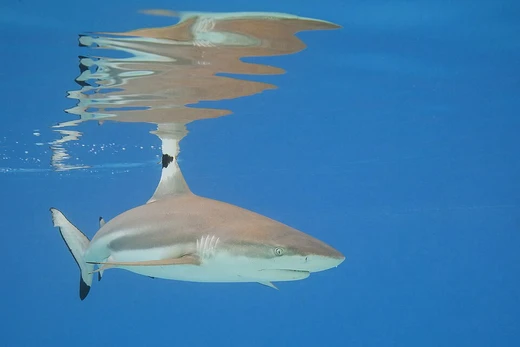
Spinner shark
A swift, spinning predator of tropical and warm temperate seas.

The spinner shark (Carcharhinus brevipinna) is a requiem shark in the family Carcharhinidae, named for the spinning leaps it makes as part of its feeding strategy. It occurs in tropical and warm temperate waters worldwide except for the eastern Pacific Ocean, from coastal to offshore habitats to a depth of 100 m, though it prefers shallow water. This species is notable for its swift, gregarious nature and its distinctive feeding behavior of charging vertically through schools of forage fish while spinning on its axis, often erupting from the water.
Quick Facts
- Genus
- Carcharhinus
- Species
- brevipinna
Facts from the source article.
Lore & Background
The spinner shark was originally described as Carcharias (Aprion) brevipinna by Johannes Peter Müller and Friedrich Gustav Jakob Henle in 1839, based on a mounted skin from Java. It has since been placed in the genus Carcharhinus. Its tooth shape and coloration vary significantly with age and geography, causing taxonomic confusion. Based on morphology, its closest relatives were thought to be the blacktip shark and graceful shark, but a 1992 allozyme analysis suggested these similarities are due to convergent evolution and that the copper shark is its closest relative. A 2007 ribosomal DNA study found the spinner shark to be the most genetically divergent requiem shark except for the tiger shark. The earliest fossil record is from the Late Miocene of Panama, with additional fossils from the Late Miocene of India and potentially the mid-Miocene to Early Pliocene of Florida.
Reader's Guide
The spinner shark is valued by commercial fisheries across its range for its meat, fins, liver oil, and skin, and is esteemed as a strong fighter by recreational fishers. It is not usually dangerous to humans but may become belligerent when excited by food. The International Union for Conservation of Nature has assessed this species as Vulnerable worldwide. Its distribution data contains uncertainty due to confusion with the blacktip shark, and parasitological evidence suggests Indian Ocean individuals have passed through the Suez Canal into the Mediterranean Sea as Lessepsian migrants. The species is migratory in the northwest Atlantic, moving inshore in spring and summer and south into deeper water in winter. Its feeding behavior, including spinning leaps and congregating around shrimp trawlers for bycatch, contributes to its ecological role as a predator of small bony fishes and cephalopods.
Did You Know?
- The spinner shark is named for its spinning leaps when feeding on schools of forage fish.
- It can be distinguished from the blacktip shark by its first dorsal fin shape and placement, and by the black tip on the anal fin in adults.
- The spinner shark has the smallest ova relative to the fully developed embryo of any viviparous shark known.
- Its closest relative may be the copper shark, according to a 1992 allozyme analysis.
Taxonomy and Evolutionary Lineage
The spinner shark's scientific identity has been a source of persistent confusion since its formal description in 1839, when Müller and Henle named it based on a 79-centimeter specimen collected off Java. Over the decades, taxonomists shuffled it between several genera—Aprion, Squalus, Aprionodon—before it settled into Carcharhinus. Much of the difficulty stems from the fact that tooth morphology and fin coloration shift dramatically as the animal ages and differs across geographic populations, making field identification tricky. The species has accumulated a long list of common names, from black-tipped shark to longnose grey whaler to smoothfang shark.
Early researchers assumed the spinner's closest kin were the blacktip and graceful sharks, given their superficial resemblance. However, Gavin Naylor's 1992 allozyme analysis revealed those similarities were the product of convergent evolution, pointing instead to the copper shark as the true nearest relative. A 2007 ribosomal DNA study pushed this isolation even further, finding the spinner to be the most genetically divergent requiem shark examined, second only to the tiger shark in its distance from other Carcharhinus members. Fossil evidence places the species in the Late Miocene of Panama and Odisha, India, with possible mid-Miocene to Early Pliocene occurrences in Florida.
Global Range and Seasonal Movement
The spinner shark inhabits tropical and warm-temperate seas across nearly every ocean basin, with the notable exception of the eastern Pacific. In the Western Atlantic it ranges from North Carolina down through the Bahamas and Cuba to the northern Gulf of Mexico, and separately from southern Brazil to Argentina. Its Eastern Atlantic distribution stretches from North African waters to Namibia. Across the Indian Ocean it appears off South Africa, Madagascar, the Red Sea, the Gulf of Aden, India, Java, and Sumatra. Pacific records include Japan, Vietnam, Australia, and possibly the Philippines.
One particularly striking aspect of its range is the presence of Lessepsian migrants: parasitological evidence confirms that Indian Ocean individuals have passed through the Suez Canal and established themselves in the Mediterranean. The species occupies depths from the surface to 100 meters, though it shows a clear preference for water shallower than 30 meters, ranging from coastal bays to well-offshore continental and insular shelves. Juveniles will enter bays but steer clear of brackish conditions. The northwest Atlantic subpopulation exhibits a pronounced seasonal migration, favoring warm inshore waters during spring and summer before retreating southward into deeper, cooler water through the winter months.
Physical Form and Distinguishing Features
The average spinner shark measures about two meters and weighs roughly 56 kilograms, with the largest known individuals reaching three meters and 90 kilograms. Indo-Pacific populations tend to be noticeably larger than their northwest Atlantic counterparts. The body is slim and streamlined, topped by a long, pointed snout, small circular eyes, and prominent forward-pointing furrows at the mouth corners. The upper jaw carries 15 to 18 teeth per half; the lower, 14 to 17, plus tiny central symphysial teeth. Upper teeth are finely serrated; lower teeth are smooth. Five pairs of long gill slits line the head.
The first dorsal fin is relatively small, more triangular than the blacktip's, and set further back so it originates behind the free rear tip of the pectoral fins. No ridge divides the dorsals. Pectoral fins are moderately short, narrow, and sickle-shaped. The skin is densely covered with diamond-shaped dermal denticles bearing seven shallow horizontal ridges. Coloration is gray above—sometimes with a bronze sheen—white below, with a faint lateral band. Juveniles have unmarked fins, but as the shark matures, black tips appear on the second dorsal, pectoral, anal, and lower caudal fins. The black-tipped anal fin is a reliable adult identifier.
Feeding, Reproduction, and Human Interaction
The spinner shark is a swift, active predator that often assembles into large schools segregated by age and sex. Its diet spans a wide variety of small bony fishes and cephalopods. The species' signature hunting technique is spectacular: when targeting a school of forage fish, the shark drives vertically through the group while spinning on its own axis, then erupts from the water's surface at the end of the spin. This acrobatic display is the behavior that gave the species its common name.
Reproduction follows the viviparous pattern typical of requiem sharks. Females produce litters of three to twenty pups on roughly a two-year cycle, giving birth in shallow coastal nursery areas. The young are relatively fast-growing.
In terms of human interaction, the spinner is not generally considered dangerous, though it can become belligerent when excited by food. Commercial fisheries across its range harvest the species for meat, fins, liver oil, and skin, while recreational anglers prize it as a strong, aggressive fighter on the line. Despite its economic importance, the International Union for Conservation of Nature has assessed the spinner shark as Vulnerable worldwide, reflecting the cumulative pressure of these fisheries.
Frequently Asked Questions
Who is Spinner shark?
The spinner shark (Carcharhinus brevipinna) is a requiem shark in the family Carcharhinidae, best known for its acrobatic spinning leaps during feeding. It is a swift, social predator inhabiting tropical and warm-temperate waters worldwide, with the sole exception of the eastern Pacific.
What are Spinner shark's powers/role?
Its signature move is an explosive vertical charge through a baitball of small fish while rotating on its own axis, often launching itself entirely clear of the water. This spinning ambush lets it strike prey from every angle in a single burst, making it a highly effective hunter in shallow coastal zones.
Why is Spinner shark important?
As a gregarious mid-level predator patrolling shallow nearshore waters, it helps keep forage-fish populations in check and provides a crucial food source for larger marine animals. Its abundance in a given area is widely used as a rough indicator of overall water-column health.
Where can you find Spinner shark?
It ranges across tropical and warm-temperate seas on every continent except in the eastern Pacific, occupying both coastal and offshore habitats from the surface down to about 100 metres. In practice, you are most likely to spot one in relatively shallow, sunlit water where baitfish schools tend to gather.
More in Reef Sharks and Rays, Part 2 1-24
Spotted an error? Know more?
Reader corrections go straight into our review queue. Suggest an edit · How this site is sourced