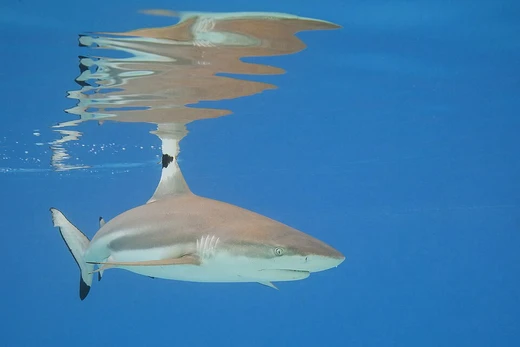
Sicklefin lemon shark
A large, slow-moving Indo-Pacific shark with sickle-shaped fins.

The sicklefin lemon shark (Negaprion acutidens), also known as the sharptooth lemon shark, is a species of requiem shark in the family Carcharhinidae, widely distributed in the tropical waters of the Indo-Pacific. It is closely related to the better-known lemon shark (N. brevirostris) of the Americas, from which it differs primarily in having more falcate (sickle-shaped) fins. This large, slow-moving predator grows up to 3.8 m (12 ft) long and inhabits shallow coastal waters, including mangrove estuaries and coral reefs.
Quick Facts
- Genus
- Negaprion
- Species
- acutidens
Facts from the source article.
Lore & Background
The sicklefin lemon shark was first described as Carcharias acutidens by German naturalist Eduard Rüppell in the 1837 Fische des Rothen Meeres. In 1940, Australian ichthyologist Gilbert Percy Whitley moved it to the genus Negaprion. The type specimen, designated in 1960, is a 68-cm-long individual caught in the Red Sea off Jeddah, Saudi Arabia. The specific epithet acutidens is derived from Latin meaning 'sharp' and 'teeth'. Based on microsatellite DNA evidence, this species diverged from its sister species N. brevirostris 10–14 million years ago, when the closure of the Tethys Sea separated lemon sharks in the Indian Ocean from those in the Atlantic.
Reader's Guide
The sicklefin lemon shark is notable for its Endangered status, assessed by the IUCN, due to its low reproductive productivity and limited movement, which reduces the capacity of depleted stocks to recover. Off India and Southeast Asia, it has been severely depleted or extirpated by unregulated exploitation for its meat, fins, and liver oil. Although potentially dangerous to humans and known to respond vigorously to provocation, under normal circumstances it is cautious and tends to retreat if approached. Its sluggish nature and tendency to remain near specific locations make it vulnerable to local overfishing. The species is also of scientific interest for its evolutionary divergence from the American lemon shark and its intermediate position on the carcharhinid evolutionary tree, as suggested by morphological and molecular phylogenetic analyses.
Did You Know?
- The sicklefin lemon shark can actively pump water over its gills, unlike most requiem sharks.
- Over 90% of tagged sicklefin lemon sharks at Aldabra Atoll were recaptured within 2 km of their tagging location.
- The species has been documented resting on the bottom and eliciting cleaning by bluestreak cleaner wrasses, sometimes stopping respiration for up to 150 seconds.
- Juvenile sicklefin lemon sharks are often found on reef flats or around mangroves in water so shallow that their dorsal fins are exposed.
More in Reef Sharks and Rays, Part 2 1-24
Spotted an error? Know more?
Reader corrections go straight into our review queue. Suggest an edit · How this site is sourced