Scoliodon
Genus of requiem sharks with two living species.

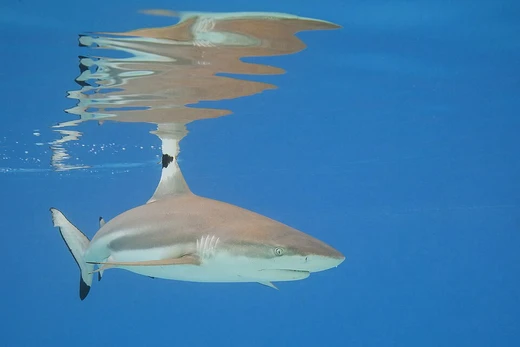
Scoliodon is a genus of requiem sharks belonging to the family Carcharhinidae. For a long time, scientists believed it contained just one species from the Indo-Pacific region, the spadenose shark (S. laticaudus), but more recent taxonomic work has revealed a second living species, the Pacific spadenose shark (S. macrorhynchos).
These sharks are found in the Indo-West Pacific, ranging from the western coast of Africa down to southern Japan, and have been observed in the Bay of Bengal. Their bodies are elongated and spindle-shaped, tapering at both ends, which allows them to swim very fast. The trunk and tail are flattened from side to side, while the head is flattened from top to bottom. A covering of placoid scales forms an external skeleton over the entire body. The mouth sits on the underside and is flanked by jaws. Two rows of teeth, which are homodont or polyphyodont, are present and are structurally similar to the placoid scales. Males reach maturity at about 33 centimeters in length, females at about 36 centimeters. Females are mostly ovoviviparous; in S. laticaudus, a single litter contains between 8 and 19 embryos, and newborns measure roughly 13.7 centimeters. Because their reproductive output is limited, these sharks are vulnerable to targeted fishing and habitat loss.
Two living species are recognized: Scoliodon laticaudus (spadenose shark) and Scoliodon macrorhynchos (Pacific spadenose shark). Three extinct species are also known: †Scoliodon taxandriae, †Scoliodon conecuhensis, and †Scoliodon terraenovae.
Quick Facts
- Taxon
- Scoliodon
- Type Species
- Scoliodon laticaudus
- Type Species Authority
- J. P. Müller & Henle, 1838
Facts from the source article.
Lore & Background
The Scoliodon genus has been seen in the Bay of Bengal and found mainly in the Indo-West Pacific oceans from the west coasts of Africa to south of Japan. It has an elongated, spindle-shaped body tapered at the ends, making it a very fast swimmer. The trunk and tail are laterally compressed, while the head region is dorsoventrally compressed. The entire body is covered by an exoskeleton of placoid scales. The mouth is located on the ventral side and is bound on both sides by jaws. It has two rows of homodont or polyphyodont teeth, which are homologous to the placoid scales covering the body.
Male Scoliodon species mature at a length of 33 cm while female Scoliodon species mature at 36 cm. When reproducing, the female is mostly ovoviviparous; Scoliodon laticaudus has a minimum of 8 to a maximum of 19 embryos when conceiving. At birth, Scoliodon laticaudus is roughly 13.7 cm in length. Because of limited fecundity, the Scoliodon genus of sharks can be negatively affected by targeted fishing and habitat degradation.
Reader's Guide
The significance of Scoliodon lies in its recent taxonomic revision, which expanded the genus from a single species to two living species: Scoliodon laticaudus (spadenose shark) and Scoliodon macrorhynchos (Pacific spadenose shark). The genus also includes three extinct species: Scoliodon taxandriae, Scoliodon conecuhensis, and Scoliodon terraenovae. Its biological traits, such as an elongated body for fast swimming and placoid scale coverage, are characteristic of requiem sharks. The reproductive strategy—ovoviviparity with a limited number of embryos (8 to 19)—makes the genus vulnerable to overfishing and habitat degradation. The species are found in the Indo-West Pacific oceans, from the west coasts of Africa to south of Japan, including the Bay of Bengal. The genus is notable for its homodont or polyphyodont teeth, which are homologous to placoid scales, and for the distinct size at maturity between males (33 cm) and females (36 cm).
Did You Know?
- Scoliodon was formerly thought to include only one species, but recent research added a second.
- Male Scoliodon mature at 33 cm, while females mature at 36 cm.
- Scoliodon laticaudus has 8 to 19 embryos per conception.
- The genus includes three extinct species: S. taxandriae, S. conecuhensis, and S. terraenovae.
More in Reef Sharks and Rays, Part 2 1-24
Spotted an error? Know more?
Reader corrections go straight into our review queue. Suggest an edit · How this site is sourced