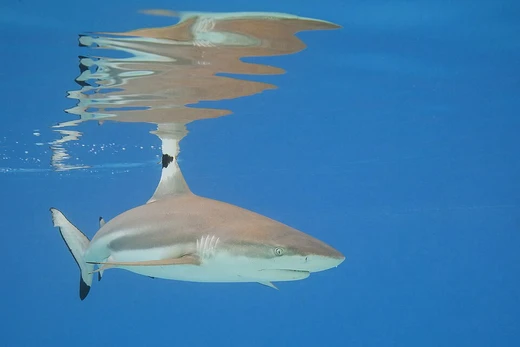
Pacific sharpnose shark
Small viviparous shark migrating along Mexico's Pacific coast.

The Pacific sharpnose shark (Rhizoprionodon longurio) is a small viviparous shark found in the eastern tropical Pacific Ocean, from southern California to Peru. It is notable for its seasonal migrations along the Pacific coast of Mexico and for being commonly caught in the artisanal fishery of Mazatlán.
Quick Facts
- Genus
- Rhizoprionodon
- Species
- longurio
Facts from the source article.
Lore & Background
The Pacific sharpnose shark is a viviparous shark of small size, born at an average length of 31 cm. Its gestation period is between ten and eleven months. Scientists found no statistical relationship between the number of embryos and the average length. Specialists David Corro, Leonardo Castillo Geniz, and J. Fernando Marquez-Farias determined that the sex ratio is one to one, with an average of 7.4 embryos per female. Females typically grow larger than males; the maximum recorded length was a female specimen at 129.5 cm. Two modal groups of adults were observed, one at 96 cm and the other at 108 cm.
The species inhabits coastal waters with muddy bottom areas, though it is not known whether it uses coastal lagoons as nursery areas or only open waters. Reports indicate nurseries in the Upper Gulf of California. The reproductive season runs from March to June, peaking in April. The gestation period is estimated at 10–12 months, but due to the shark's great migratory movements, this estimate was made without observing the complete embryonic growth cycle.
Diet studies of 82 specimens found about 36% of stomachs empty; the remainder contained mainly crustaceans and fish. The shark is fished commercially in the Pacific Ocean off Mexico from the Gulf of California to Puerto Madero, Chiapas. Fishing is seasonal in southern Sinaloa, from November to April, with the peak in February, driven by factors including sea temperature changes that cause massive movements. The species is very susceptible to gillnets and bottom longlines, and is caught from fiberglass boats of 22–25 feet with a crew of 2–3 members and a capacity of up to 1.5 tons.
Reader's Guide
The Pacific sharpnose shark is significant as a commonly caught species in the artisanal fishery of Mazatlán, reflecting its importance to local fishing communities along the Pacific coast of Mexico. Its seasonal migrations, from the central Gulf of California to the southern region of Nayarit in winter–spring and back in summer–autumn, drive a targeted fishery that peaks in February. The species' susceptibility to gillnets and bottom longlines, and the use of small fiberglass boats with limited crew and capacity, highlight the artisanal nature of its harvest. The scientific findings—such as the 1:1 sex ratio, average of 7.4 embryos per female, and lack of correlation between embryo number and maternal length—provide baseline data for understanding its reproductive biology. The uncertainty about nursery areas (coastal lagoons versus open waters) and the incomplete observation of gestation due to migration underscore gaps in knowledge. The diet dominated by crustaceans and fish, along with a high proportion of empty stomachs, offers insight into its feeding ecology. Overall, the Pacific sharpnose shark exemplifies a small, migratory, viviparous shark that supports a seasonal artisanal fishery and presents ongoing research questions about its life history.
Did You Know?
- The Pacific sharpnose shark is born at an average length of 31 cm.
- The species is very susceptible to being caught by gillnets and bottom longlines.
More in Reef Sharks and Rays, Part 2 1-24
Spotted an error? Know more?
Reader corrections go straight into our review queue. Suggest an edit · How this site is sourced