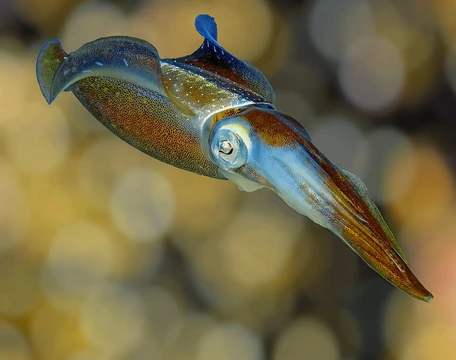
Wunderpus
A small octopus with unique white markings and mimicry abilities.

The wunderpus octopus (Wunderpus photogenicus) is a small-bodied species with distinct white and rusty brown coloration. Its name derives from the German 'wunder' meaning 'marvel' or 'wonder'. It is frequently confused with its close relative, the mimic octopus, due to appearance and behavior. The species was not discovered until the 1980s and was officially described in detail in 2006. It is commercially important to underwater photography, dive, and tourism communities, especially in Indonesia, and is also valued as an expensive ornamental marine species for home aquariums.
Quick Facts
- Genus
- Wunderpus
- Species
- photogenicus
Facts from the source article.
Lore & Background
The wunderpus octopus displays an individually unique pattern of white spots and bands over a rusty brown background. Generally, all individuals show a circular pattern of about six white spots at the posterior lip of the mantle, head, and neck area, some of which are fused. As the wunderpus ages, its body patterns become more complex. The body is consistently covered in brownish-red coloration both dorsally and ventrally, with white lateral bands and markings along the arms, mantle, head, and eye stalks. The suckers are yellowish-cream, and the skin is relatively smooth with papillae throughout.
The wunderpus is known for its ability to mimic other sea animals, changing color patterns when disturbed or threatened. It can alter both color and shape to blend in with surroundings or impersonate a venomous species to scare threats away. This ability has evolved to ensure survival. The wunderpus has small eyes on elongated stalks, a thin-walled mantle with weak musculature, and a Y-shaped head. The dorsal arms are shortest, while ventral or lateral arms are longest. Males have a hectocotylized third right arm. The arms are thin, elastic, and triangular in cross-section, with webs along the ventro-lateral edge that allow the octopus to form a net for prey capture.
Little is known about the behavior and life history of the wunderpus, partly due to its solitary lifestyle. It is believed to impersonate venomous animals such as the lionfish and the banded sea krait. The wunderpus will burrow six of its arms, leaving two free to mimic the banded sea krait, and its banded white markings allow it to mimic the stripes and spines of the lionfish. These behaviors are thought to ward off potential predators.
Reader's Guide
The wunderpus octopus holds significance primarily through its commercial value to underwater photography, dive tourism, and the ornamental aquarium trade, particularly in Indonesia. Its unique and individually variable white markings over a reddish-brown background make it a popular subject for photographers and divers. The species was not discovered until the 1980s and was only officially described in 2006, highlighting its relatively recent entry into scientific knowledge.
Photo-identification has become the preferred method for tracking wunderpus individuals over time, as their body patterns vary across individuals but remain constant. This technique avoids the risks of tattooing or external tags, which octopuses can remove or heal from. Photo-identification allows scientists to study intraspecific behavioral interactions, survivorship, migration patterns, and population estimates, contributing to understanding this under-documented species.
The wunderpus is also notable for its chromatophores, neuromuscular organs that contain pigment and enable rapid color and pattern changes for camouflage, mimicry, and intraspecific communication. Juvenile and paralarvae have founder chromatophores that produce distinct patterns, making them easy to identify. The species' ability to impersonate venomous animals like the lionfish and banded sea krait further underscores its ecological adaptations. Despite its popularity, much about its behavior and life history remains unknown due to its solitary nature.
Did You Know?
- The wunderpus can mimic venomous species such as the lionfish and the banded sea krait to ward off predators.
- Photo-identification is the best method for tracking wunderpus individuals because their body patterns vary across individuals but remain constant over time.
Frequently Asked Questions
What is a wunderpus octopus?
The wunderpus (Wunderpus photogenicus) is a small reef-dwelling octopus recognized by its bold white-and-rusty-brown pattern. Its name comes from the German word 'wunder,' meaning marvel or wonder.
How is the wunderpus different from the mimic octopus?
Although the two species look and behave closely enough that people routinely mix them up, they are separate close relatives. The wunderpus wasn't given a full scientific description until 2006, which is part of why the confusion lingers.
When was the wunderpus octopus discovered?
Researchers first noticed the species in the 1980s, but a detailed formal description wasn't published until 2006. That roughly two-decade gap between initial sighting and full taxonomy is notable for a cephalopod.
Where do wunderpus octopuses live?
Their range covers parts of the western Pacific, including Bali, Sulawesi, the Philippines, and Vanuatu. They generally stay within about 20 meters (66 feet) of the surface and can occur at densities up to five individuals per 25 square meters.
Why is the wunderpus so popular with divers and aquarium hobbyists?
Its eye-catching white markings and playful mimicry make it a go-to subject for underwater photographers, especially at Indonesian dive sites. It is also a highly sought-after—and expensive—ornamental species for home reef aquariums.
More in Reef Cephalopods, Part 2 1-24
Spotted an error? Know more?
Reader corrections go straight into our review queue. Suggest an edit · How this site is sourced