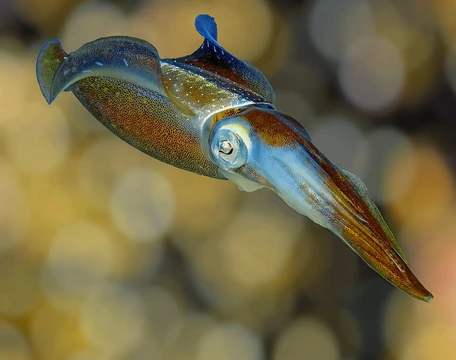
Ascarosepion tullbergi
A small cuttlefish used to study neural color-change waves.

**Ascarosepion tullbergi**, the paintpot cuttlefish, is a small and little-studied cuttlefish living in the Indo-Pacific region from Japan down to Hong Kong. It was originally placed in the genus *Metasepia* alongside one other species, but both were moved into *Ascarosepion* in 2023. Members of the former *Metasepia* group share a small, thick, diamond-shaped cuttlebone and a particular color pattern.
This bottom-dwelling animal moves slowly. Its oval mantle reaches about 70 mm (2.8 in) in length, with 10 to 13 pores on each side. The fins are joined at the rear, and the arms are at the opposite end, as in all coleoids. Each arm typically has 10 to 12 rows of small suckers near the base, then larger ones, then smaller ones toward the tip. Adults weigh between 30 and 40 g (1.1 to 1.4 oz). Males store sperm in the left ventral arm (the hectocotylus). Unlike many cuttlefish, the cuttlebone is noticeably smaller than the mantle. A thin chitin film covers the entire upper surface of the cuttlebone, tapering to a sharp point at the dorsal corner; the front surface is also covered in chitin, while the back is calcareous. The skin’s chromatophores are mostly dark, with bright yellow spots on the head, the upper side of the mantle, and the arms. The protective membranes on the arms are red.
The paintpot cuttlefish lives in the neritic zone of the subtropical Indo-Pacific, around Japan, China, and Korea. Sightings have been recorded from southern Honshu, the Sea of Japan, the Yellow Sea, the East China Sea, Taiwan, Hong Kong, the South China Sea, the Philippines, and the Gulf of Thailand. It inhabits the continental shelf at depths of 20 to 100 m (66 to 328 ft), on sandy or muddy bottoms, or among sea pens on rocky substrate. Whether it shares its range with its relative, the flamboyant cuttlefish, is unknown.
Like its sister species, the paintpot cuttlefish lives directly on the seafloor because its cuttlebone is too small to provide enough buoyancy to lift it off the bottom. It walks using its tentacles and mantle protrusions. As with all cephalopods, individuals are either male or female. Males store sperm in the hectocotylus and use it to transfer spermatophores to a female during mating. After displays to attract a mate, the male inserts the hectocotylus into the female’s mantle cavity to fertilize the eggs.
Quick Facts
- Genus
- Ascarosepion
- Species
- tullbergi
Facts from the source article.
Lore & Background
The paintpot cuttlefish is a slow-moving, bottom-dwelling species. Its mantle is broad and oval-shaped, with 10 to 13 pores on each side. The fins are joined at the back, and the arms are located at the opposite end at the head, as in all coleoids. The arms typically have 10 to 12 rows of shorter suckers followed by larger ones, then tapering to the tip. The hectocotylus, a modified arm for storing and transferring sperm, is present on the left ventral arm. Unlike other cuttlefish, former Metasepia have a cuttlebone much smaller than their mantle. The cuttlebone has a thin chitin film covering its entire dorsal surface, tapering to a sharp point on the dorsal corner; the anterior surface is entirely covered in chitin, while the posterior surface is calcareous. The chromatophores are mostly darkly colored with bright yellow spots on the head, dorsal side of mantle, and arms, and the protective membranes on the arms are red.
This species lives directly on the benthos because its cuttlebone is too small to lift it off the seabed, so it walks on its tentacles and mantle protrusions. It is gonochoric, with males using the hectocotylus to transfer spermatophores to females during copulation. Egg masses are laid in rocky areas at around 20 meters deep and hatch during the summer. Freshly hatched cuttlefish, resembling miniature adults, migrate to 80 meters depth in sandy-mud areas from August to September to grow, then move towards shallows to spawn in March. Embryos hatch and live as plankton for several weeks before becoming benthic adults.
Reader's Guide
The paintpot cuttlefish has been used as a research specimen to analyze how neuronal activity may propagate through the body. Cephalopods share the ability for their skin to change colors due to chromatophores, activated by action potentials traveling through the skin. Because all neural activity is controlled by action potential propagation, neuroscientists are especially interested in this visual representation. Cuttlefish exhibit a mode of color change typified by dark bands traveling across the body in a coordinated pattern called 'passing clouds'. The paintpot cuttlefish is especially conducive to this research due to its small size, slow speed, and the frequency of the passing clouds display. The study concluded that the passing clouds phenomenon resulted from central wave generation, indicating the action potential originated at a single point controller. This may suggest that cephalopods have a central nervous system similar to humans, with larger implications in neuroscience. The species remains poorly researched overall, and its potential sympatry with the flamboyant cuttlefish is unknown.
Did You Know?
- The paintpot cuttlefish was one of two species formerly classified in the genus Metasepia, which was lumped into Ascarosepion in 2023.
- Its cuttlebone is much smaller than its mantle, forcing it to walk on the seabed rather than swim.
- The passing clouds color-change display in this species was found to originate from a single point controller in the central nervous system.
Origins & Taxonomic Reckoning
The flamboyant cuttlefish first entered the scientific record during the legendary Challenger expedition. On October 9, 1874, a female specimen was hauled from a depth of roughly fifty-one metres in the Arafura Sea, near what was logged as Challenger Station 188. That single individual, now preserved in the collections of the Natural History Museum in London, served as the type specimen for the species for nearly a century and a half. In 2023, however, a major taxonomic reshuffle placed the flamboyant cuttlefish into the genus Ascarosepion, a grouping that now encompasses fourteen species in total, including the broadclub, reaper, and giant cuttlefish. This reassignment effectively rendered the older genus Metasepia obsolete. Within Ascarosepion, the flamboyant cuttlefish shares a close sister-species relationship with A. tullbergi, and together they occupy a distinctive ecological niche that no other cuttlefish lineage has matched.
Anatomy of a Walker
The flamboyant cuttlefish presents a stocky, broad-bodied silhouette, its oval mantle wide and its arms thick and blade-like, each bearing four rows of suckers. Males carry a specialised hectocotylus on the left ventral arm, whose oral surface is notably swollen and fleshy, marked by transverse ridges and a central furrow. Perhaps the most consequential anatomical feature, however, is the cuttlebone. Measuring only two-thirds to three-quarters of mantle length and set far forward in the body, it is rhomboidal, tapering to sharp points at both ends, and—critically—lacks the outer cone found in most other cuttlefish. This genus, comprising both the flamboyant cuttlefish and its sister A. tullbergi, is the only one documented to walk along the seabed rather than swim, a direct consequence of that small, anteriorly positioned buoyancy organ. Adults reach roughly six to eight centimetres in mantle length, and three pairs of large, flat, flap-like papillae adorn the dorsal surface, with additional papillae clustered above the eyes.
Warning Colours & the Poison Question
At rest, the flamboyant cuttlefish is an unremarkable dark brown, blending into sand and mud substrates across its Indo-Pacific range. But when threatened, the transformation is dramatic: the body erupts into bold patches of black, white, and yellow, while the arm-tips flash a vivid red. During this display the animal lowers itself onto the seafloor, ambling along on its lower arms while rhythmically waving the broad protective membranes that fringe its limbs—a behaviour interpreted as an advertisement of its toxic flesh. A toxicology report confirmed that the muscle tissue is highly poisonous, making this species only the third known poisonous cephalopod. Research from Museum Victoria linked the toxin to the same compound found in the blue-ringed octopus. Yet later work by teams at Georgia Southern University and Utah State University detected only trace quantities of tetrodotoxin, concentrations too low to pose a threat to vertebrate predators. This discrepancy leaves the true potency of the flamboyant cuttlefish's chemical defence unresolved, and the species remains of no commercial interest to fisheries.
Courtship, Egg-Laying & Precocial Hatchlings
Mating in the flamboyant cuttlefish is an intimate, face-to-face affair. The male deposits a packet of sperm into a specialised pouch on the ventral side of the female's mantle, after which she uses that stored sperm to fertilise her eggs. Rather than producing a clutch in a single mass, the female lays each egg individually, tucking them into crevices, rock ledges, or the hollows of driftwood. In one documented case, a female threaded roughly a dozen eggs through the central hole of an overturned coconut husk, effectively building a natural nursery that shielded the developing young from predatory fish. Freshly laid eggs are opaque white, but they gradually become translucent, revealing the growing cuttlefish within. The hatchlings emerge fully independent—truly precocial—with no parental care whatsoever. Remarkably, even at the moment of hatching they can produce the same complex camouflage and warning colour patterns that adults display, suggesting these defensive behaviours are hard-wired from the very first breath of open water.
Frequently Asked Questions
What is Ascarosepion tullbergi?
The paintpot cuttlefish is a small, slow-moving cephalopod native to the Indo-Pacific, ranging from Japan down to Hong Kong. It is a bottom-dweller that typically occupies depths between 20 and 100 meters.
How big does Ascarosepion tullbergi get?
Adults have an oval mantle measuring roughly 70 mm (about 2.8 inches) and weigh between 30 and 40 grams. Each side of the mantle carries 10 to 13 pores, and the arms bear 10 to 12 rows of suckers.
Why was Ascarosepion tullbergi moved out of the genus Metasepia?
In 2023, this species and one other formerly grouped under Metasepia were reclassified into the genus Ascarosepion. Both share a distinctive small, thick, diamond-shaped cuttlebone and a particular color pattern that set them apart from other metasepiids.
Where does Ascarosepion tullbergi lay its eggs?
This cuttlefish deposits its eggs at a depth of around 20 meters, near the upper end of its typical 20-to-100-meter range. Its fins are joined together at the rear, while the arms sit at the opposite end of the mantle.
Why is Ascarosepion tullbergi important to science?
Despite being small and relatively understudied, this species has become a useful model for investigating neural color-change waves in cephalopods. Its manageable size and accessible Indo-Pacific range make it a practical subject for both laboratory and field research.
More in Reef Cephalopods, Part 2 1-24
Spotted an error? Know more?
Reader corrections go straight into our review queue. Suggest an edit · How this site is sourced