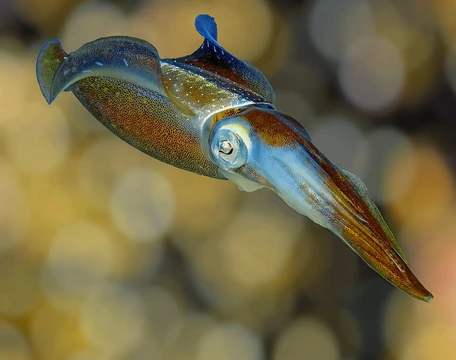
Cuttlefish
Intelligent marine molluscs with a unique internal shell and W-shaped pupils.

Cuttlefish, or cuttles, are marine molluscs of the family Sepiidae, belonging to the class Cephalopoda, which also includes squid, octopuses, and nautiluses. They are notable for their unique internal shell, the cuttlebone, used for buoyancy control, and are considered among the most intelligent invertebrates, with one of the largest brain-to-body size ratios of all invertebrates.
Quick Facts
- Taxon
- Sepiidae
Facts from the source article.
Lore & Background
The word 'cuttle' in 'cuttlefish' derives from the Old English cudele, possibly cognate with Old Norse koddi (cushion) and Middle Low German Kudel (rag). The Greco-Roman world valued the cuttlefish as a source of the brown pigment it releases when alarmed; the Greek and Latin word sepia now refers to the reddish-brown color sepia in English.
Cuttlefish have large, W-shaped pupils, eight arms, and two tentacles with denticulated suckers for securing prey. They eat small molluscs, crabs, shrimp, fish, octopuses, and other cuttlefish, while their predators include dolphins, larger fish (including sharks), seals, seabirds, and other cuttlefish. Their blood is green-blue due to copper-containing hemocyanin, and they have three hearts and a closed circulatory system.
Taxonomically, 116 species are recognized. A 2023 paper revived several synonymized genera and elevated some subgenera, with Metasepia becoming a junior synonym of Ascarosepion. The earliest fossils are from the end of the Cretaceous, represented by Ceratisepia from the Netherlands.
Reader's Guide
Cuttlefish are significant for their unique biological features and historical use. Their cuttlebone, a porous aragonite structure, provides buoyancy and is unique among cephalopods except Spirula. Their eyes, though superficially similar to vertebrate eyes, are an example of convergent evolution, with W-shaped pupils, two foveae, and the ability to perceive polarized light and use stereopsis. They can change focus by shifting the lens rather than reshaping it, and have no blind spot. Their ink stores serve for chemical deterrence, phagomimicry, and sensory distraction. The Greco-Roman world valued them for the brown pigment sepia, which gave its name to the color. Studies indicate cuttlefish are among the most intelligent invertebrates, with a high brain-to-body size ratio. Their life expectancy is typically 1–2 years, and they range in size from 15 to 25 cm, with the giant cuttlefish reaching 50 cm and over 10.5 kg.
Did You Know?
- Cuttlefish have three hearts: two branchial hearts for the gills and one for the rest of the body.
- Their blood is green-blue because it uses copper-containing hemocyanin instead of iron-based hemoglobin.
- Cuttlefish can perceive the polarization of light, enhancing contrast, though they cannot see color.
- The earliest cuttlefish fossils are from the end of the Cretaceous period, found in the Maastricht Formation of the Netherlands.
The Cuttlebone and Cephalopod Anatomy
Cuttlefish occupy a distinctive niche within the cephalopod class, sharing that lineage with squid, octopuses, and nautiluses, yet setting themselves apart through a remarkable internal structure. The cuttlebone—a porous, aragonite-based shell found nowhere else among coleoid cephalopods except the rare Spirula—is divided into chambers by thin septa, forming what biologists call a phragmocone. The creature actively manages its buoyancy by shifting the balance of gas and liquid within these chambers through a specialized ventral siphuncle. No two species share the same cuttlebone; each displays its own shape, size, and ridge pattern, making the bone a reliable taxonomic marker. Beyond this internal architecture, cuttlefish present a striking external profile: large eyes with W-shaped pupils, eight muscular arms, and a pair of longer tentacles lined with denticulated suckers for gripping prey. Most individuals measure between fifteen and twenty-five centimeters, though the giant Australian cuttlefish can stretch to fifty centimeters in mantle length and exceed ten and a half kilograms. Their visual system, while superficially resembling that of vertebrates, develops through a fundamentally different organogenic pathway.
Ecology, Predation, and Cognitive Capacity
In the marine food web, cuttlefish occupy a middle tier that is both predator and prey. Their diet spans small molluscs, crabs, shrimp, small fish, octopuses, and even conspecifics, making them opportunistic hunters that will take whatever the denticulated suckers on their tentacles can secure. In return, they face a broad array of threats: dolphins, large predatory fish including sharks, seals, seabirds, and larger cuttlefish themselves. Their lifespan is brief by most animal standards, typically spanning only one to two years, which means each individual must forage, evade predators, and reproduce within a compressed window. What elevates cuttlefish above many other invertebrates is their cognitive profile. Research consistently places them among the most intelligent invertebrate species known, and they possess one of the largest brain-to-body size ratios in the entire invertebrate kingdom. This neurological endowment likely underpins the sophisticated hunting strategies that make them such effective predators in the marine environment.
Taxonomy and the 2023 Reorganization
For decades, the family Sepiidae was organized around just three genera—Metasepia, Sepia, and Sepiella—with the latter absorbing the vast majority of the one hundred sixteen recognized species into numerous subgenera. That tidy framework was upended by a 2023 phylogenetic study, which revealed that what had been lumped under Sepia actually comprised several distinct monophyletic clades. The authors responded by resurrecting previously synonymized genera and promoting certain subgenera to full genus rank, redistributing many species into groups such as Acanthosepion, Ascarosepion, Decorisepia, Digitosepia, Doratosepion, Rhombosepion, and Spathidosepion. In a further twist, Metasepia was found to nest inside one of these revived lineages; because it was named after Ascarosepion, it was demoted to a junior synonym of that genus. The reorganization also left a handful of species—Sepiella cyanea, mangkangunga, and ocellata—flagged for further taxonomic review, as they were not examined in the 2023 analysis. The broader classification places Sepiidae within the suborder Sepiina and order Sepiida, alongside two extinct families, Anomalosaepiidae and Belosaepiidae.
Fossil Record and Cultural Imprint
The deep-time history of cuttlefish begins at the very end of the Cretaceous period. The earliest known fossils belong to Ceratisepia, recovered from the Late Maastrichtian Maastricht Formation in the Netherlands, anchoring the group's first appearance in the final stage of that era. A Jurassic form, Trachyteuthis, was once tentatively linked to cuttlefish, but subsequent research reclassified it as a closer relative of octopuses and vampire squids, narrowing the fossil record's direct connection to the family Sepiidae. Beyond paleontology, cuttlefish left a lasting mark on human language and culture. In the Greco-Roman world, the animal was prized for the distinctive brown pigment it ejects from its siphon when alarmed. That pigment became so culturally embedded that the Greek and Latin word for the creature, sepia, migrated into English as the name for the reddish-brown color still in common use today. The English common name cuttlefish itself traces back to the Old English cudele, a term possibly cognate with the Old Norse word for cushion and the Middle Low German word for rag, preserving a linguistic thread that stretches back over a millennium.
Frequently Asked Questions
Who is Cuttlefish?
Cuttlefish are a group of 116 marine mollusc species in the family Sepiidae, sharing the class Cephalopoda with squid, octopuses, and nautiluses. They're instantly recognizable by their broad, flattened bodies, distinctive W-shaped pupils, and a lightweight internal shell called the cuttlebone.
What are Cuttlefish's powers/role?
Cuttlefish rank among the most intelligent invertebrates on the planet, holding one of the largest brain-to-body ratios in the invertebrate world. Their cuttlebone lets them fine-tune buoyancy, while chromatophore-rich skin enables near-instantaneous shifts in color and texture for camouflage and signaling.
Why is Cuttlefish important?
As one of the most cognitively advanced invertebrates, cuttlefish are prized subjects in neuroscience and behavioral research, offering a window into complex problem-solving outside the animal kingdom. Ecologically, they serve as agile mid-water predators that help regulate small fish and crustacean populations.
What's the biggest Cuttlefish?
The giant cuttlefish (Sepia apama) holds the record, reaching roughly 50 cm in mantle length and weighing over 10.5 kg. Most other species in the group stay considerably smaller, typically measuring 15 to 25 cm from tip to tail.
More in Reef Cephalopods, Part 2 1-24
Spotted an error? Know more?
Reader corrections go straight into our review queue. Suggest an edit · How this site is sourced