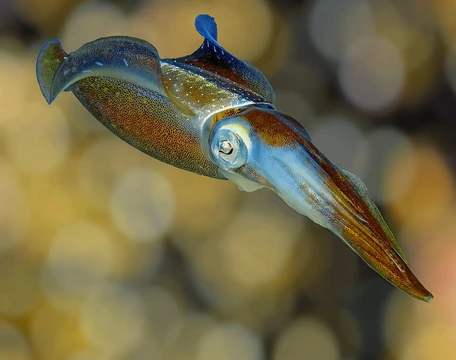
White V octopus
An undescribed octopus that mimics flatfish while remaining cryptically colored.

The white V octopus—also called Octopus sp.18 or blandopus—is an unnamed octopus species from the Octopodidae family, living in the Indo-Pacific. Because its physical features haven’t been fully documented, it lacks a formal scientific name, but genetic analysis shows it is closely related to both the mimic octopus and the wunderpus. Some researchers classify it under the genus *Abdopus*.
This species is small, with arms reaching up to 15 centimeters (5.9 inches) long. It lives in marine environments in Indonesia, including the Lembeh Strait, and the Philippines, favoring sandy seafloors at depths less than 50 meters (160 feet). Like its relatives, the white V octopus can mimic flatfish, but it stays cryptically colored while doing so—unlike the mimic octopus. It has been described as a “high-fidelity mimic of *Bothus mancus*.” It only performs this flatfish imitation when moving quickly and appears less versatile as a mimic than the mimic octopus. Since it shares its habitat with both the wunderpus and the mimic octopus, scientists assume they compete, but the details of their ecological interactions need more study.
A 2010 phylogenetic study by Huffard, Saarman, Hamilton, and Simison proposed that the white V octopus and the Hawaiian long-armed sand octopus should be placed in the genus *Thaumoctopus*, though this would make *Wunderpus* a junior synonym of that genus. Alternatively, the group is called the “Long Armed Sand Octopus” (LASO) clade.
Quick Facts
- Taxon
- Octopodidae
- Species Text
- White V octopus
- Binomial Text
- Not yet named
Facts from the source article.
Lore & Background
The white V octopus is a small-bodied species with arms up to 15 centimetres long. It is found in marine habitats in Indonesia, such as the Lembeh Strait, and the Philippines, inhabiting sandy substrates at depths less than 50 metres. It is sympatric with both the wunderpus and mimic octopus, and it is assumed they all compete with one another, though the specifics of their ecological interaction require further study.
The white V octopus is able to mimic flatfish, akin to its close relatives, though it remains cryptically colored during this behavior, unlike the mimic octopus. It has been suggested that this species is a 'high-fidelity mimic of Bothus mancus'. The white V octopus only mimics flatfish when moving quickly and seems to be a less prolific mimic than the mimic octopus.
A 2010 phylogenetic study by Huffard, Saarman, Hamilton, and Simison placed the white V octopus in a clade that also includes the Hawaiian long-armed sand octopus. The authors suggested that both should be included in the genus Thaumoctopus, though this would necessarily render Wunderpus as that genus' junior synonym. Alternatively, the clade is referred to as the 'Long Armed Sand Octopus' clade (LASO).
Reader's Guide
The white V octopus is notable primarily for its genetic and behavioral relationship to the better-known mimic octopus and wunderpus. Its undescribed status means it lacks a formal binomial name, but genetic studies have confirmed its close kinship within the family Octopodidae. The species is considered a 'high-fidelity mimic of Bothus mancus', a flatfish, but it only performs this mimicry when moving quickly and remains cryptically colored during the act, distinguishing it from the more flamboyant mimic octopus. Its sympatry with both wunderpus and mimic octopus suggests ecological competition, though the details remain unstudied. The 2010 phylogenetic study by Huffard et al. proposed placing it in the genus Thaumoctopus, which would make Wunderpus a junior synonym, but this taxonomic revision has not been universally adopted. The species is also sometimes considered a member of Abdopus. Its presence in the Lembeh Strait and Philippines makes it a subject of interest for marine biologists studying mimicry and competition among cephalopods.
Anatomy & Physical Versatility
The White V octopus is a soft-bodied mollusc defined by its extraordinary physical versatility. Lacking any internal skeleton, its entire form is composed of flexible tissue, allowing it to contort and compress its body to pass through openings barely wider than a thumb. Its eight arms function as muscular hydrostats, packed with longitudinal, transverse, and circular muscle fibers arranged around a central nerve, giving each limb the ability to coil in any direction, stiffen at will, or stretch and squash as needed. The inner surfaces of these arms are lined with circular, adhesive suckers—each a two-part muscular structure—that let the animal grip surfaces or manipulate objects with precision. The two rear arms typically serve as walking legs along the seafloor, while the remaining six are deployed for foraging. Size variation across the roughly 300 species in the order is staggering: the giant Pacific octopus can reach a documented live mass of 71 kilograms with an arm span approaching five meters, while the tiniest known species measures just 2.5 centimeters and weighs under a gram. A hollow, bulbous mantle fused to the head houses the gills and most vital organs, and a muscular siphon handles both respiration and jet-propelled locomotion.
Life Cycle & Reproductive Sacrifice
Reproduction in the White V octopus follows a starkly tragic arc. Most species grow rapidly, reach maturity early, and live only briefly. When the time comes, the male employs a specially modified arm to transfer sperm directly into the female's mantle cavity. Immediately afterward, he enters a state of rapid senescence and dies. The female, by contrast, deposits her fertilized eggs in a sheltered den and devotes herself entirely to guarding them until they hatch. Once the young emerge, she too perishes, completing a lifecycle in which both parents sacrifice their lives for a single reproductive event. As predators, these animals prey on crustaceans, bivalves, gastropods, and small fish. When threatened by larger hunters, they deploy an arsenal of defenses: expelling clouds of ink, shifting coloration for camouflage, performing threat displays, jetting away at speed, hiding in crevices, and even employing deceptive behaviors. Every octopus species carries venom, though only the blue-ringed variants possess toxins lethal to humans.
Intelligence, Habitat & Sensory World
Among invertebrates, the White V octopus stands out for the sophistication of its nervous system and the breadth of its behavioral repertoire. It possesses excellent vision and a complex neural architecture that places it among the most intelligent and behaviorally diverse invertebrates known. The order Octopoda, to which it belongs, encompasses approximately 300 species and sits within the broader class Cephalopoda alongside squids, cuttlefish, and nautiloids. These animals occupy an astonishing range of marine environments, from coral reefs and open pelagic waters to abyssal depths, with some species thriving in the intertidal zone. Their bilateral symmetry places the beaked mouth and two eyes at the center of the eight-limbed arrangement, while the head houses both the brain and the mouth. The skin itself is a dynamic organ: a thin epidermis layered over a collagen-rich dermis containing specialized cells that enable rapid color change for camouflage. This combination of neural complexity, sensory acuity, and physical adaptability makes the octopus one of the most behaviorally diverse animals in the invertebrate world.
Cultural Presence & Linguistic Legacy
The White V octopus has left a deep imprint on human culture and language. In Norse mythology it surfaces as the terrifying kraken; among the Ainu people it appears as Akkorokamui; and some scholars have even linked it to the Gorgons of ancient Greek legend. Victor Hugo devoted a dramatic chapter to a sailor's struggle with one in his novel Toilers of the Sea, and in Japanese shunga erotic art the creature appears as a recurring motif. In the kitchens of the Mediterranean and across Asia, octopus is regarded as a culinary delicacy. The very name carries a linguistic history: the scientific term derives from Ancient Greek oktōpous, a compound of oktō meaning 'eight' and pous meaning 'foot,' a form used by the Byzantine-era writer Alexander of Tralles. The English plural has been a source of persistent debate. The standard form is octopuses; the Greek-derived octopodes is acknowledged but rare; and octopi, though common in casual speech, is widely regarded as etymologically incorrect because it misapplies a Latin second-declension ending to a third-declension noun. H. W. Fowler declared only octopuses acceptable, while the Oxford English Dictionary lists all three in order of frequency.
Frequently Asked Questions
What is the White V octopus?
The White V octopus is a small, undescribed octopus in the family Octopodidae found across the Indo-Pacific. It is known by informal labels such as "Octopus sp.18" and "blandopus," and some taxonomists slot it into the genus Abdopus based on genetic data linking it to the mimic octopus and the wunderpus.
Where does the White V octopus live?
It has been recorded in shallow Indonesian waters, notably the Lembeh Strait, as well as in Philippine seas. The species favors sandy substrates at depths shallower than about 50 metres.
How big does the White V octopus get?
It is a compact octopus whose arms can reach roughly 15 centimetres (about 6 inches) in length, placing it among the smaller members of its family.
Why hasn't the White V octopus been given a proper scientific name?
A complete morphological description has never been published, so no valid binomial name exists yet. Researchers rely on genetic comparisons to the mimic octopus and wunderpus to place it tentatively within Abdopus until a full physical account is available.
How does the White V octopus defend itself from predators?
Instead of flashy coloration, it stays cryptically colored to match sandy seafloors and can additionally mimic the body shape of a flatfish. This combination of background matching and behavioral mimicry makes it extremely difficult for predators to single out.
More in Reef Cephalopods, Part 2 1-24
Spotted an error? Know more?
Reader corrections go straight into our review queue. Suggest an edit · How this site is sourced