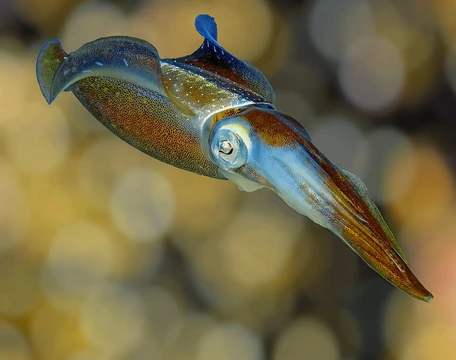
Pharaoh cuttlefish
A large cuttlefish complex native to the Indian Ocean and Red Sea.

The pharaoh cuttlefish (Acanthosepion pharaonis) is a large cuttlefish species, growing to 42 cm in mantle length and 5 kg in weight. It is likely a complex of at least three species, with the type specimen collected in the Gulf of Suez and deposited at the Museum für Naturkunde in Berlin. It is notable as the most commonly caught cuttlefish in the Persian Gulf and the most economically important cuttlefish in the northern Indian Ocean.
Quick Facts
- Genus
- Acanthosepion
- Species
- pharaonis
Facts from the source article.
Lore & Background
The pharaoh cuttlefish shows a solid colour when resting on a solid background, alternating from pale white to dark brown, and can also show a mottled white and brown pattern with a brown centre circle. Its colour-changing function is produced by groups of red, yellow, brown, and black chromatophores above reflective blue and green iridophores and leucophores, with up to 200 pigment cells per square millimeter controlled by rings of muscle. It is native to at least the western Indian Ocean, including the Red Sea and Persian Gulf, and is thought to have reached the Mediterranean as a Lessepsian migrant via the Suez Canal after cuttlebones washed up on Israeli beaches in the early 2000s. It prefers mud substrata during the day and either sand or mud at night, and has been observed migrating off the southwest coast of India, with more juveniles in May and more adults in August.
Reader's Guide
The pharaoh cuttlefish is significant as a commonly fished species in the Philippines and the most economically important cuttlefish in the northern Indian Ocean, often consumed as dried, shredded cuttlefish. Its roe was considered a sought-after delicacy in the Qing Dynasty-era manual Suiyuan shidan. It is also harvested commercially in the Suez Canal, Egypt. Cuttlefish ink was historically used as the dye sepia, now mostly replaced by artificial dyes. In terms of behavior, it exhibits an arm-flapping display during hunting, believed to mimic hermit crabs to lure prey, though this requires further verification. Its ambush hunting style uses a three-step process of attention, positioning, and seizure, adapted due to its small squat body and lack of speed. Reproduction involves male combat resolved through displays, followed by mating and egg-laying in phases.
Did You Know?
- It has been observed using an arm-flapping display that may mimic hermit crabs.
- Its type specimen is deposited at the Museum für Naturkunde in Berlin.
Frequently Asked Questions
What is the Pharaoh cuttlefish?
The Pharaoh cuttlefish (Acanthosepion pharaonis) is a large cephalopod native to the Indian Ocean and Red Sea, recognized as one of the biggest cuttlefish in that region. Its type specimen was collected in the Gulf of Suez and is currently held at the Museum für Naturkunde in Berlin.
How big does a Pharaoh cuttlefish get?
Individuals can reach up to 42 cm in mantle length and weigh as much as 5 kg, placing them among the largest cuttlefish you will encounter in the northern Indian Ocean.
Where can I find a Pharaoh cuttlefish?
This species ranges across the Indian Ocean and the Red Sea, with the Persian Gulf being a particularly common area where it turns up in fishery catches.
Is the Pharaoh cuttlefish actually a single species?
Not quite—researchers suspect A. pharaonis is really a complex of at least three distinct species (designated I, II, and III) that have been lumped together under one name.
Why is the Pharaoh cuttlefish important to fisheries?
It is the most frequently landed cuttlefish in the Persian Gulf and is regarded as the most economically significant cuttlefish across the northern Indian Ocean as a whole.
More in Reef Cephalopods, Part 2 1-24
Spotted an error? Know more?
Reader corrections go straight into our review queue. Suggest an edit · How this site is sourced