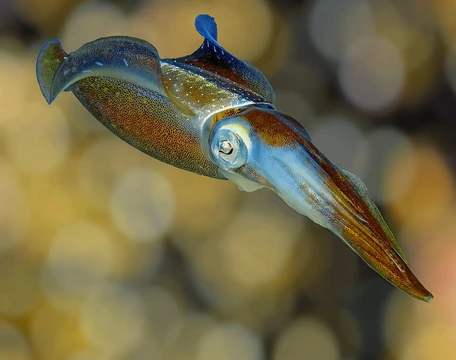
Thaumeledone gunteri
A small deep-sea octopus with purple tubercles near South Georgia.

Thaumeledone gunteri is a small, bottom-dwelling octopus that lives in the deep sea, specifically the bathyal zone of the Southern Ocean near South Georgia. Its body is whitish, but both the top and underside are covered with large, irregular, deep purple bumps called tubercles. The mantle is about 5 cm long, and the total length reaches 10 cm, with arms that are also around 5 cm. The web connecting the arms is pale, and the head is narrower than the mantle, with several large tubercles above each eye. Each of the eight arms is linked by a deep web and has roughly 35 small suckers. The funnel organ is shaped like a "VV," and the radula has five elements. A key identifying feature is the posterior salivary gland, which measures 11 mm in diameter.
In terms of relationships, *T. gunteri* shares a similar funnel organ and a characteristic loop in the rectum with *Thaumeledone peninsulae*. However, a 2008 molecular study found that *T. gunteri* and *Thaumeledone rotunda* are sister species, while *T. peninsulae* is more distantly related. *T. rotunda* itself is a circumpolar species found at greater depths and differs in several morphological traits from the other two.
This octopus is found in the far southern Atlantic Ocean, around South Georgia and the Shag Rocks, between 53°S and 55°S and 39°W to 35°W. It has been caught by trawling at depths of 364 to 964 meters, though it may live deeper, as the area remains relatively unexplored.
Quick Facts
- Taxon
- Thaumeledone gunteri
Facts from the source article.
Lore & Background
Thaumeledone gunteri is a benthic octopus with a mantle length of about 5 cm and total length of 10 cm, its arms being relatively short at 5 cm. The background colour is whitish, but both dorsal and ventral surfaces are covered by large, irregular, deep purple tubercles. The web linking the arms is uniformly pale, and the head is narrower than the mantle, with several large tubercles above the eye. The eight arms are joined by a deep web, with about 35 small suckers on each arm. The funnel organ is 'VV'-shaped, and there are five elements in the radula. The posterior salivary gland, a diagnostic feature in this genus, has a diameter of 11 mm.
Phylogenetically, the funnel organ in T. gunteri is similar to that in Thaumeledone peninsulae, and they both share a characteristic loop in the rectum. Thaumeledone rotunda is a circumpolar species found at greater depths and has several morphological features differing from the other two species. Despite this, a phylogenetic study of the molecular relationships in the genus determined that T. gunteri and T. rotunda are sister taxa and that T. peninsulae is more distantly related.
T. gunteri is found in the far south Atlantic Ocean in an area around South Georgia, including the Shag Rocks, ranging from 53°S to 55°S and 39°W to 35°W. It has been caught by trawling at depths of 364–964 m, but may well occur at greater depths, as these waters are relatively underexplored.
Reader's Guide
Thaumeledone gunteri contributes to the understanding of deep-sea octopus diversity in the Southern Ocean. Its morphological features, such as the 'VV'-shaped funnel organ and the large posterior salivary gland, are diagnostic within the genus. The species' phylogenetic relationships are notable: although T. gunteri shares a similar funnel organ and a rectal loop with T. peninsulae, molecular analysis shows it is more closely related to T. rotunda, a circumpolar species found at greater depths. This highlights that morphological similarity does not always reflect evolutionary relatedness. The species' known distribution is restricted to a relatively small area around South Georgia and the Shag Rocks, at depths between 364 and 964 m, but the article notes that it may occur at greater depths due to underexploration. This uncertainty underscores the need for further survey work in the region. The species' small size, benthic lifestyle, and distinctive tubercles add to the known morphological variation among deep-sea octopods. Its presence in the bathyal zone of the Southern Ocean contributes to the ecological characterization of this remote habitat.
Did You Know?
- The posterior salivary gland of Thaumeledone gunteri has a diameter of 11 mm.
- Thaumeledone gunteri and Thaumeledone rotunda are sister taxa according to a molecular phylogenetic study.
- The species has been caught by trawling at depths from 364 to 964 m.
- Its funnel organ is described as 'VV'-shaped.
Frequently Asked Questions
What is Thaumeledone gunteri?
It is a small, benthic octopus species that inhabits the deep waters of the Southern Ocean, specifically the bathyal zone off the coast of South Georgia. It belongs to the family Megaleledonidae and is one of the less commonly encountered cephalopods in that region.
What does Thaumeledone gunteri look like?
Its body is predominantly whitish, but both the dorsal and ventral surfaces are studded with large, irregular, deep-purple tubercles. The head is noticeably narrower than the mantle, and each eye sits beneath several prominent tubercles, while the arms are joined by a deep, pale web.
Where and at what depth does Thaumeledone gunteri live?
It is a bottom-dweller found in the bathyal zone of the Southern Ocean near South Georgia, with recorded depths ranging from roughly 364 to 964 metres. It remains on or near the seafloor throughout its range rather than rising into the water column.
How big is Thaumeledone gunteri?
The mantle measures about 5 cm in length, and the animal reaches roughly 10 cm end-to-end, with each of its eight arms also around 5 cm long. Each arm carries approximately 35 small suckers, and the posterior salivary gland is about 11 mm in diameter.
What makes Thaumeledone gunteri stand out among deep-sea octopuses?
Its striking pattern of large, deep-purple tubercles against a pale body is unusual even among bathyal cephalopods. Combined with its very small size and the deep, continuous web linking all eight arms, it has a distinctive silhouette that separates it from most other Southern Ocean octopods.
More in Reef Cephalopods, Part 2 1-24
Spotted an error? Know more?
Reader corrections go straight into our review queue. Suggest an edit · How this site is sourced