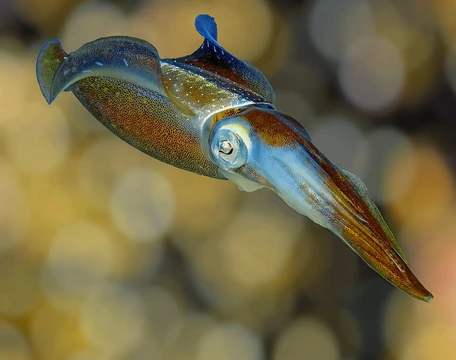
Ascarosepion novaehollandiae
A cuttlefish from southern Indo-Pacific, often confused with juvenile Sepia apama.

Ascarosepion novaehollandiae is a species of cuttlefish native to the southern Indo-Pacific, with a natural range from Shellharbour, New South Wales to the Northwest Shelf in Western Australia. It lives at depths between 15 and 348 m and is notable for its morphological similarities to juvenile Ascarosepion apama, which has led to difficulties in distinguishing the two species.
Quick Facts
- Genus
- Ascarosepion
- Species
- novaehollandiae
Facts from the source article.
Lore & Background
The type specimen of Ascarosepion novaehollandiae was collected off Kangaroo Island, South Australia, and is deposited at the Muséum National d'Histoire Naturelle in Paris. The species was described by Hoyle in 1909. It is known to grow to a mantle length of 77 mm, but specimens from Spencer Gulf reach mantle lengths of around 125 mm, and larger cuttlebones reaching lengths of 170 mm have also been found.
Specimens from Spencer Gulf have mantle lengths and weights rarely exceeding 125 mm and 521 grams respectively. The mantle is oblong with narrow lateral fins running along its length. Specimens are brown, with small white blotches speckled on the mantle, and there are no discernible patterns on the arms. The cuttlebone is elongate oval, acutely narrowing at both ends, with a pinkish tinge on the posterior dorsal surface and fine denticulate projections.
Fishery dependent and independent data from Spencer Gulf show that largest populations of sexually immature individuals are caught between February and May annually, with no data published for months July–October or January. The species is not targeted commercially in South Australia but is caught in marine scalefish fisheries and as bycatch by trawl fisheries.
Reader's Guide
Ascarosepion novaehollandiae is significant primarily for its interactions with fisheries in South Australia, particularly the Spencer Gulf Prawn Fishery, which catches more individuals of this species than either of the other cuttlefish bycatch species: Sepia apama and Sepia braggi. Its morphological similarities and overlapping geographical ranges with juvenile Ascarosepion apama have caused difficulties in distinguishing the two species, complicating bycatch assessments. The species is not commercially targeted but is caught incidentally in marine scalefish fisheries and as bycatch by trawl fisheries. The description of its cuttlebone by SARDI scientist Mike Steer in 2015 provides detailed morphological characteristics that aid in identification. The lack of published data for months July–October and January leaves gaps in understanding its seasonal population dynamics. Its type specimen, collected off Kangaroo Island and housed in Paris, anchors its taxonomic history, while the Spencer Gulf population shows larger sizes than typical, suggesting regional variation.
Did You Know?
- Specimens from Spencer Gulf rarely exceed 125 mm mantle length and 521 grams.
- The Spencer Gulf Prawn Fishery catches more individuals of A. novaehollandiae than either Sepia apama or Sepia braggi.
Taxonomic Placement & the 2023 Reorganization
Ascarosepion novaehollandiae, commonly known as the New Holland cuttlefish, occupies a position within one of the family Sepiidae's most recently restructured lineages. For decades, the entire family was organized under just three genera—Metasepia, Sepia, and Sepiella—with the bulk of species crammed into Sepia and its numerous subgenera. That tidy picture shattered in 2023, when a phylogenetic study revealed that Sepia actually harbored several distinct monophyletic clades. The authors responded by resurrecting previously synonymized genus names and elevating select subgenera to full genus rank, redistributing many species in the process. In that reshuffling, Metasepia was shown to nest inside one of the revived genera and, because it had originally been named after Ascarosepion, was demoted to a junior synonym. The result is a genus Ascarosepion now housing thirteen species, from the flamboyant cuttlefish to the giant Australian cuttlefish, with A. novaehollandiae standing as one of its members. Across the family, one hundred sixteen species are currently recognized.
The Cuttlebone & Physical Architecture
Like every member of the family Sepiidae, the New Holland cuttlefish carries a substantially reworked internal shell called the cuttlebone, a porous structure built from aragonite. Unlike squid or octopus relatives, cuttlefish are the only coleoid cephalopods (aside from Spirula) whose shell is organized as a phragmocone—a series of chambers separated by thin septa. The animal fine-tunes its buoyancy by shifting the gas-versus-liquid balance inside those chambers through a specialized ventral siphuncle. What makes each species visually distinct is the cuttlebone's shape, size, and ridge pattern, meaning A. novaehollandiae possesses its own characteristic bone architecture. Externally, the animal displays the classic cephalopod toolkit: large W-shaped pupils, eight flexible arms, and two longer tentacles lined with denticulated suckers used to seize prey. Most cuttlefish species fall in the fifteen-to-twenty-five-centimeter range, though the giant Australian cuttlefish in the same genus can stretch to fifty centimeters in mantle length. Their eyes, while superficially resembling vertebrate eyes, develop through a fundamentally different organogenic pathway.
Ecological Niche & Cognitive Capacity
In its marine habitat, the New Holland cuttlefish occupies a mid-level position in the food web. Its diet spans small molluscs, crabs, shrimp, small fish, octopuses, and even conspecifics, reflecting the opportunistic predatory strategy typical of the family. In turn, it faces threats from dolphins, larger fish including sharks, seals, seabirds, and rival cuttlefish. The species' life expectancy hovers around one to two years, a brief window in which it must grow, reproduce, and navigate a crowded ecological landscape. What sets cuttlefish apart from most other invertebrates is their cognitive profile: studies consistently place them among the most intelligent invertebrate animals known, and they boast one of the largest brain-to-body-size ratios in the entire invertebrate kingdom. This combination of sensory acuity—exemplified by their sophisticated, independently evolved eyes—and neural processing power underpins the complex hunting, camouflage, and social behaviors that make the family Sepiidae a subject of sustained scientific fascination.
Deep Time & Cultural Footprint
The lineage to which the New Holland cuttlefish belongs stretches back to the close of the Cretaceous period. The earliest recognized cuttlefish fossils, represented by Ceratisepia, come from the Late Maastrichtian Maastricht Formation in the Netherlands, anchoring the group's fossil record in that final chapter of the dinosaur era. An earlier Jurassic form, Trachyteuthis, was once thought to be a cuttlefish relative, but subsequent analyses have repositioned it closer to octopuses and vampire squids. Beyond paleontology, cuttlefish left a lasting mark on human culture. The Greco-Roman world prized the reddish-brown pigment the animal ejects from its siphon when alarmed, and the Greek and Latin word for the creature—sepia—survives in English as the name for that distinctive hue. The English common name 'cuttlefish' itself traces back to the Old English cudele, a term possibly cognate with Old Norse koddi meaning cushion and Middle Low German Kudel meaning rag, hinting at how early European speakers perceived the animal's soft, rounded body.
Frequently Asked Questions
What is Ascarosepion novaehollandiae?
It is a small cuttlefish species distributed across the southern Indo-Pacific, stretching from New South Wales to the Western Australian Northwest Shelf. Hoyle first gave it a formal name in 1909, and it inhabits waters ranging from roughly 15 m to about 348 m in depth.
How large does Ascarosepion novaehollandiae grow?
Most specimens top out around 77 mm in mantle length, making it a compact cuttlefish. However, records from Spencer Gulf document individuals reaching 125 mm in mantle length and weighing up to 521 grams, suggesting some populations can be considerably larger.
Why do researchers keep mistaking Ascarosepion novaehollandiae for Sepia apama?
The two species are morphologically nearly indistinguishable in their juvenile stages, which creates persistent identification headaches in field collections. This overlap has made definitive species-level sorting a long-standing challenge for cephalopod taxonomists working in the southern Australian region.
Where is the type locality of Ascarosepion novaehollandiae?
The original specimens examined by Hoyle in 1909 came from Kangaroo Island, South Australia, at approximately 35°50′S, 138°03′E. This site anchors the species' formal description in the taxonomic record.
What depth range does Ascarosepion novaehollandiae occupy?
It has been recorded from shallow zones near 15 m all the way down to roughly 348 m, giving it a remarkably broad vertical distribution. This wide depth tolerance helps explain why it turns up across such diverse habitats along the southern Australian coastline.
More in Reef Cephalopods, Part 2 1-24
Spotted an error? Know more?
Reader corrections go straight into our review queue. Suggest an edit · How this site is sourced