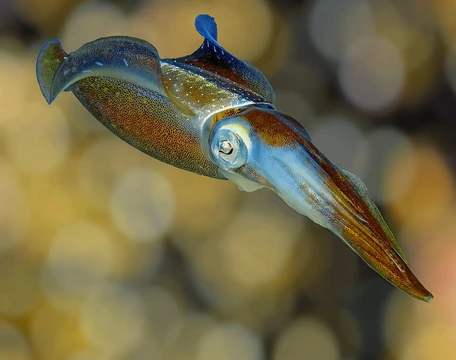
Ascarosepion pfefferi
A venomous cuttlefish that walks and flashes warning colors.

Ascarosepion pfefferi, called the flamboyant cuttlefish, lives in the tropical Indo-Pacific, from northern Australia and southern New Guinea to islands in the Philippines, Indonesia, and Malaysia.
The first specimen—a female—was collected on October 9, 1874, during the Challenger expedition at a depth of 51 meters in the Arafura Sea. It is now kept at the Natural History Museum in London. In 2023, this species was moved into the genus Ascarosepion, alongside 13 others like the broadclub, reaper, and giant cuttlefish. This change made the old genus Metasepia obsolete.
This cuttlefish has a broad, oval body and wide, blade-like arms with four rows of suckers. Males use a modified left ventral arm (the hectocotylus) for fertilization; its tip is swollen and fleshy, with grooved ridges and a deep central furrow. The tentacle clubs are flattened, with five or six suckers per row; the largest sit near the club’s center, and three or four median suckers are especially big. The swimming keel extends close to the carpus. The dorsal and ventral protective membranes are not joined at the club’s base but fuse to the stalk; they differ in length, and the dorsal membrane has a shallow cleft where it meets the stalk.
The cuttlebone is small—two-thirds to three-quarters the length of the mantle—and sits toward the front. It is rhomboid-shaped, tapering to a point at both ends. The dorsal surface is yellowish, smooth, and evenly convex, with no bumps or a median rib. A thin chitin film covers it. There is no pronounced spine; if present, it is tiny and chitinous. The striated zone is concave, with the last loculus thick and convex in the front third. The sulcus is deep and wide, running only along the striated zone. Striae form an inverted V. The inner cone has short, narrow limbs of even width, with a U-shape that thickens slightly toward the back. There is no outer cone, which—along with its sister species A. tullbergi—allows this cuttlefish to walk on the seafloor. Because the cuttlebone is small, it can only float briefly.
Most sources say the mantle grows to 8 cm long, though some give 6 cm. The dorsal mantle has three pairs of large, flat, flap-like papillae, with more papillae over the eyes.
Its range stretches from Mandurah in Western Australia northeast to Moreton Bay in southern Queensland, across the Arafura Sea to southern New Guinea.
Quick Facts
- Genus
- Ascarosepion
- Species
- pfefferi
Facts from the source article.
Lore & Background
The type specimen of Ascarosepion pfefferi, a female, was collected on October 9, 1874, during the Challenger expedition at a depth of 28 fathoms in the Arafura Sea. It is housed at The Natural History Museum in London. In 2023, the species was moved into the genus Ascarosepion, grouping it with 13 other species including the broadclub cuttlefish, reaper cuttlefish, and giant cuttlefish, rendering the former genus Metasepia obsolete.
A. pfefferi has a robust, broad oval mantle and blade-like arms with four rows of suckers. Its cuttlebone is small, rhomboidal, and lacks an outer cone, which is unique among cuttlefish and allows it to walk on the sea floor. The dorsal surface bears three pairs of large, flat papillae, with additional papillae over the eyes. Its normal base color is dark brown, but when disturbed it changes to a pattern of black, dark brown, white, and yellow patches, with bright red arm-tips, and it may walk while waving its arm membranes to advertise its toxicity.
The species ranges from Mandurah in Western Australia to Moreton Bay in southern Queensland, across the Arafura Sea to southern New Guinea, and is recorded from Sulawesi, the Maluku Islands, the Malaysian islands of Mabul and Sipadan, and the Philippines, especially the Visayas. It inhabits sand and mud substrates at depths of 3–86 m, is active during the day, and hunts fish and crustaceans using complex camouflage.
Reader's Guide
The flamboyant cuttlefish holds significance as one of only three cephalopods confirmed to be poisonous, with muscle tissue found highly toxic in a toxicology report. Research by Mark Norman at Museum Victoria showed the toxin matches that of the blue-ringed octopus, though preliminary studies at Georgia Southern University and Utah State University-Uintah Basin found only trace amounts of tetrodotoxin too low to be toxic to vertebrates. This toxicity, combined with its spectacular color and textural displays, makes it of no interest to fisheries but an excellent candidate for private aquariums if supply were steady. It is sometimes seen in public aquariums through captive breeding programs, such as at the Monterey Bay Aquarium. Its unique walking behavior, enabled by the small cuttlebone lacking an outer cone, and its precocial hatchlings that can immediately produce adult camouflage patterns, further distinguish it among cephalopods. The species' reclassification in 2023 into Ascarosepion reflects ongoing taxonomic refinement, and its type specimen remains a key historical reference from the Challenger expedition.
Did You Know?
- The flamboyant cuttlefish is one of only three cephalopods confirmed to be poisonous, with muscle tissue containing a toxin similar to that of the blue-ringed octopus.
- Its cuttlebone lacks an outer cone, a feature that allows it to walk on the sea floor using its lower arms.
- Hatchling A. pfefferi are precocial and can produce the same camouflage patterns as adults immediately after emergence.
Discovery & Taxonomic Journey
The flamboyant cuttlefish first entered the scientific record during the Challenger expedition. On October 9, 1874, a female specimen was hauled from 51 meters of water in the Arafura Sea near Challenger Station 188, and that single individual became the type specimen now housed at The Natural History Museum in London. For nearly a century and a half, the species sat within the genus Metasepia. That arrangement ended in 2023 when taxonomists reorganized the group, placing A. pfefferi into the newly recognized genus Ascarosepion. This move made Metasepia obsolete and grouped the flamboyant cuttlefish alongside thirteen relatives, including the broadclub, reaper, and giant cuttlefish. The reclassification reflects a deeper understanding of cephalopod evolutionary relationships and underscores how much can shift in our understanding of even well-known marine animals.
Anatomy of a Sea-Floor Walker
The flamboyant cuttlefish is a compact, robust animal, typically reaching 6 to 8 centimeters in mantle length. Its most striking anatomical feature is the cuttlebone: small, rhomboidal, and occupying only two-thirds to three-quarters of the mantle's anterior length. Crucially, it lacks the outer cone found in most other cuttlefish. This structural absence means the animal can maintain buoyancy only briefly, compelling it to spend most of its life in contact with the seafloor. Indeed, A. pfefferi and its close relative A. tullbergi are the only known cuttlefish that walk. Its arms are wide and blade-shaped, each lined with four rows of suckers, while the dorsal surface of the mantle carries three pairs of large, flat, flap-like papillae. The hectocotylus—the specialized left ventral arm used in mating—features a wide, swollen, fleshy oral surface with transversely grooved ridges and a deep central furrow, and its tentacular clubs carry five or six suckers of markedly different sizes arranged in transverse rows.
A Warning Written in Color
During daylight hours, the flamboyant cuttlefish patrols sandy and muddy bottoms between 3 and 86 meters, stalking fish and crustaceans with elaborate camouflage. At rest, its base coloration is a muted dark brown. But when threatened, the transformation is dramatic: the body erupts into a high-contrast mosaic of black, dark brown, and white, with vivid yellow patches flanking the mantle, arms, and eyes. The arm tips flash bright red. While displaying this aposematic pattern, the animal lowers its body and uses its lower arms to amble across the substrate, rhythmically waving the broad protective membranes on its arms—a visual advertisement meant to signal its toxic flesh. The toxin question remains debated. A toxicology report confirmed the muscle tissue is highly poisonous, and research by Mark Norman at Museum Victoria linked the compound to that of the blue-ringed octopus. Yet preliminary work from Georgia Southern and Utah State–Uintah Basin detected only trace tetrodotoxin, at concentrations too low to harm vertebrates.
Courtship, Eggs, and Precocial Young
Reproduction in the flamboyant cuttlefish is an intimate, face-to-face affair. The male inserts a sperm packet into a pouch on the underside of the female's mantle, after which she fertilizes her eggs internally. She then lays them one at a time, tucking each into crevices or ledges of coral, rock, or driftwood. In one documented case, a female threaded roughly a dozen eggs through the central hole of an overturned coconut husk half, sheltering them from predatory fish. Freshly deposited eggs are opaque white, but they gradually become translucent, revealing the developing embryo within. Once hatched, the tiny cuttlefish are fully independent—precocial in every sense. They can immediately produce the same complex camouflage patterns as adults and receive no parental care whatsoever. This self-sufficiency from the moment of emergence is a remarkable trait for such a small, benthic cephalopod.
Frequently Asked Questions
Who is Ascarosepion pfefferi?
Ascarosepion pfefferi is a small, venomous cuttlefish commonly known as the flamboyant cuttlefish, native to tropical Indo-Pacific reef waters. It is instantly recognizable for its bold warning coloration and its unusual ability to walk across the seafloor using its arms.
What are Ascarosepion pfefferi's powers or special traits?
This cuttlefish produces a potent venom and flashes vivid orange, yellow, and black patterns as an aposematic warning to would-be predators. It also locomotes by extending its arms in a slow walking gait rather than relying solely on jet propulsion.
Where does Ascarosepion pfefferi live and how deep can it be found?
The flamboyant cuttlefish ranges across tropical Indo-Pacific reefs, from northern Australia and southern New Guinea eastward to the Philippines, Indonesia, and Malaysia. Individuals have been recorded at depths spanning roughly 3 to 86 meters.
How big does Ascarosepion pfefferi get?
Adults typically reach a maximum mantle length of about 8 centimeters, though some references list a slightly smaller figure near 6 centimeters. Either way, it remains one of the smaller members of its genus.
Why was Ascarosepion pfefferi moved into a new genus in 2023?
A 2023 taxonomic revision transferred this species, along with thirteen other cuttlefishes including the broadclub, reaper, and giant cuttlefish, into the genus Ascarosepion. That reorganization rendered the formerly used genus name Metasepia obsolete.
More in Reef Cephalopods, Part 2 1-24
Spotted an error? Know more?
Reader corrections go straight into our review queue. Suggest an edit · How this site is sourced