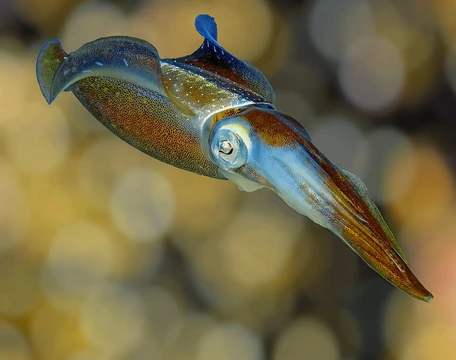
Sepiidae
Marine cephalopods with a unique internal shell and high intelligence.

Sepiidae is a family of marine molluscs commonly known as cuttlefish or cuttles, belonging to the class Cephalopoda, which also includes squid, octopuses, and nautiluses. They are notable for their unique internal shell, the cuttlebone, which is used for buoyancy control, and for being among the most intelligent invertebrates, with one of the largest brain-to-body size ratios of all invertebrates.
Quick Facts
- Taxon
- Sepiidae
Facts from the source article.
Lore & Background
The word 'cuttle' in 'cuttlefish' is derived from the Old English name cudele, possibly cognate with Old Norse koddi (cushion) and Middle Low German Kudel (rag). The Greco-Roman world valued the cuttlefish as a source of the brown pigment it releases from its siphon when alarmed; the word for cuttlefish in both Greek and Latin, sepia, now refers to the reddish-brown color sepia in English.
Cuttlefish have large, W-shaped pupils, eight arms, and two tentacles with denticulated suckers for securing prey. They eat small molluscs, crabs, shrimp, fish, octopuses, and other cuttlefish. Their predators include dolphins, larger fish (including sharks), seals, seabirds, and other cuttlefish. The cuttlebone is a highly modified internal shell made of aragonite, porous and chambered, used for buoyancy regulation via the ventral siphuncle. Each species' cuttlebone has a distinct shape, size, and pattern of ridges or texture.
Cuttlefish have sophisticated eyes that develop fully before birth, allowing them to observe surroundings while still in the egg. They cannot see color but perceive light polarization and use stereopsis for depth perception. Their blood is green-blue due to copper-containing hemocyanin, and they have three hearts: two branchial hearts for the gills and one for the rest of the body. They also possess ink stores used for chemical deterrence, phagomimicry, and sensory distraction.
Reader's Guide
The family Sepiidae has undergone taxonomic revision based on a 2023 study that recovered the genus Sepia as containing several monophyletic clades, leading to the revival of synonymized genera and elevation of some subgenera to full genus level. The genus Metasepia was found to nest within the revived genus Ascarosepion, becoming a junior synonym. Currently, 116 species are recognized, distributed among genera including Acanthosepion, Ascarosepion, Aurosepina, Decorisepia, Digitosepia, Doratosepion, Erythalassa, Hemisepius, Lusepia, Rhombosepion, Sepia, Sepiella, and Spathidosepion. Several species remain in need of taxonomic review, as they were not examined in the 2023 study. The earliest cuttlefish fossils date from the end of the Cretaceous period, with Ceratisepia from the Maastricht Formation of the Netherlands. The Jurassic Trachyteuthis, once considered possibly related, is now thought to be more closely related to octopuses and vampire squids. Cuttlefish are distinguished from squid by their unique cuttlebone, and their sophisticated visual system and large brain-to-body size ratio contribute to their reputation as among the most intelligent invertebrates.
Did You Know?
- Cuttlefish have three hearts: two branchial hearts and one systemic heart.
- Their blood is green-blue because it uses copper-containing hemocyanin instead of iron-containing hemoglobin.
- Cuttlefish cannot see color but can perceive the polarization of light.
- The earliest cuttlefish fossils are from the end of the Cretaceous period, represented by Ceratisepia from the Netherlands.
Frequently Asked Questions
What is Sepiidae?
Sepiidae is the family of marine molluscs we commonly call cuttlefish, sitting alongside squid, octopuses, and nautiluses within the class Cephalopoda. They are set apart by a porous internal structure called a cuttlebone that helps them regulate buoyancy underwater.
What makes cuttlefish different from squid and octopuses?
Their signature feature is the cuttlebone, a lightweight internal shell no other cephalopod possesses, which they use to fine-tune their depth in the water column. They also rank among the most cognitively advanced invertebrates, boasting one of the highest brain-to-body ratios in the animal kingdom.
How big can a cuttlefish get?
Most species fall in the 15 to 25 cm (roughly 6 to 10 in) range, but the giant cuttlefish, Sepia apama, can reach a mantle length of about 50 cm and weigh over 10.5 kg. That makes it by far the largest member of the family.
How long do cuttlefish live?
The typical lifespan for a cuttlefish is only around one to two years, which is remarkably brief for an animal of their size and complexity. This short life cycle means they must mature and reproduce quickly within their marine environment.
How many species of cuttlefish are there, and how old is the family?
Scientists currently recognize 116 distinct species within the family Sepiidae. The earliest known fossil evidence, represented by Ceratisepia from the Late Maastrichtian Maastricht Formation in the Netherlands, dates back to the very end of the Cretaceous period.
More in Reef Cephalopods, Part 2 1-24
Spotted an error? Know more?
Reader corrections go straight into our review queue. Suggest an edit · How this site is sourced