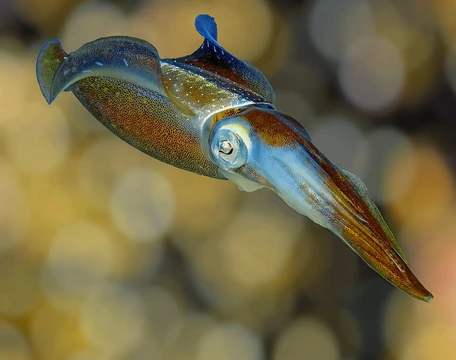
Sepiella japonica
A migratory cuttlefish nearly harvested to extinction.

Sepiella japonica, commonly called the Japanese spineless cuttlefish, lives in the western Pacific near China, Japan, and South Korea. It has long been a key part of local seafood fisheries, but human damage to its crucial habitats and overfishing brought it close to extinction. Protecting this species is tricky because it migrates, which makes fixed strategies like marine protected areas less effective. Its life cycle depends on the specific stops along its migration route, so scientists are studying its behavior and environmental needs more closely—needs that keep shifting as the climate changes.
**Description** This cuttlefish belongs to the class Cephalopoda and phylum Mollusca. Like all cuttlefish (order Sepiida), it has a large, flat mantle cavity that holds its internal shell, the cuttlebone. The cuttlebone stores gases between its septa to control buoyancy, a feature common to cuttlefish but with shapes that vary by species. Despite being an invertebrate, the name “spineless” actually refers to the shape of this internal shell. It has ten limbs: eight arms and two tentacles lined with suckers. The tentacles grab prey first, then the arms pull food toward the mouth at the center of the arms. Suckers also help transfer spermatophores during mating. Like other cephalopods, it uses a siphon—a muscle attached to the mantle—to jet away from predators quickly. Pigments called chromatophores cover its body, allowing it to camouflage, communicate with its own kind, and interact with other species. Its ink has been used in traditional medicine and also helps it escape predators or respond to stress.
**History** Japanese spineless cuttlefish were historically a major asset to Asian fisheries because they were abundant and had short lifespans, so harvested populations could rebound quickly. Their ink was valued in traditional medicine and for its antimicrobial and antioxidant properties. But destruction of key migration sites and heavy harvesting near spawning grounds drove the species to near extinction.
**Habitat** This cuttlefish prefers shallow water and is most common in the East China Sea and South China Sea, with populations also around Japanese islands and South Korea. Because it migrates, its location changes with the seasons.
Quick Facts
- Genus
- Sepiella
- Species
- japonica
Facts from the source article.
Lore & Background
Japanese spineless cuttlefish have been historically very valuable to Asian fishery industries as they were widely abundant and lived short lifespans which helped to replace those that were caught. Their ink has also been very valuable as both an item in traditional medicine, as well as for its antimicrobial and antioxidant properties. Despite their previous abundance, destruction of their major migratory sites, in addition to over harvesting in proximity to their spawning grounds reduced this species to near extinction.
Sepiella japonica is a member of the Cephalopoda class, in the phylum Mollusca. Like other cuttlefish species, the cuttlebone is used to regulate the fish's buoyancy by storing gases between their septa dividers. Despite being a member of the invertebrates, the term 'spineless' is actually in reference to the morphology of their internal cuttlebone. They have 10 limbs, 8 of which are arms, and the remaining two are tentacles lined with suckers for improved utility. Their tentacles are lined with suction cups to help them grip onto prey or transfer their spermatophores during mating. Cuttlefish also have special pigments called chromatophores that help them camouflage, interact with members of their own species, and others. Their ink has been used historically as traditional medicine but also serves the individual in predator evasion or as a stress response.
Most cephalopods, including the near species Sepiella inermis, are gonochoristic. Sepiella japonica are also thought to be semelparous, meaning they only reproduce once in their lifetime and die soon after. Males pass spermatophores into the female's cavity; it is recorded that males may spray a jet of water into the females’ cavity to clear it of competing male's sperm. Females lay eggs attached to rocky substrate, often gorgonian coral, in shallow spawning grounds.
Reader's Guide
The conservation of Sepiella japonica has presented numerous complications as their migratory nature complicates typical protection strategies like the establishment of marine protected areas (MPAs). Their development is contingent upon the stops along their migration, which has prompted further research into their behavior and environmental requirements. Currently, there are established MPAs along the Chinese coastline near this species' spawning grounds to reduce anthropogenic interruption, but because of the migratory nature of the species, only protecting their spawning grounds only helps a stage across their entire life cycle. The specialized protection of their spawning grounds still leaves them vulnerable as they migrate away from coastal regions into open ocean where they feed to grow and mature. Continued increase in ocean acidification poses a potential concern, as this species has demonstrated considerable sensitivity to salinity, pH, water temperature, and dissolved oxygen content. Ocean acidification also threatens the calcium carbonate substrates to which they attach their eggs. Anthropogenic interference can decimate potential spawning grounds, reducing their capacity to lay eggs.
Did You Know?
- Sepiella japonica is called 'spineless' in reference to the morphology of its internal cuttlebone, not because it lacks a spine.
- Males may spray a jet of water into the female's cavity to clear competing males' sperm.
- Their migration destinations may shift according to different environmental factors, but they routinely rely on shallow waters with firm substrate for spawning grounds.
- Juveniles hatch from egg clusters in shallow coastal regions less than 60 meters deep.
More in Reef Cephalopods, Part 2 1-24
Spotted an error? Know more?
Reader corrections go straight into our review queue. Suggest an edit · How this site is sourced