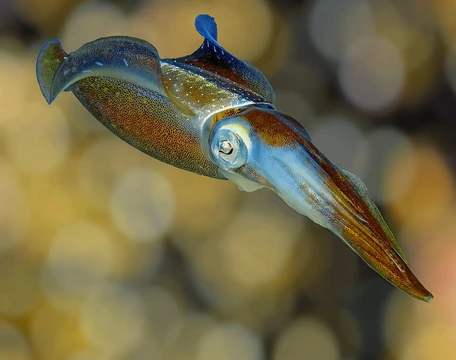
Sepiella inermis
A small, economically important cuttlefish of the Indo-Pacific.

Sepiella inermis is a species of cuttlefish in the family Sepiidae, indigenous to the Indo-Pacific region. It is notable as an economically important species that is sold and eaten throughout its range.
Quick Facts
- Genus
- Sepiella
- Species
- inermis
Facts from the source article.
Lore & Background
Sepiella inermis is a relatively small cuttlefish with narrow fins and a moderately small, ovate shell that is white with a brown, polished horny margin. Its dorsal surface ranges from gray-brown to purple depending on chromatophores, while the ventral surface is light gray or brown; both sexes have a series of white spots on the dorsolateral mantle. The species is found throughout the Indo-Pacific from shallow water down to about 40 m depth, living primarily benthically but also hovering in the water column like a pelagic organism, displaying more active behavior than other sepiid cuttlefish.
Reproduction occurs year-round, with seasonal peaks varying by geographic location, environment, and habitat. Males court by raising a pair of dorsal arms and displaying a dark brown color with white and orange spots on their fins; consenting females show white spots along their fins. Mating is head-to-head. Females lay about 400 eggs in one to five batches, preferring branch-like substrates, and do not eat between batch releases. The black, round egg capsules, dyed by the female's ink, each contain one egg and have a tip and stalk. The embryonic period ranges from 8 to 19 days, averaging about 13 days.
Hatchlings are morphologically miniature adults with a planktonic habit; their normal color is dark brown, white, or transparent, and their chromatophores are functional. At around 3 days they enter the benthic juvenile stage, using arms to hold onto the sea bottom. After about 5 days, their tentacles function and they can attack and capture prey.
Reader's Guide
Sepiella inermis is an economically important species within the Indo-Pacific region, where it is sold and eaten. It is part of a broader trend in which cuttlefish are becoming an increasingly abundant aspect of the fishing industry worldwide, commonly making up a majority of all cephalopod catch, though the percentage varies by location and time of year. Trawlers are the main means by which cuttlefish are caught, both intentionally and as bycatch, and they are exploited all year long. The percentage catch typically decreases in summer months because many species spawn in late spring. Despite consistent fishing pressure, there is no evidence that implies overexploitation of this species. Its high tolerance to environmental fluctuations and its benthic-pelagic habitat, which requires less territory than pelagic squid of similar size, may contribute to its resilience and continued availability in fisheries.
Did You Know?
- Sepiella inermis has an average mantle length of about 50 mm and a maximum of about 125 mm.
- Females lay approximately 400 eggs in one to five batches, with an average embryonic period of about 13 days.
- Hatchlings are planktonic miniature adults that become benthic juveniles at around 3 days of age.
- This species is highly tolerant to environmental fluctuations and requires less territory than pelagic squid of similar size.
More in Reef Cephalopods, Part 2 1-24
Spotted an error? Know more?
Reader corrections go straight into our review queue. Suggest an edit · How this site is sourced