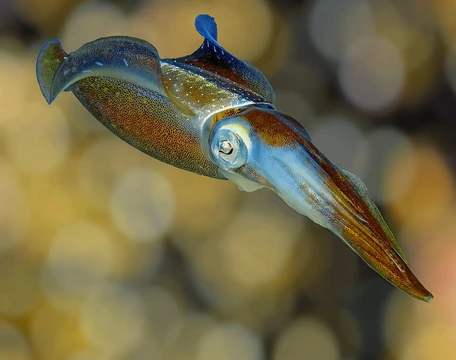
Sepia zanzibarica
A commercially important cuttlefish of the western Indian Ocean.

Sepia zanzibarica, the Zanzibar cuttlefish, lives in the Indian Ocean. Its arms each have four rows of suckers. The left ventral arm is modified into a hectocotylus with six rows of suckers; these suckers shrink noticeably in the middle of the arm before returning to normal size near the tip. The modified area’s oral surface is wide, swollen, fleshy, and marked with transverse grooves. In two of the dorsal and two of the ventral sucker rows, the suckers are pushed sideways and widely spaced, while the other two ventral rows sit so close together that the rows appear to alternate. The tentacular clubs are short and oval, bearing six suckers in crosswise rows; suckers vary in size, with those in the inner rows slightly larger. The club’s swimming keel extends a little past the carpus toward the head, and the ventral protective membranes do not meet at the club’s base. A small number of tiny suckers appear on the buccal membrane. The cuttlebone is oblong, with rounded front and rear edges, a strongly curved underside, and an evenly convex upper surface. Average mantle length is 250 mm.
This species is found in the western Indian Ocean along Africa’s east coast, from Port Elizabeth in South Africa’s Eastern Cape Province north to Djibouti and the Gulf of Aden. It also occurs off Madagascar, the Comoro Islands, the Mascarene Islands, the Seychelles, and Socotra. It lives at depths between 34 and 95 meters.
Sepia zanzibarica is commercially important to fisheries in the Gulf of Aden and likely contributes significantly to mixed-species fisheries along eastern African coasts and in deeper waters.
Quick Facts
- Genus
- Sepia
- Parent
- Sepia (Acanthosepion)
- Species
- zanzibarica
Facts from the source article.
Lore & Background
The arms of Sepia zanzibarica each possess four series of suckers. The left ventral arm is modified into a hectocotylus featuring six rows of suckers, with those in the middle portion significantly reduced in size, gradually returning to normal towards the tip. The oral surface of the modified region is wide, engorged, fleshy, and has transversely grooved ridges. The suckers of two each of the dorsal and ventral series are laterally displaced and widely separated, while another two ventral series are so close that the sucker rows appear to alternate.
The tentacular clubs are short and oval with six suckers in crosswise rows; the suckers vary in size, with some on the inner rows being a little larger than others. The swimming keel of the club reaches slightly beyond the carpus at the end nearest the head, and the ventral protective membranes do not join at the club base. A small number of tiny suckers are present on the buccal membrane. The cuttlebone is oblong, rounded on the anterior and posterior edges, with a strongly recurved ventral surface and an evenly convex dorsal surface. The mantle length averages 250 mm.
Sepia zanzibarica occurs at depths of 34 to 95 m. Its distribution extends from Port Elizabeth in the Eastern Cape Province of South Africa north to Djibouti and the Gulf of Aden, and it is also found off Madagascar, the Comoro Islands, the Mascarene Islands, the Seychelles, and Socotra.
Reader's Guide
Sepia zanzibarica is a commercially important quarry for fisheries in the Gulf of Aden, and it is probably an important part of the mixed species fisheries along the coast of eastern Africa and in deeper waters. Its significance lies in its role as a targeted species in regional fisheries, contributing to local economies and food supply. The species' morphological features, such as the modified hectocotylus arm and the arrangement of suckers on the tentacular clubs, aid in its identification among cuttlefish. The cuttlebone shape and the specific sucker patterns are key diagnostic traits. The depth range of 34 to 95 m indicates its habitat preference on the continental shelf and upper slope. The broad distribution from South Africa to the Gulf of Aden and across several island groups highlights its adaptability to various reef and benthic environments in the western Indian Ocean.
Did You Know?
- The left ventral arm of Sepia zanzibarica is modified into a hectocotylus with 6 rows of suckers.
- The suckers on the hectocotylus are significantly reduced in size in the middle portion of the arm.
More in Reef Cephalopods, Part 2 1-24
Spotted an error? Know more?
Reader corrections go straight into our review queue. Suggest an edit · How this site is sourced