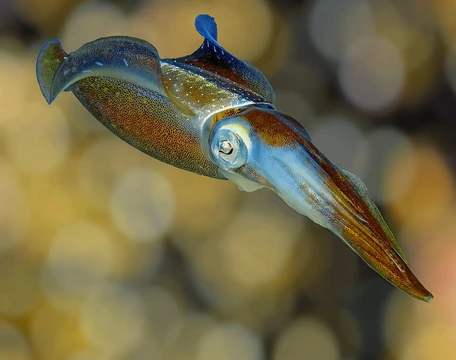
Sepia vermiculata
A southern African cuttlefish with rapid colour change and lagoon entry.

Sepia vermiculata, a cuttlefish species found only in southern Africa, goes by several common names including patchwork cuttlefish, common cuttlefish, and ink-fish. However, the term "common cuttlefish" more often refers to the species *Sepia officinalis*.
This cuttlefish has a long body and ten arms, all lined with rows of suckers. Two of these arms are longer tentacles used to capture prey. Paired fins run along both sides of the body for its entire length. The upper body is smooth and displays rippling bands of color, which the animal typically uses for camouflage.
Its range along the South African coast extends from Saldanha Bay to Algoa Bay, living in subtidal waters down to at least 40 meters. Beyond South Africa, it can be found as far north as central Mozambique, as well as on the Saya-de-Malha Bank and around the Indian Ocean islands of Seychelles, Mauritius, and Rodrigues.
Living on reefs, it feeds on shrimp and small fish. An internal, gas-filled shell called a cuttlebone helps it control buoyancy. Its eggs are pea-sized and either black or white, usually attached to sea fans. The cuttlefish can rapidly change color for camouflage, as a threat display, or to signal readiness to mate. A male ready to mate approaches another cuttlefish with dark, brightly rippling colors. If that cuttlefish is a male or a non-receptive female, it responds with the same dark, rippling threat display. If it is a receptive female, she remains pale, and the pair mates head-to-head. When disturbed, the cuttlefish may also lift two arms above its head, possibly as a threatening gesture.
It is the only cuttlefish species in southern Africa known to enter lagoons and estuaries, having been recorded in Langebaan Lagoon, Knysna Lagoon, and the mouth of the Kowie River.
Quick Facts
- Genus
- Sepia
- Parent
- Sepia (Sepia)
- Species
- vermiculata
Facts from the source article.
Lore & Background
The South African common cuttlefish has an elongated body with ten arms bearing rows of suckers. Two arms are elongated tentacles used for catching prey. Paired lateral fins extend the whole length of the body. The upper surface of the body is smooth, with rippling bars of colour and the animal is usually well camouflaged. This animal lives on reefs and feeds on shrimp and small fishes. A gas-filled internal shell, the cuttlebone, is used for buoyancy. The eggs are pea-like and black or white and are usually seen attached to sea fans. The animal is capable of rapid changes of colour for camouflage, threat displays or for communicating mating readiness. A male ready to mate will show dark brightly rippling colours as he approaches another cuttlefish. If the other cuttlefish is either a male cuttlefish or a non-receptive female, the other cuttlefish will also show dark brightly rippling colours as a threat display. If the other cuttlefish is a receptive female, her colours will remain pale and head-to-head mating will take place. It may also lift two arms above its head when disturbed, possibly as threat gesture.
Reader's Guide
This cuttlefish is notable as the only southern African species of cuttlefish to enter lagoons and estuaries, having been recorded in Langebaan Lagoon and Knysna Lagoon as well as the mouth of the Kowie River. Its distribution extends from Saldanha Bay to Algoa Bay along the South African coast, and beyond to central Mozambique, the Saya-de-Malha Bank, and the Indian Ocean islands of the Seychelles, Mauritius and Rodrigues. Its ability to rapidly change colour serves multiple purposes: camouflage, threat displays, and communication of mating readiness. The species' mating behaviour is distinctive, with males displaying dark rippling colours and receptive females remaining pale. The eggs, pea-like and black or white, are typically attached to sea fans. The cuttlebone provides buoyancy, and the animal may lift two arms above its head when disturbed, possibly as a threat gesture.
Did You Know?
- This cuttlefish is the only southern African species known to enter lagoons and estuaries.
- A receptive female remains pale during mating, while a male shows dark rippling colours.
More in Reef Cephalopods, Part 2 1-24
Spotted an error? Know more?
Reader corrections go straight into our review queue. Suggest an edit · How this site is sourced