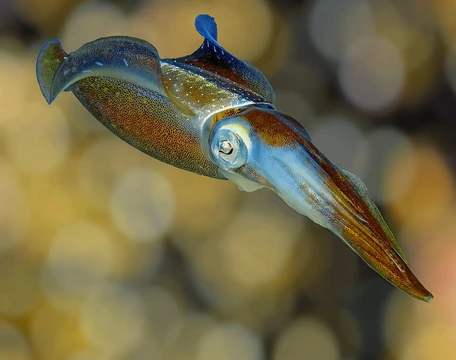
Sepia tuberculata
A shallow-water cuttlefish endemic to South Africa's coast.

Sepia tuberculata is a species of cuttlefish native to South African waters, ranging from Melkbosstrand near Cape Town to Knysna in the south. It is endemic to the region and lives in very shallow water up to a depth of 3 m. The species is notable for possessing adhesive glandular patches on its lower body surface, a rare trait among cuttlefish, and for being listed as Data Deficient on the IUCN Red List due to a lack of published information.
Quick Facts
- Genus
- Sepia
- Parent
- Sepia (Sepia)
- Species
- tuberculata
Facts from the source article.
Lore & Background
The type specimen of Sepia tuberculata was collected off the coast of South Africa and is deposited at the Muséum National d'Histoire Naturelle in Paris. The species grows to a mantle length of 82 mm and has a rough upper body surface with variably extending bumps. Its lower body surface features two glandular patches, which it uses to cling to rocks. Like all cuttlefish, it has ten arms, including two elongated tentacles for catching prey, and narrow fins that extend the length of the body.
Ecologically, Sepia tuberculata is capable of rapid color change and feeds on shrimps. It is preyed upon by the Cape Clawless Otter, an opportunistic mammal adept at capturing available prey. The species is often caught in the Tsitsikama Coastal National Park in South Africa. Although it is on the IUCN Red List, it is considered Data Deficient because very little published information exists, preventing assignment to a specific threat category.
A significant threat to Sepia tuberculata, as well as many other cephalopods, is ocean acidification from anthropogenic carbon dioxide emissions. Changes in seawater chemistry have been found to increase calcification rates in a relative, Sepia officinalis, which negatively impacts the cuttlebone's function as a lightweight buoyancy structure. It is unknown whether S. tuberculata is of interest to fisheries in South Africa, though cuttlefish have contributed to fisheries earnings in the English Channel.
Reader's Guide
Sepia tuberculata holds significance primarily as a subject of research on adhesion in cephalopods. Much of the published work on this species concerns its adhesive structures; it is one of at least four Sepia species that possess an adhesive glandular patch, and it produces a chemical substance for adhesion, a trait not universal among cuttlefish. This makes it a valuable model for understanding how cephalopods bond to substrates in shallow, high-energy environments. The species is also notable for its conservation status: despite being listed on the IUCN Red List, it is categorized as Data Deficient, highlighting a critical gap in knowledge about its population, ecology, and threats. The primary documented threat—ocean acidification—is extrapolated from studies on a congener, Sepia officinalis, and underscores the vulnerability of cuttlefish to global environmental change. Its endemic range along a limited stretch of South African coast further emphasizes the need for baseline data to inform conservation. The species' role as prey for the Cape Clawless Otter and its occurrence in a national park indicate some level of ecological integration, but without further study, its broader significance remains poorly understood.
Did You Know?
- Sepia tuberculata is one of at least four Sepia species that possess an adhesive structure on the lower body surface.
- Ocean acidification from anthropogenic carbon dioxide emissions is a documented threat to this species.
More in Reef Cephalopods, Part 2 1-24
Spotted an error? Know more?
Reader corrections go straight into our review queue. Suggest an edit · How this site is sourced