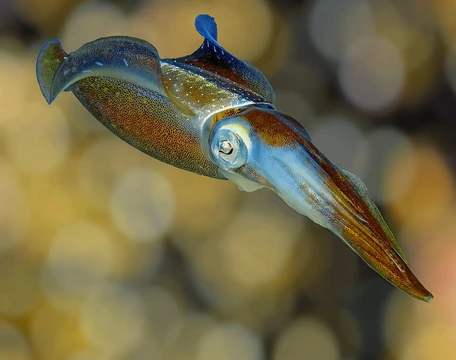
Sepia prashadi
A migratory demersal cuttlefish with a pink cuttlebone.

Sepia prashadi, commonly known as the hooded cuttlefish, is a widely distributed species of cuttlefish found chiefly in the Indian Ocean. It is notable for its thin, oval body, distinct club-shaped tentacle tips, and pink dorsal surface of the cuttlebone.
Quick Facts
- Genus
- Sepia
- Parent
- Sepia (Acanthosepion)
- Species
- prashadi
Facts from the source article.
Lore & Background
The species was first reported in 1936 by Ronald Winckworth. It has an elongate, thin, oval body, tapering subequal arms, and fins of medium width. The tentacles end in broad, short clubs with suckers organized into eight oblique transverse rows; three suckers on the third series are enlarged. The dorsal surface of the cuttlebone is pink, making it highly distinct. Off Mumbai, India, dorsal mantle lengths measured from 55 to 95 mm.
Sepia prashadi is very widely distributed, found along the east coast of Africa, around Madagascar, in the waters of India, the Bay of Bengal, the Red Sea, Persian Gulf, Gulf of Oman, and the Andaman Sea. It is native to almost two dozen countries. It is a demersal species living in shallow waters at depths of roughly 40 to 50 meters. It is migratory, with notable seasonal occurrence patterns: in northeastern India, greatest numbers appear between January and June, though some years it is most abundant between October and December; in southern Indian waters such as Chennai, it occurs in greater numbers between January and April, becoming abundant during upwelling of deep water.
Reader's Guide
Sepia prashadi is a widely distributed cuttlefish in the Indian Ocean, first reported in 1936. Its diet off Mumbai consists mainly of prawns. Males display to attract females; during copulation the male holds the female and inserts his hectocotylus into her mantle cavity. Males die shortly after spawning, and females die after brooding. The species is caught by trawlers in the Red Sea and off northeast India, and also as bycatch. In 2005 in the Gulf of Suez, stock assessment studies identified it as an 'under-exploited resource'. Population and density are unknown due to lack of studies; catch statistics are anecdotal and underreported. Ocean acidification from increased carbon dioxide is a potential threat, causing a denser cuttlebone that likely affects buoyancy regulation. The hooded cuttlefish may act more curious and confident around divers compared to squid or octopus.
Did You Know?
- In 2005 in the Gulf of Suez, Sepia prashadi was identified as an 'under-exploited resource'.
- Males die shortly after spawning; females die after brooding.
More in Reef Cephalopods, Part 2 1-24
Spotted an error? Know more?
Reader corrections go straight into our review queue. Suggest an edit · How this site is sourced