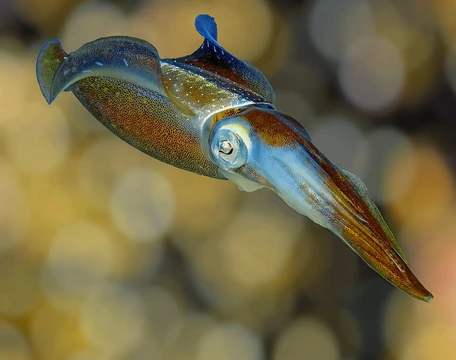
Sepia hedleyi
A small cuttlefish endemic to Australian waters, named after Charles Hedley.

Sepia hedleyi, commonly known as Hedley's cuttlefish, is a species of cuttlefish in the family Sepiidae. It is endemic to subtropical and temperate waters off Australia, notable for its relatively small size and distinctive ridge-like bumps along each side of the mantle.
Quick Facts
- Genus
- Sepia
- Parent
- Sepia (Rhombosepion)
- Species
- hedleyi
Facts from the source article.
Lore & Background
Sepia hedleyi was named by the American malacologist Samuel Stillman Berry in 1918, honouring the English-born Australian conchologist Charles Hedley (1862–1926). The type specimen was collected in the Investigator Strait and is held in the Australian Museum in Sydney. The species is beige in colour lacking any markings on the arms, with longitudinal rows of up to 6 ridge-like bumps forming ridges along each side, next to the base of each fin, which vary in colour from orange to pink. The tentacular club is crescent-shaped and has a flattened surface bearing 9 to 12 suckers in transverse rows. The fins are widest in their posterior third, rounded at their posterior ends where there is a narrow separation between the fins. The cuttlebone is oblong.
Reader's Guide
Sepia hedleyi is frequently caught as bycatch in trawl fisheries in which the quarry is prawn or mixed species. Its range extends from the Great Barrier Reef off Queensland around the eastern, southern, and western coasts of Australia to just to the southwest of Shark Bay in Western Australia, including Tasmania. It occurs from shallow water to the continental slope, with the maximum depth recorded being 1092 m and the minimum 47 m. The species is relatively small, with a mantle length of 83 mm in males and 102 mm in females. Its significance lies in its endemic status to Australian waters and its role as a common bycatch species in commercial trawl fisheries, contributing to the understanding of benthic cephalopod diversity in subtropical and temperate regions.
Did You Know?
- Sepia hedleyi has a maximum recorded depth of 1092 m.
- The species was named by American malacologist Samuel Stillman Berry in 1918.
- Its tentacular club bears 9 to 12 suckers in transverse rows.
More in Reef Cephalopods, Part 2 1-24
Spotted an error? Know more?
Reader corrections go straight into our review queue. Suggest an edit · How this site is sourced