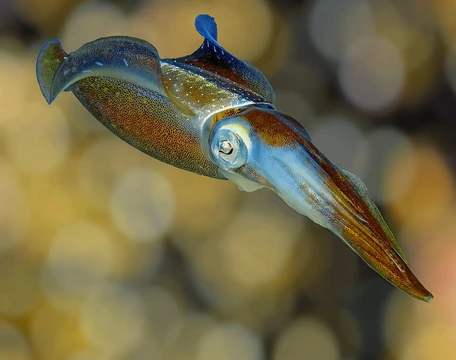
Sepia dollfusi
A data-deficient cuttlefish native to the Red Sea and Suez Canal.

Sepia dollfusi belongs to the cuttlefish order Sepiida, within the mollusk class Cephalopoda. William Adam first described this species in the early 1940s. A type specimen was gathered near Périm Island in the southern Red Sea and now resides at the Muséum National d'Histoire Naturelle in Paris. The only other known specimen is a cuttlebone with no recorded location, which came from Adam himself and appears in a catalogue for the Royal Scottish Museum in Edinburgh.
In terms of appearance, this cuttlefish reaches an average mantle length of about 110 mm. Its oval cuttlebone is roughly the same length as the mantle, the gap between head and mantle is small, and its arms are shorter than those of related species like *Acanthosepion pharaonis*. The underside is white with a distinctive bulge, while the upper side is beige. Suckers on the tentacular clubs become smaller toward the tip. Juveniles grow faster than older individuals, and males and females look very similar.
Geographically, *Sepia dollfusi* is native to the West Indian Ocean, specifically between latitudes 31°N and 30°N and longitudes 32°E and 33°E. It is considered indigenous to the Red Sea and the southern Suez Canal in Egypt, though some researchers question whether it originally came from there. One record exists from the Egyptian Mediterranean, suggesting it may be a Lessepsian migrant that traveled through the Suez Canal, alongside various other invertebrates that have entered the region in recent decades. It is also described as widely distributed in the Indo-Pacific. The first Mediterranean documentation occurred in 2014, noting a small cuttlefish with a mantle length of about 15 cm, found in benthic neritic habitats.
Reproductive behavior generally follows patterns seen in other Sepiida. Fecundity, based on counts of maturing and mature ova, ranges from 30 to 273. Breeding occurs from January to April, and individuals become harder to find during summer after spawning, likely moving elsewhere to deposit eggs—though egg-laying sites remain mostly unknown. Males begin sexual maturation as early as November, females as early as December. Maturation affects the sexes differently: females lose total body mass, while males only lose mass in the viscera. Feeding decreases as maturity progresses, and without sufficient nutrition, both sexes die shortly after the breeding season.
Quick Facts
- Genus
- Sepia
- Parent
- Sepia (Sepia)
- Species
- dollfusi
Facts from the source article.
Lore & Background
Sepia dollfusi grows to an average mantle length of about 110 mm. Its shell (cuttlebone) is oval and roughly the same length as its mantle. The species has a short distance between head and mantle, and short arms compared to other cuttlefish such as Acanthosepion pharaonis. Its underside is white with unique ventral bulging, while the overside is beige. The tentacular club suckers become smaller toward the end of the club. Younger individuals grow faster than older ones, and both sexes are similar in appearance.
A known type specimen was collected near Périm Island in the southern Red Sea and is deposited at the Muséum National d'Histoire Naturelle in Paris. The only other known related specimen is a bone with 'no locality', obtained from Adam himself, mentioned in a catalogue for the Collections of the Royal Scottish Museum in Edinburgh.
Species distribution is typically in the West Indian Ocean, with a depth range of 31°N–30°N and a distribution range of 32°E–33°E. They are considered native to the Red Sea and southern part of the Suez Canal in Egypt, though some suggest they are not originally from the area. It has been recorded once in the Egyptian sector of the Mediterranean Sea, making it a potential Lessepsian migrant. The first documentation of their existence in the Mediterranean was in 2014, noting a small-sized cuttlefish with a mantle length of about 15 cm, present in benthic habitats of the neritic zone.
Reader's Guide
Sepia dollfusi is significant as an important commercial species in the Suez Canal, used for human consumption, yet it remains poorly understood. Most scientific journals rely on the same photographs and information from the same sources or specimen studies. Public platforms such as iNaturalist and Animalia describe the species as 'DD' (data deficient), a status placed by the IUCN Red List. The last known assessment took place on 23 March 2009. Its potential as a Lessepsian migrant into the Mediterranean highlights its role in documenting marine species movement through the Suez Canal, alongside various other invertebrate species that have joined the area in recent decades. However, not a lot of in-depth information is available, and tracking reliable data is difficult. The species' reproductive behavior is generally similar to other cuttlefish in the Sepiida Order, with a typical breeding window from January to April. Both sexes follow a timeline for sexual maturation—males beginning as early as November, females as early as December—but sexual maturation affects physiology differently: females typically show a decline in total body mass, while males show decline only in the viscera. Feeding lessens as they progress through sexual maturity, eventually leading to death shortly after breeding season. Where they lay their eggs is currently mostly unknown.
Did You Know?
- Sepia dollfusi was discovered in the early 1940s by William Adam.
- Fecundity ranges from 30 to 273 ova, with a breeding window from January to April.
- It is a potential Lessepsian migrant into the Mediterranean, first documented there in 2014.
More in Reef Cephalopods, Part 2 1-24
Spotted an error? Know more?
Reader corrections go straight into our review queue. Suggest an edit · How this site is sourced